At All-Energy Australia 2024, held in Melbourne, Kate Clark, programme manager at Victoria’s Department of Energy, Environment, and Climate Action, stated: “There are many different definitions and types of value that can be generated by community batteries.”
The panel discussion titled ‘The community benefits of neighbourhood batteries,’ taking place on the first day of the trade event (23 October) emphasised that community batteries currently lack a cohesive definition for the technology, which has hindered and supported its surge into the Australian energy market.
For Clark, the Victoria government department tends to “use the chemistry and the scale of the battery” to define what is enabled for a community battery. Clark added: “We need a hard definition because we are giving out grants and need to tell you what that is, but not prescribing it so much that a community or the owner of that battery can’t have some flexibility to make sure that that piece of technology meets their needs”.
As Clark said, this flexibility has been used to support the uptake of neighbourhood and community batteries across the Australian state. Readers of Energy-Storage.news will likely be aware of Victoria’s 100 Neighbourhood Batteries Program, which aims to provide communities with the benefits collective solar PV can grant.
Try Premium for just $1
- Full premium access for the first month at only $1
- Converts to an annual rate after 30 days unless cancelled
- Cancel anytime during the trial period
Premium Benefits
- Expert industry analysis and interviews
- Digital access to PV Tech Power journal
- Exclusive event discounts
Or get the full Premium subscription right away
Or continue reading this article for free
Applications for the second round of the scheme close today (29 October) with successful applicants to be notified, and a funding agreement will be executed in March 2025.
Liam Henderson, principal of energy and carbon at the City of Melbourne Council, also touches on community battery definitions. “As we [City of Melbourne] see it, it is a system that is either owned by the community or operated to deliver a community benefit, whatever that may be, such as financial resilience or protection from a bushfire,” Henderson said.
“This is distinct from a factory that might be doing solar sponging, helping the network absorb renewable energy and stabilise the local network. I see this as a network battery. Straight away, a community battery has a clear community participant or beneficiary.”
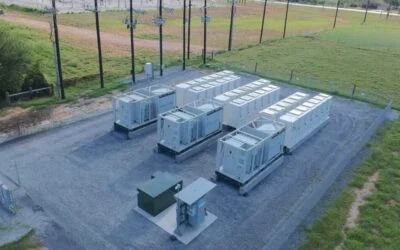
Much like Clark, Henderson also sees the lack of a definition as something that can cause problems, mainly by trying to maintain realistic expectations. People often do not understand exactly what a community or neighbourhood battery is or does. The council faced this when progressing its ‘Power Melbourne’ initiative, which saw several 1.1MWh community batteries installed across the city.
“We realised when we started talking with the community that people didn’t know what it meant, which is fine, but they then started projecting their hopes and dreams onto what it might mean,” Henderson explained.
The financial aspect of community batteries
Although the financial aspect and benefits of installing community batteries could bring, especially when pooling together rooftop solar PV resources in the local vicinity, Matthew Charles-Jones, president of Totally Renewable Yackandandah, a volunteer-run renewable energy group based in Victoria, outlined that battery costs are still high.
“The idea often prefixes the intention. We want to make power cheaper. What I would have to say is, very typically, batteries are a difficult way to make power cheaper,” Charles-Jones said.
“That answer is twofold. We need energy storage to enable the power and storage at night, but we also need to make sure that there are other pathways to support people who perhaps don’t have as much access to capital or don’t own their properties.”
Charles-Jones added: “We don’t see batteries as a great way to save money. The technology is rapidly becoming more affordable, but the task is to understand how to use batteries well so that when they’re affordable and increase in safety, we’re good to go.”
Battery prices have been falling rapidly over the year, contributing to the revenue fall for NHOA Group’s energy storage arm in the first half of 2024. The trend was also explored in an exclusive article for Energy-Storage.news Premium subscribers.
Clark also touched on the financial benefits of community batteries throughout the panel discussion. One key highlight was the indirect benefits such a system can bring to a community in addition to the typical energy and financial benefits.
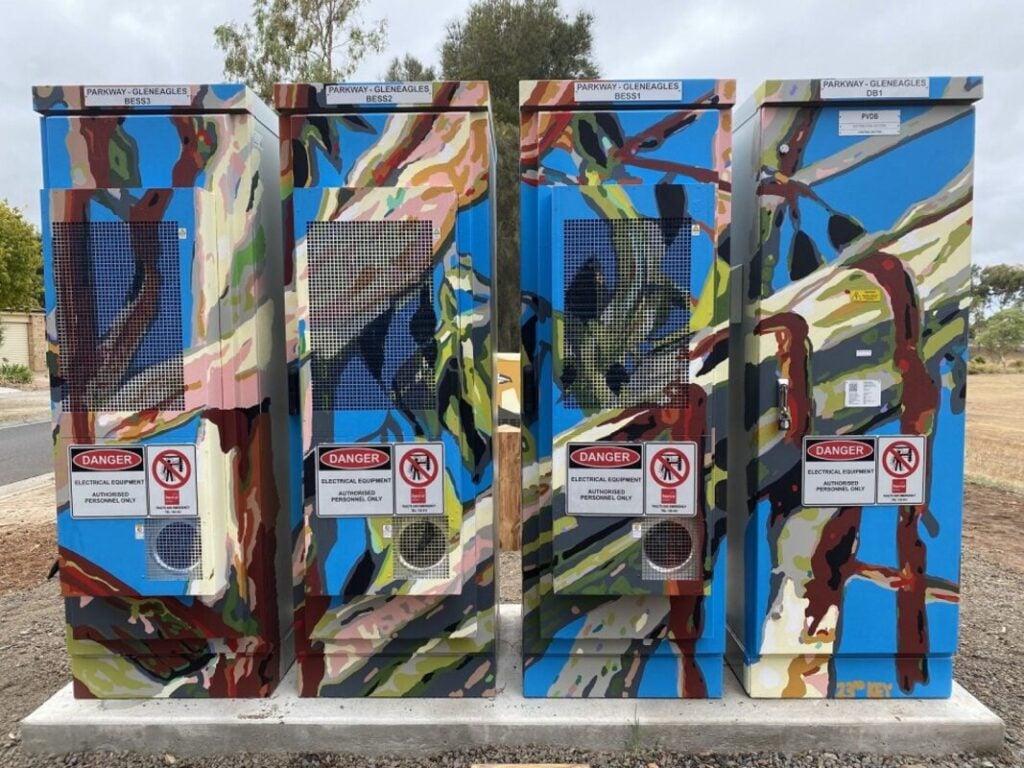
“The effect of a battery is not just to deliver energy; it’s looking at it as a broader tool, helping a community to understand what this asset is to them so that we move beyond this being an electrical box that sits in the corner to truly becoming a community asset that the community understands,” Clark said.
It is also worth noting that there are several ways to deploy a community battery, and developers cannot employ a “one-size-fits-all” approach for each project. The developer must understand exactly what the battery energy storage system (BESS) is attempting to solve and tailor the project to this.
“The greatest BESS that delivers the best solution to your problem is the right model for you to go for,” Clark said. “It may be that it is a couple of household batteries installed in series on the side of a community building that provides resilience in times of emergency. That might be the best solution, but that’s not going to be the right solution for an inner urban community looking to have battery support reliability on their whole street.”
“It’s really understanding what the problem is and then determining whether there is a model currently available that’s economically viable.”