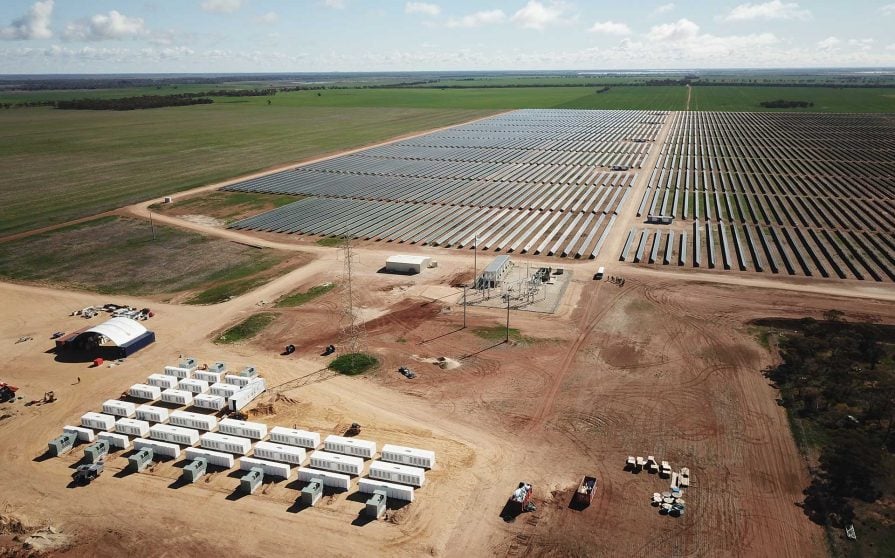
Nearly A$4 billion (US$2.72 billion) of battery projects in Australia are in the running to receive financial support from the Australian Renewable Energy Agency (ARENA).
ARENA opened up its Large Scale Battery Storage Round at the beginning of this year, offering A$100 million in support for projects of 70MW or larger, which would use advanced, aka grid-forming, inverter technologies.
The agency said today that it has now shortlisted 12 projects totalling 3,050MW/7,000MWh out of a pool of 54 from which it received Expressions of Interest (EOI). The successful dozen, which have a total value of A$3.7 billion, and requested a total A$297 million of grant funding, are now invited to submit full applications.
They have until 20 July to do so and a decision is expected to be announced before the end of this year.
Try Premium for just $1
- Full premium access for the first month at only $1
- Converts to an annual rate after 30 days unless cancelled
- Cancel anytime during the trial period
Premium Benefits
- Expert industry analysis and interviews
- Digital access to PV Tech Power journal
- Exclusive event discounts
Or get the full Premium subscription right away
Or continue reading this article for free
As reported by Energy-Storage.news in January shortly after the round launched, maximum grant value is capped at A$35 million per project and ARENA said at the time it expected to support at least three projects.
It won’t be the first time ARENA has supported battery storage projects, nor the first time it has supported battery projects with grid-forming capabilities.
The first example of the latter was the Energy Storage for Commercial Renewable Integration (ESCRI) project in South Australia, which uses advanced inverters at a 30MW/8MWh battery energy storage system (BESS) supplied by Hitachi ABB Power Grids (now Hitachi Energy).
ESCRI was commissioned in 2018. It provides synchronous inertia and therefore grid stability to a remote region at the far end of transmission lines which has seen its local share of renewable energy – mainly rooftop solar and large-scale wind – grow rapidly.
Synchronous inertia is a vital application that has traditionally been done by thermal power plants that provide large rotating mass to the system.
Earlier this year, Energy-Storage.news reported that a 50MW/50MWh BESS in the Broken Hill region of New South Wales will demonstrate the same capability. BESS system integrator Fluence signed an agreement with utility AGL to supply systems to that project, with ARENA providing A$14.84 million of it’s A$41 million total expected cost.
Two existing large-scale battery systems in Australia – Hornsdale Power Reserve in South Australia and Wallgrove in New South Wales – are being retrofitted with grid-forming inverter technology which should be in place by the end of this year, ARENA said.
“Advanced inverters that can help stabilise the grid are the missing piece of the puzzle that will support the transition to 100% renewable energy penetration for short periods,” ARENA’s acting CEO Chris Faris said.
More generally, ARENA referred to the recently published Integrated System Plan (ISP) from the Australian Energy Market Operator (AEMO) which highlighted the critical need for large amounts of energy storage in the National Electricity Market (NEM) to maintain system stability as coal retires and renewables take over the lion’s share of generation.
Projects competing the new funding round must either be connected to the NEM or Western Australia’s Wholesale Electricity Market.