The Australian Renewable Energy Agency (ARENA) is opening a competitive funding round to provide up to AU$100 million (US$72.16 million) in support for large-scale battery storage projects.
The national agency, which administers financial support and promotes knowledge-sharing for the sector on behalf of Australia’s government, launched the Large Scale Battery Storage Funding Round just before the Christmas break.
Projects of 70MW or larger that use advanced inverter technologies will be eligible. The battery energy storage system (BESS) projects must also operate in either their National Electricity Market (NEM) which covers most of eastern and central Australia, or the Wholesale Electricity Market of Western Australia.
Developers of new-build projects can apply, as well as those seeking to retrofit advanced inverter capabilities to their existing BESS projects. Maximum grant value is capped at AU$35 million per project and ARENA said that it expected to support at least three projects.
Try Premium for just $1
- Full premium access for the first month at only $1
- Converts to an annual rate after 30 days unless cancelled
- Cancel anytime during the trial period
Premium Benefits
- Expert industry analysis and interviews
- Digital access to PV Tech Power journal
- Exclusive event discounts
Or get the full Premium subscription right away
Or continue reading this article for free
ARENA wants to promote the way that advanced inverters can help batteries provide synchronous inertia to stabilise electricity grids, a service traditionally provided by centralised thermal generation plants.
“Grid scale batteries and other types of energy storage technology will be vital to support our future electricity system powered by renewables,” ARENA CEO Darren Miller said.
“This funding round will demonstrate the role of advanced inverters in grid scale batteries to provide system stability, facilitating a more efficient transition and accelerate the uptake of renewable generation.”
Miller said that there are “promising signs” advanced inverters could be used to support electricity system stability, but that there is still a clear need for public sector investment to prove the technology can work at scale.
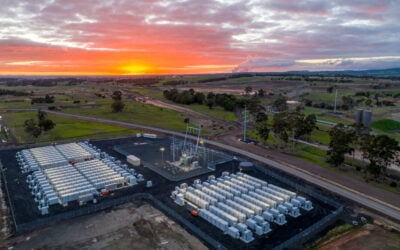
The funding round’s aims build on projects such as the Energy Storage for Commercial Renewable Integration (ESCRI) demonstration in South Australia which was commissioned in 2018 and is Australia’s first ‘virtual synchronous generator’ using a 30MW / 8MWh BESS to integrate growing shares of renewables and support system stability at the far end of the state’s transmission line network.
Neoen-Tesla’s Hornsdale Power Reserve energy storage system, also in South Australia, is being retrofitted to an advanced inverter upgrade, while ARENA also pointed to a study by electricity network company Powerlink Queensland which highlighted the strong potential of advanced inverters.
The funding round opens for expressions of interest in February and will be due in by the end of March before a full application process opens later in 2022.