
ESN Premium discusses “long-term value creation” for infrastructure investors, with Daniel Burrows of BESS developer Eku Energy.
It has always been an overarching aim of clean energy industries to bring long-term investors into the sector. For example, the arrival of pension funds into solar PV and wind about ten years ago, encouraged by feed-in tariffs and long-term power purchase agreements (PPAs) with fixed components, helped those sectors scale into a global investment proposition.
The energy storage sector is a little more complex in that the underlying opportunities in electricity markets are largely based on short-term volatility that enables ancillary market and wholesale arbitrage revenues. Opportunities predicated on merchant revenue streams remain attractive to investors with a higher risk appetite for high returns, but for energy storage to scale in the same way we saw renewables do in the past likely means bringing in more risk-averse patient capital.
Eku Energy, incubated in Macquarie Asset Management’s Green Investment Group, has developed 10 projects totalling 2.9GWh and counting, since its launch in 2022. It is now co-owned by Macquarie and British Columbia Investment Management Corporation (BCI).
Try Premium for just $1
- Full premium access for the first month at only $1
- Converts to an annual rate after 30 days unless cancelled
- Cancel anytime during the trial period
Premium Benefits
- Expert industry analysis and interviews
- Digital access to PV Tech Power journal
- Exclusive event discounts
Or get the full Premium subscription right away
Or continue reading this article for free
Speaking with Energy-Storage.news at the Energy Storage Summit 2026 in London in late February, CEO Daniel Burrows explains that the developer-investor is focused on developing, building and managing battery energy storage system (BESS) projects to attract infrastructure capital.
“What we’ve sought to do is create institutional infrastructure-appropriate, risk-return cash flows that make them eligible for project finance and infrastructure capital. We think, and we hope, that gives us the flexibility to keep growing but also drive down price,” Burrows says.
As a company specialised in developing energy storage projects and owning them over the long term, the CEO has been pleased to see the development of multi-year revenue contracts in the market, which can underpin the sort of long-term value creation Eku pursues.
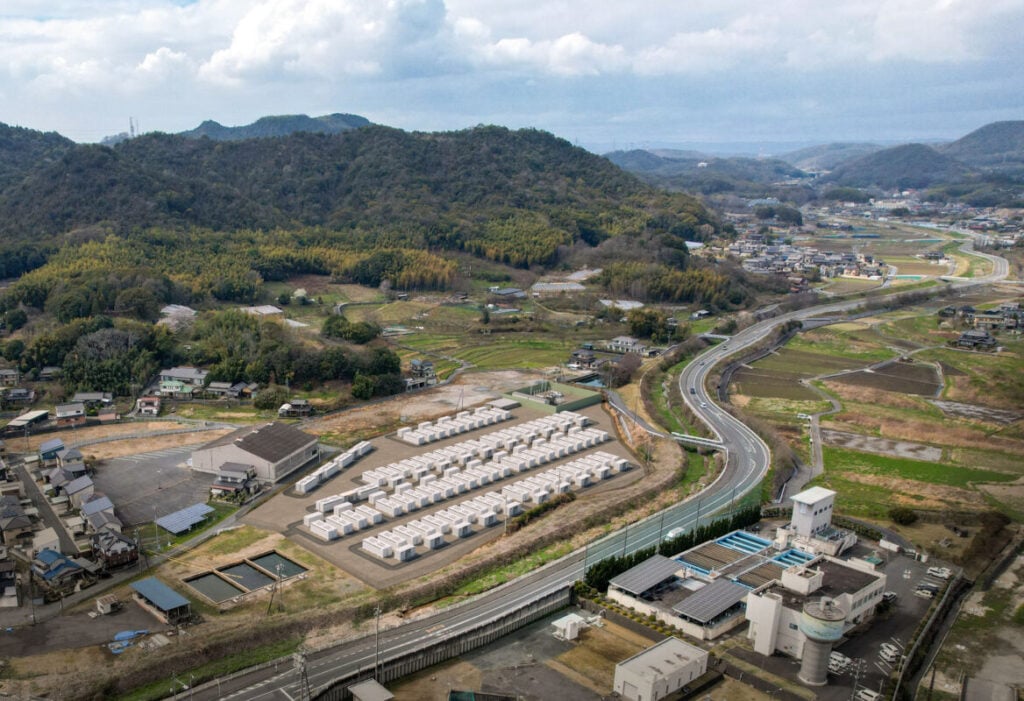
Of those first 10 projects, five are in operation as of the time of our conversation at the event in London, UK, three are in construction and two have been recently contracted for, one of which is an 800MWh long-duration energy storage (LDES) contract in Australia and the other a 150MW/600MWh capacity market contracted asset in Japan.
Currently nearing completion for the coming months is Eku Energy’s Ocker Hill project in England, for which a 10-year contract has been signed with Smartest Energy.
Contracts have been proliferating, Burrows says, as energy storage is increasingly viewed as a reliable way to manage and contract for risk, particularly by electricity retailers and traders.
Eku Energy’s backstory of incubation on the Macquarie Bank balance sheet gave the developer a “fantastic head start,” in which it was able to hone its business model risk management process.
“We’ve been able to sort of take that culture and approach to risk management with us into the market, and we’ve tried to hold that discipline of making sure that we’re putting projects together consistent with the principles of project finance. That’s really the underlying principle.”
If that makes it sound easy, Burrows assures us that it is not. One of the biggest challenges is to ensure appropriate cash flow while avoiding the sorts of risks that he says are “asymmetric and quite frankly, inappropriate for that form of capital”.
The business model, which he claims brings together the disciplines of developing, building and actively managing, with community engagement activities—thinking about the long-term presence Eku will have in the communities that host its projects—is consistent with that “long-term value creation” mantra.
Long-term contracting is also a hedge of sorts against technical risk. With shorter-duration assets seeing their lunch eaten in merchant markets, and emerging battery technologies competing to commercialise, Eku Energy nonetheless keeps a close eye on those developments.
“One of our verticals is our technology markets and trading teams, so we’re constantly assessing and following new technologies: sodium-ion is probably coming down the cost curve, and there’s some pretty large plants being built that are looking more likely to be commercial faster than you might have thought 12 months ago. [We’re] probably also seeing geopolitical hedge or supply chain diversity coming into things as well.”
“When we look at duration, lithium-ion is pretty competitive around that 8-hour level, and when you look at technologies that are available today, or that you can see coming in the future, there’s probably a reasonable curve for the medium term that probably suggests lithium-ion is okay. But again, for us, we don’t speculate. That’s where taking a higher level of contracted revenue is sort of the best hedge for us. We own the [grid] connection point, so we can always augment and change over time as well. “
The key is to include those considerations in the design and permitting of projects and building in a degree of futureproofing, he says. At the same time, Eku remains excited about the emergence of new technologies and continues to work with academic institutions on R&D initiatives.
“We do those things to keep our finger on the pulse and just make sure we’re following what’s coming down the pipe.”
Contracting as a non-linear art form
Separately, at this year’s show, I moderated a panel discussion on BESS construction challenges and lessons learned. Outside of what can go well, or not so well, on a project site, the panellists all agreed that putting contracts together with different partners and suppliers, often simultaneously and in coordination, is one of the major challenges.
Burrows agrees that trying to put together supplier contracts, whether that be with Eku’s BESS suppliers, which to date include Fluence and Tesla, with balance of plant (BOP) suppliers, engineering, procurement and construction (EPC) partners or revenue offtakers, and “bringing it all together at the same time, can be quite hard to do”.
“There’s a lot of juggling,” he says. Eku Energy sees its BOP and BESS suppliers as partners, and a lot of time is taken to onboard suppliers, system integrators, and cell suppliers.
“We spend a lot of time upfront, and we have a view on who we want to partner with, depending on the use case. We’re operating in five countries around the world, we’ve created 10 projects and there’s about 50 projects in the pipeline.”
Those 50 projects represent an “inventory” for Eku’s offtaking customers, which will be shaped into between five and 10 in late-stage commercialisation at any one time. The next stage is to partner with suppliers and, at the same time, find long-term revenue offtakers for its customers that typically operate in multiple jurisdictions that the developer is also active in.
“It does require a bit of a juggling act and a balance, but you do need those things all to converge on financial close,” Burrows says.
“That’s one of the hardest things about storage. If you were to compare it to wind or solar, you’re working on small footprints. There’s market risk, different considerations, and you need to retire risk in a non-linear way. You don’t have the luxury of time to sort of do things in a very sequential way. It’s where it requires a cross-discipline project and capability team that’s able to work together flexibly to pull it off.”
Another interesting takeaway from the BESS construction lessons panel that day is the range of contracting options, including full-wrap (typically EPC+BESS integration) and split-scope (separate contracts).
While there are different solutions for different projects and markets, and the different lead times for different types of equipment or services mean there is no one-size-fits-all approach, Burrows says Eku tends to prefer a separate but highly coordinated contracting strategy.
“For us, again, it just comes back to that fundamental principle of risk allocation and creating projects with an infrastructure risk profile. If you’re facing significant liquidated damages that you’re looking to have no gap risk on, or back-to-back that with the contractor, you would prefer to have no interface risk, so have one EPC contract.”
While that single contract may have flexible terms that can be traded off, as an infrastructure player, Eku Energy has to consider what its guarantees are to its customers, whether government, network operator or energy retailer.
“We’ll explore both options, but I do think balance of plant (BOP) and BESS as split-scope is going to remain the prevalent way for infrastructure capital,” Burrows says, adding that while he sees more developers today opting for self-integration or other forms of deeper technical involvement, that isn’t a step Eku Energy has taken as yet.
Burrows says that over the past couple of years, he has seen the size of projects grow in both capacity and duration, and energy storage become “reasonably well accepted as a core part of the energy transition.”
“It’s moved out of a test phase into reliability being key. Whether that’s transmission network, government, retailers, people are relying on our assets to manage their risk and secure operations.”
This steps up the industry’s delivery obligations, he says, while the cost-of-living crisis in many countries has put greater emphasis on affordability.
Meanwhile, the biggest challenge the industry faces, and one that was highly appropriate to discuss in the UK and wider European context, is grid connection and process and queue reforms.
“One of the pleasing things I see is that globally, it does seem that policy and grid connections are moving to a fair bias to action,” he says.
“Obviously, everyone should have fair access to the network. But I think when you see things moving in the direction of a bias to action in those things that are actually going to happen, that’s good for the industry, that’s good for capacity, and that’s good for the energy transition.”
Connected to that, he says, is the importance of community engagement by developers and their partners, a long-term commitment which Burrows argues has been “core” for Eku from the beginning.
The company has set up ‘Powering Dreams’, a community benefit programme, which it was not compelled to do but sees as part of its long-term value creation and community partnership-building work.
“When you look at a storage asset, you create jobs while you’re building, but there’s no jobs post fact, really. So, making those contributions in the community you’re in, in other ways that are enduring, are going to be more important as well.”
You can also read our recent ESN Premium interview from Energy Storage Summit Australia 2026 with Eku Energy policy director Rachel Rundle and COO Tom Best: ‘The market design must evolve’: Eku Energy on energy storage in Australia’s NEM.
