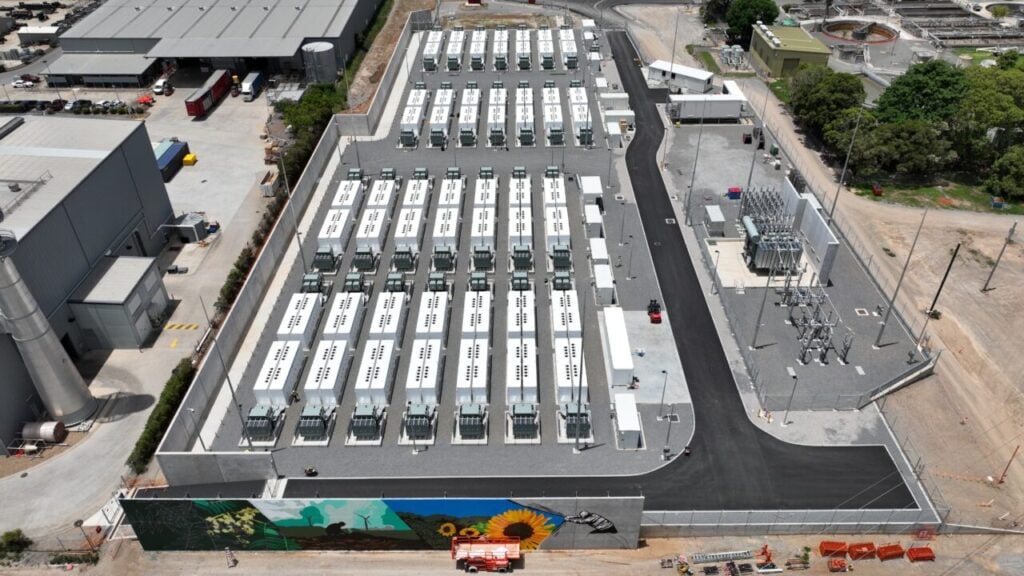
BlackRock-backed Akaysha Energy has commenced operations at its 205MW/410MWh Brendale battery energy storage system (BESS) in Queensland, Australia, delivering the project close to five months ahead of the original schedule.
The project includes grid-forming capabilities, granting further support to Southeast Queensland’s transmission network.
The Tesla Megapack 2-based system connects directly to Powerlink’s South Pine substation in Brisbane’s northern suburbs, providing fast-acting frequency control and ancillary services to the National Electricity Market (NEM) while supporting increased renewable energy integration across Queensland’s grid infrastructure.
Akaysha Energy is also using Tesla Megapacks at its 1,660MWh Orana BESS, located in the Central-West Orana Renewable Energy Zone (REZ), in New South Wales.
Try Premium for just $1
- Full premium access for the first month at only $1
- Converts to an annual rate after 30 days unless cancelled
- Cancel anytime during the trial period
Premium Benefits
- Expert industry analysis and interviews
- Digital access to PV Tech Power journal
- Exclusive event discounts
Or get the full Premium subscription right away
Or continue reading this article for free
Nick Carter, CEO at Akaysha Energy, emphasised the project’s operational significance.
“Bringing the Brendale BESS online ahead of schedule is a massive achievement for the entire team,” Carter said.
“The functionality of the BESS, combined with the Gunvor offtake agreement, will ensure consumers have reliable energy when they need it, at an affordable price.”
As reported by Energy-Storage.news last year, the Brendale BESS operates under a long-term battery revenue swap agreement with global energy trader Gunvor Group.
This grants Akaysha Energy the ability to balance contracted revenue streams with merchant-market exposure while preserving operational flexibility to optimise bidding strategies across ancillary services markets for energy and frequency control.
Project delivery involved collaboration between Consolidated Power Projects as the engineering contractor, Tesla as the battery technology provider, Wilson Transformer Company for the electrical infrastructure and Powerlink Queensland as the transmission network service provider.
Grid-forming capabilities enable the Brendale system to provide voltage support and network stability services to Queensland’s major transmission infrastructure.
Grid-forming with advanced inverters is a big topic for the Australian battery storage market. The Australian Renewable Energy Agency (ARENA) is providing funding support for a wave of large-scale BESS projects that include smart power-electronics equipment, both new builds and retrofits of existing projects.
However, the inclusion of grid-forming inverters is not without its drawbacks. At the Battery Asset Management Summit Australia 2025 last year, Dave Bowly, operations manager at Australian utility AGL, noted that grid-scale BESS projects with grid-forming capabilities could be subject to higher standby consumption costs than grid-following batteries.
Akaysha Energy’s expanding battery storage portfolio
The project represents Akaysha Energy’s continued expansion in Queensland’s battery storage market, following the company’s entry of its 300MWh Ulinda battery storage system into NEM trading.
Akaysha Energy has established itself as a major player in Australia’s utility-scale battery storage sector, developing what it describes as the “world’s most powerful battery storage system,” the 850MW/1,680MWh Waratah Super Battery in New South Wales.
The battery storage system achieved its first full output to the NEM (NEM) in October last year. However, a catastrophic transformer failure raised concerns around the project before it entered a planned balance of plant shutdown from 20 November to 2 December.
Beyond Australia, Akaysha has exposure in several international markets, including the US, Japan and Germany. In September 2025, the group secured an AU$300 million corporate debt facility to support its expansion into these markets.
Akaysha Energy’s operational portfolio now encompasses 1.4GWh across multiple Australian markets, with 4.5GWh under construction and an additional 30GWh in development globally.
The organisation is also reportedly considering options to raise additional funds, including selling a minority stake, to support the expansion of its battery energy storage operations.
The Energy Storage Summit Australia 2026 will be returning to Sydney on 18-19 March. It features keynote speeches and panel discussions on topics such as the Capacity Investment Scheme, long-duration energy storage, and BESS revenue streams. To secure your tickets and learn more about the event, please visit the official website. ESN Premium subscribers receive an exclusive discount on ticket prices.