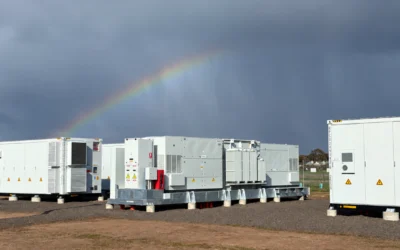
The Australian Energy Market Operator (AEMO) has detailed in a new report that the estimated net revenue, covering both energy and FCAS markets, for grid-scale batteries on the National Electricity Market (NEM) reached AU$69.5 million (US$43.2 million) in Q4 2024.
Revealed in the organisation’s latest Quarterly Energy Dynamics, which encompasses Q4 of 2024, AEMO said that year-on-year this represented a more than doubling from the AU$31.5 million estimate for Q4 2023 for battery energy storage systems (BESS) on the NEM.
In the energy market, net revenue from batteries increased by AU$34.6 million, representing a 257% rise, bringing the total to AU$48.1 million, accounting for 69% of the total estimated net revenue. The significant growth in revenue from energy arbitrage was primarily due to an AU$38.4 million increase (300%) from energy generation.
Additionally, charging during negative price periods contributed an increase of AU$3.9 million, resulting in total battery revenue of AU$7.2 million for the quarter. However, energy costs associated with charging at prices above AU$0/MWh also rose by AU$7.7 million, a 298% increase YoY.
Try Premium for just $1
- Full premium access for the first month at only $1
- Converts to an annual rate after 30 days unless cancelled
- Cancel anytime during the trial period
Premium Benefits
- Expert industry analysis and interviews
- Digital access to PV Tech Power journal
- Exclusive event discounts
Or get the full Premium subscription right away
Or continue reading this article for free
AEMO also said that grid-scale solar PV output achieved a new quarterly high average on the NEM of 2,212MW, an increase of 9% year-on-year (YoY). The increase in variable renewable energy generation from grid-scale solar PV rose by 259MW YoY due to newly connected facilities and those progressing through the commissioning processes.
The majority of the increase was found in the state of New South Wales. This was predominantly through the availability of solar generation from the 300MW Wellington North PV plant, owned by Beijing Energy International Australia, and Fotowatio Renewable Ventures Australia’s 353MW Walla Walla PV plant, which was first energised in November 2024.
You can read the full article on our sister site PV Tech.