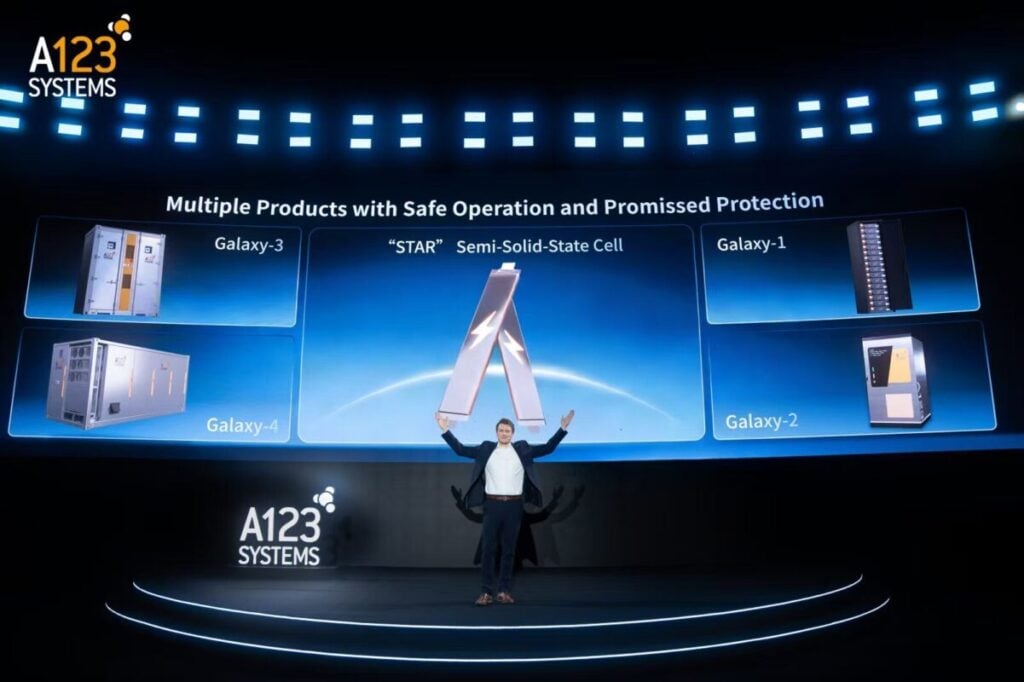
With battery storage safety under increasing scrutiny, Wanxiang A123 Systems and Hithium have unveiled new products and large-scale fire testing (LSFT), respectively.
A123: Storied manufacturer combines semi-solid cells and system-level immersion cooling
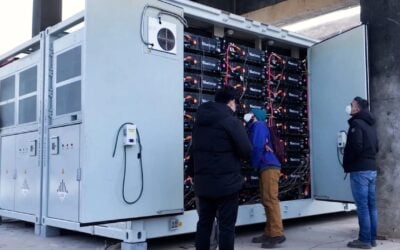
Wanxiang A123 Systems (A123) unveiled a new battery energy storage system (BESS) solution last week (7 February), which features semi-solid-state battery technology integrated with immersion cooling.
A123 claims it marks a shift toward intrinsic, system-level protection, from the industry’s reliance until now on fire suppression systems that are reactive.
The new Star Series semi-solid-state battery cells and Star River complete BESS solution are aimed at what the company described as ‘high-risk applications’.
Try Premium for just $1
- Full premium access for the first month at only $1
- Converts to an annual rate after 30 days unless cancelled
- Cancel anytime during the trial period
Premium Benefits
- Expert industry analysis and interviews
- Digital access to PV Tech Power journal
- Exclusive event discounts
Or get the full Premium subscription right away
Or continue reading this article for free
The Star Series cells join A123’s product range of 300Ah lithium iron phosphate (LFP) cells for grid-scale and industrial applications. While not much detail was given in a release, the company claimed Star Series is equipped with proprietary technologies that could mitigate electrolyte leakage issues and thermal instability.
While exact definitions vary from maker to maker, semi-solid-state cells utilise a portion of solid electrolytes instead of the all-liquid or gel electrolytes found in lithium-ion (Li-ion) batteries. This promises improvements such as reduced dendrite formation and enhanced thermal stability and increased cell capacity.
Semi-sold is considered a stepping stone to fully solid-state batteries, which many companies are working to develop and commercialise, but which are still considered tricky to manufacture and will require new manufacturing techniques.
Although sodium-ion (Na-ion) is often seen as a potential drop-in replacement or alternative to Li-ion, solid-state is perhaps a longer-term successor.
Meanwhile, the Star River BESS features full immersion cooling which A123 claimed maintains cell temperature variance within 2 °C even in ‘demanding’ operating conditions.
Thermal management of BESS is of course a big topic for the industry and liquid cooled systems are becoming widely available, if not actively a standard as yet, but the only other provider thought to provide immersion cooling, where battery cells are submerged in a dielectric liquid when temperature issues are detected, is US manufacturer Etica AG.
Formed as a joint venture (JV) between Taiwan’s Etica Battery and Pennsylvania, US-headquartered Asset Genie, Etica AG claims immersion cooling eliminates thermal runaway.
A123 makes similar claims with its dual-layer safety protection in the Star River BESS solution, which the maker said offers 10,000 cycle life at room temperatures and 7,000 cycles even at 45 °C. A123 said this is a 40% improvement over industry averages and that the temperature performance reduces the levelised cost of energy (LCOE) by around 15%.
Hithium: LSFT on 6.25MWh BESS with kilowatt-hour-scale cells
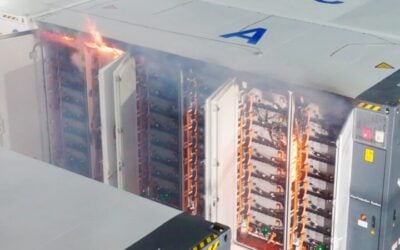
Hithium recently completed large-scale fire testing (LSFT) of its ∞Power 6.25MWh BESS solution under open-door conditions, noting that this is the first such test in the world of a system equipped with 1,000+Ah cells.
The testing was conducted under the supervision of representatives from UL, various US authorities having jurisdiction (AHJs) and fire protection engineers.
In large-scale fire testing, a complete BESS unit is set on fire with its fire detection and suppression systems disabled and the results observed.
Ultimately, manufacturers are seeking to demonstrate to customers, insurers, lenders and other stakeholders that in a worst-case scenario, fire will be contained to one unit alone and not propagate to others, or to other surrounding or nearby equipment or buildings.
Hithium’s ∞Power 6.25MWh BESS is a 4-hour duration system. It features the company’s 1175Ah ∞Cell, one of a growing number of large-format LFP cells produced by manufacturers seeking to increase energy density and capacity of their systems.
The company said in a release earlier this week (8 February) that during the LSFT, container doors were left open to create open-door combustion conditions, in other words, maximising oxygen supply and potential impact of flames.
Three other BESS containers were placed adjacent to the one lit on fire, back-to-back and side-to-side with 15 cm between them, while the test unit was operated at 100% state of charge (SoC).
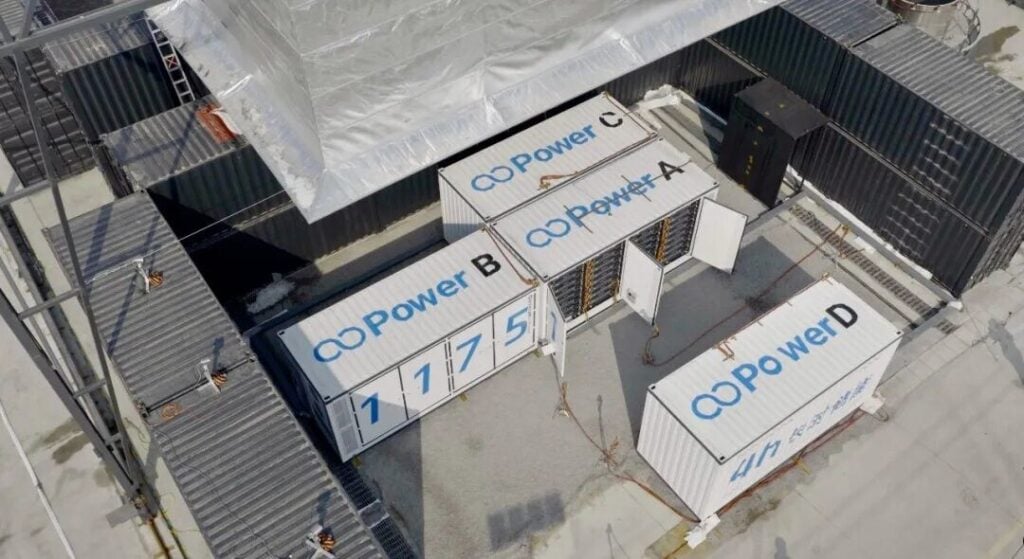
Through testing, fire was contained to the one system, and no thermal propagation was observed. Cells in adjacent containers remained below safety thresholds.
The test verified the ∞Power unit’s system-level safety features, Hithium claimed, with the enclosure reinforced with a high-strength steel frame and dual-layer partitions, modules sheathed in fire-resistant covers, and a three-dimensional airflow channel offered directional venting of energy released during the 1175Ah cells’ thermal runaway.
It follows an earlier test of Hithium’s 5MWh product. LSFT has been conducted by dozens of other makers and the test method, developed by Canada’s CSA Group, is mandatory as part of the US National Fire Protection Agency (NFPA) standard, NFPA 855, from its 2026 edition. Adherence to NFPA 855 is a common requirement for projects in the US and increasingly also in other countries.
A123 and Hithium: Players from different ends of Chinese BESS industry chronology
The two Chinese companies have backstories that come from different ends of the energy storage industry’s timeline and global maturation.
Wanxiang A123 Systems (A123) was established at the beginning of the century in 2001 in Massachusetts, USA, by founders that included noted MIT battery scientist Yet-Ming Chiang.
A pioneer in commercialising lithium-ion (Li-ion) batteries for both electric vehicle (EV) and BESS applications, following a lengthy saga of receiving US government support but perhaps diving too early into both sectors, A123’s battery division was acquired by Chinese automotive company Wanxiang in 2012, while its grid storage business was acquired by NEC in 2014.
Yet-Ming Chiang went on to launch other battery companies, most notably 24M, which has developed a semi-solid lithium battery manufacturing platform. A123 recently re-entered the North American grid-scale BESS market, while the system integrator arm bought by NEC was later acquired by Korea’s LG Energy Solution (LG ES) in a deal which completed in 2022.
Hithium, meanwhile, only launched in 2019 in Xiamen, China, but has expanded rapidly in manufacturing footprint, product range and global sales presence. Last year, the vertically integrated company opened new production lines in the US, signed deals in emerging markets in Eastern Europe and the Middle East and followed up the August launch of its 1175Ah cell with even bigger 1300Ah cells designed for 8-hour long-duration energy storage (LDES) applications unveiled in December.
The company is currently seeking an IPO on the Hong Kong Stock Exchange (HKEX), one of a number of Chinese energy storage players seeking to leverage foreign investment through H-shares listings on the HKEX in addition to A-shares listings in mainland Shanghai and Shenzhen Stock Exchanges in China.