Investor-owned utility (IOU) Portland General Electric (PGE) has become the latest US entity to reveal the impact of changes to import tariffs and tax credits recently implemented by the Federal Government.
Earlier this month, the Oregon Public Utilities Commission (OPUC) approved a “price refresh” relating to a portfolio of three energy storage projects which PGE is procuring with a cumulative capacity exceeding 1GW.
John McFarland, VP chief commercial and customer officer of PGE said the pricing amendments were needed to “reflect current economics, tariff risks, evolving tax credit opportunities and deliver value for customers.”
Reshaping of industry
The projects impacted by the pricing amendment are the result of PGE’s 2023 all-source request for proposals (RFP) issued to the market in February 2024, that initially sought 545MWac of energy, alongside 600MW of both summer and winter capacity through 2028.
Try Premium for just $1
- Full premium access for the first month at only $1
- Converts to an annual rate after 30 days unless cancelled
- Cancel anytime during the trial period
Premium Benefits
- Expert industry analysis and interviews
- Digital access to PV Tech Power journal
- Exclusive event discounts
Or get the full Premium subscription right away
Or continue reading this article for free
Since its issuance to the market in February 2024, these forecasts have been updated with the availability of new data. However, the utility’s 2028 capacity shortfalls are still significant, with PGE looking to fill a 797MW and 465MW capacity gap in summer and winter, respectively.
Despite PGE commencing contract negotiations with shortlisted projects, the utility filed for a “critical and immediate” price refresh in October this year “in light of material and systematic changes in federal tax and tariff policies.”
It highlighted foreign entity of concern (FEOC) restrictions on procurement for solar and storage projects hoping to obtain the investment tax credit (more on its comments further down).
Within recent documents published with the OPUC, PGE detailed the severity of these changes as not just impacting individual project bids, “but also reshaping the renewable energy industry as a whole.”
“This meant there would be material price impacts across the board,” said PGE.
Instead of asking for refreshed prices from just shortlisted projects, PGE asked for resubmissions from the developers of all eligible projects to ensure every bid “reflected these new economic realities and stood on equal footing.”
64% increase in capacity price
PGE received seven refreshed bids from developers able to meet the requirements of the RFP, with four of these being standalone BESS and the remaining three pairing solar with energy storage.
Through assessment of these refreshed bids, PGE witnessed a 64.6% increase in the average cost of capacity, from US$144/kW-year to US$237/kW-year, highlighting the impact of recent federal changes.
In the end, PGE chose to move forward with one standalone 400MW BESS, alongside two solar and storage hybrid energy storage projects with a cumulative capacity of 615MW.
Although the majority of project information was redacted, the filings did reveal that PGE will own the standalone BESS, with the two hybrid projects being subject to a mixture of power purchase agreements (PPA) and utility-owned structure.
All three projects are slated to come online before 31 December, 2027 in order to meet 2028 reliability needs.
During its 9 December meeting, staff at the OPUC acknowledged PGE’s refreshed shortlist, finding it to be reasonable and in the public interest.
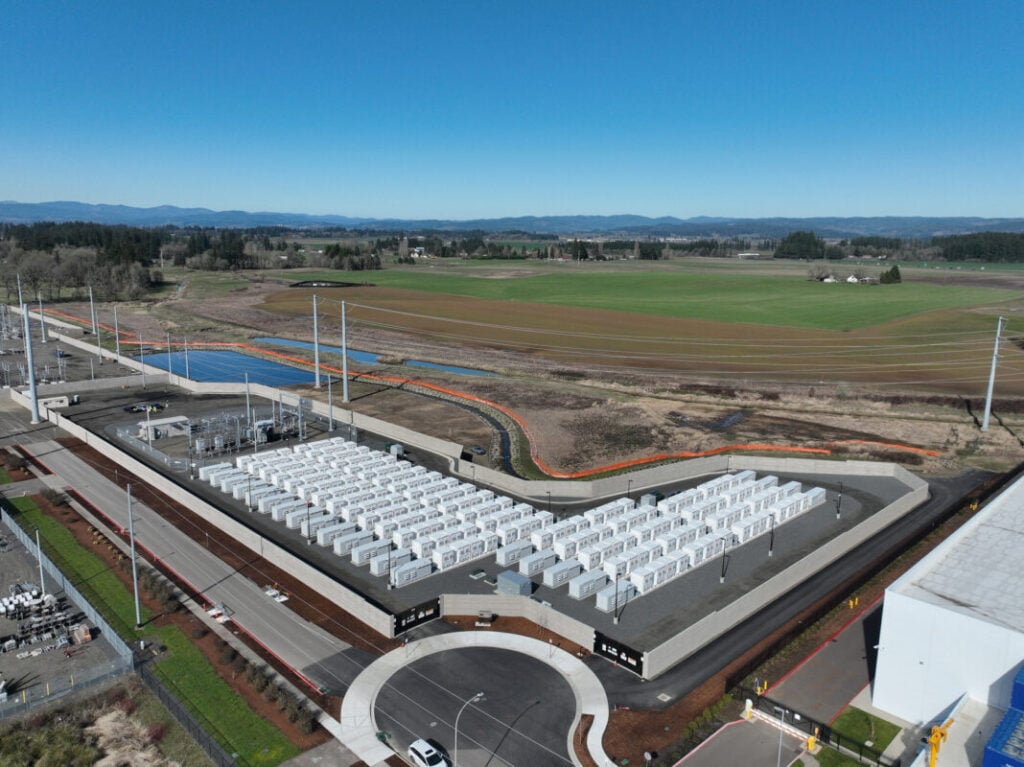
It follows the completion of three BESS projects for PGE in August totalling 1.9GWh; one in partnership with Eolian under a Build-Transfer Agreement (BTA), one wholly PGE-owned and delivered, and one procured under a 20-year capacity deal with owner NextEra Energy Resources.
Reshaping of the industry: ‘tariffs now a fundamental driver of project economics’
When it comes to taxation policy changes, PGE noted the detrimental impact of the FEOC restrictions, which it says “disproportionately affect solar and storage supply chains.”
Although developers not sourcing components from FEOC countries (which includes China) will continue to receive investment tax credits (ITCs) well into the next decade, others still procuring from FEOC countries doing this need to commence project construction by the end of 2025 to continue receiving credits.
China being listed as one of the restricted countries has presented itself as a huge issue for many US-based developers who source their batteries from companies based in the East Asian country, such as CATL and Hithium. China dominates the lithium-ion battery and BESS industry.
“The project economics of renewable resources is significantly impacted by federal tax credit availability,” said PGE, which, within recent OPUC filings, stated that ITCs can reduce project costs by as much as 50%.
Additionally, as part of refreshed bids, PGE asked developers to explicitly account for tariff exposure in order to “avoid surprises” during contract execution.
“Tariffs are now a fundamental driver of renewable project economics,” said the utility.
In related news, the New York Power Authority (NYPA) this month reduced the scale of its renewable portfolio in the face of “strong federal headwinds.”