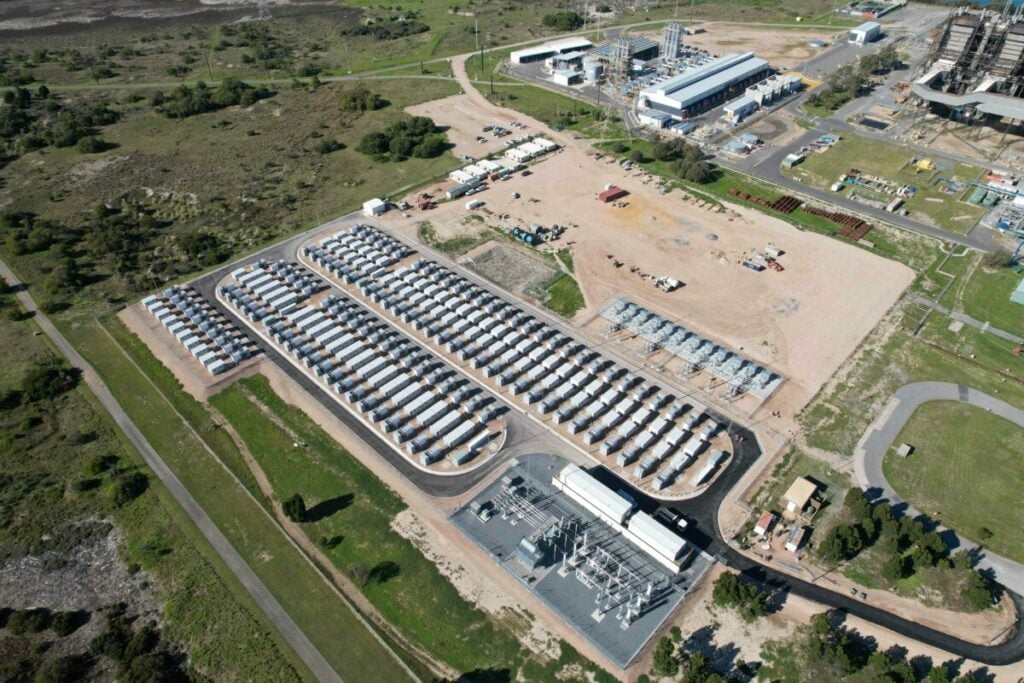
Finnish marine and energy technology group Wärtsilä will deliver what it claims is “Australia’s largest DC-coupled hybrid battery energy storage system (BESS)” for the National Electricity Market (NEM).
The project will be Wärtsilä’s ninth BESS site in Australia, expanding the company’s local footprint to 1.5GW/5.5GWh of capacity. The battery storage system is expected to be operational in 2028. The order will be booked by Wärtsilä in Q4 2025.
The announcement builds on Wärtsilä’s previous DC-coupled project in Australia, the 64MW/128MWh Fulham Solar Battery Hybrid project for Octopus Australia. Announced in April 2025, the project represented one of the first large-scale DC-coupled hybrid battery systems in the NEM.
Wärtsilä has not disclosed what project or developer it will supply the battery storage system for. However, the largest announced DC-coupled hybrid battery storage system in the NEM at the time of writing is Lightsource bp’s 49MW/562MWh Goulburn River solar-plus-storage site, which recently started construction.
Try Premium for just $1
- Full premium access for the first month at only $1
- Converts to an annual rate after 30 days unless cancelled
- Cancel anytime during the trial period
Premium Benefits
- Expert industry analysis and interviews
- Digital access to PV Tech Power journal
- Exclusive event discounts
Or get the full Premium subscription right away
Or continue reading this article for free
This would also match Wärtsilä’s description of the new project being “nearly four times the scale” of the Fulham Solar Battery Hybrid project. Energy-Storage.news has contacted Wärtsilä to clarify the project and will update the article accordingly.
“This project is significantly larger than our earlier DC-coupled project, underscoring the need for this type of technology in expanding at scale,” said David Hebert, vice president of global sales management at Wärtsilä Energy Storage.
“It’s particularly exciting to work on the largest DC-coupled project in the country; DC-coupled technology is a breakthrough for hybrid renewable energy plants and a critical step towards establishing a financially viable renewable energy future.”
Wärtsilä also confirmed the battery system will utilise a digital energy management and controls platform, GEMs, which has been deployed at numerous utility-scale BESS projects in Australia, such as Amp Energy’s 150MW/300MWh 2-hour duration Bungama BESS in South Australia. It will also be deployed at varying stages of the 2.8GWh Eraring BESS project in New South Wales.
DC-coupled hybrid projects in Australia
DC-coupled systems link solar generation and batteries directly through a DC/DC converter, minimising energy losses and capturing solar power that would otherwise be curtailed.
Compared to traditional AC-coupled arrangements, the hybrid configuration significantly improves project economics, system efficiency, and overall grid stability.
Australia’s hybrid solar-battery market has gained momentum as developers recognise the operational and economic advantages of co-located systems. GPG’s Western Australia hybrid project demonstrated early adoption of hybrid configurations outside the NEM, combining 10.2MW of solar capacity with 2MW/1MWh of battery storage at the Kalbarri Microgrid.
The GPG project, inaugurated in 2023, represented Western Australia’s first grid-connected large-scale hybrid solar-battery installation and showcased the potential for hybrid systems to provide grid services while maximising renewable energy utilisation. The project’s success helped establish technical and commercial precedents for larger hybrid developments across Australia’s various electricity markets.
The scale of Wärtsilä’s latest DC-coupled project reflects the technology’s maturation and growing acceptance among Australian energy market participants. While specific capacity details for the new project were not disclosed, it is expected to exceed the company’s previous DC-coupled installations and contribute to Australia’s renewable energy transition objectives.