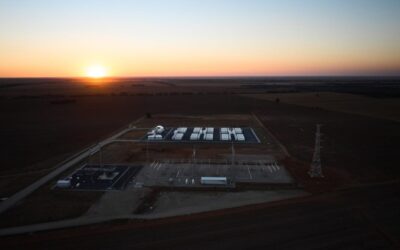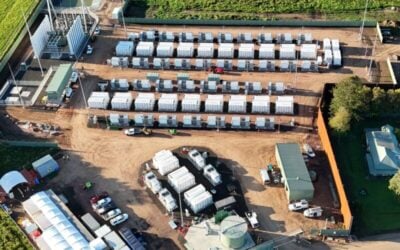
The first large-scale battery energy storage system (BESS) with grid-forming capabilities in Germany was inaugurated a few days ago.
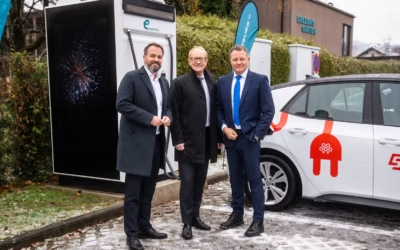
A celebration event was held by developer and investor Schoenergie on 10 October for the 21MW/55MWh project at Trier Region Industrial Park (IRT) in the municipality of Föhren, Rhineland-Palatinate.
In attendance were Rhineland-Palatinate minister-president Alexander Schweitzer and colleagues from the southwest German state’s Minister for Climate Protection, Environment, Energy, and Mobility (MKUEM).
The system will perform typical energy storage system load shifting applications such as storing energy from a co-located 20MW solar PV plant and participating in electricity market opportunities, but it will also be the first application of, and a test case for, the use of BESS to support network stability with grid-forming advanced inverters.
Try Premium for just $1
- Full premium access for the first month at only $1
- Converts to an annual rate after 30 days unless cancelled
- Cancel anytime during the trial period
Premium Benefits
- Expert industry analysis and interviews
- Digital access to PV Tech Power journal
- Exclusive event discounts
Or get the full Premium subscription right away
Or continue reading this article for free
Föhren BESS is connected to the local distribution grid and will provide frequency and voltage support. It can also black start the local grid in the event of a major outage and is ready to start providing inertia when the German inertia market opens up in 2026.
It is expected to serve as an important source of data on how battery storage systems equipped with advanced inverters can provide these system stability services, for which grids have traditionally been reliant on the rotating mass of thermal power generators.
As fossil fuel power plants retire and their capacity is replaced by solar and wind, the need for those other services, once delivered as a byproduct of turbines spinning to generate power, grows too.
SUREVIVE project evaluates distribution network role of grid-forming
Schoenergie’s Föhren BESS is part of SUREVIVE, a research project supported with funding from the German Federal Ministry for Economic Affairs and Energy (BMWE) and its programme for low- and medium-voltage distribution grid modernisation, OptiNeD.
Led by local electricity distribution grid operator Westnetz, the SUREVIVE consortium includes the University of Stuttgart and solar and storage technologies research institute Fraunhofer ISE.
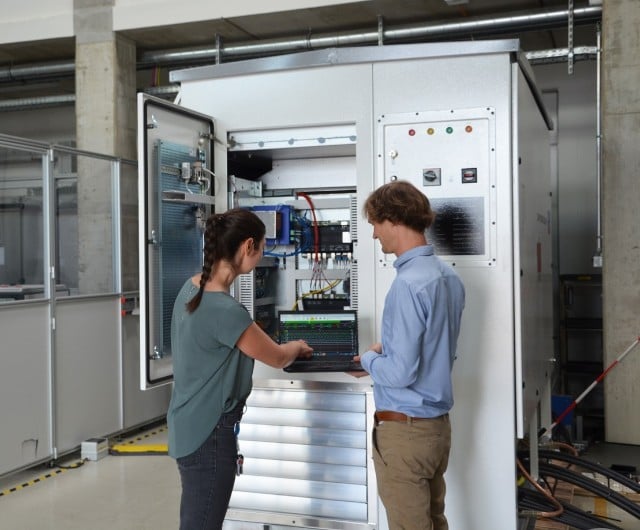
Fraunhofer ISE tested the SMA power electronics at its multi-megawatt test laboratory ahead of field deployment. The institute said this testing was used to create a best practice guide for the connection and operation of grid-forming inverters in distribution grids.
This guide would benefit stakeholders, including system manufacturers, project planners, installers and operators, as well as distribution grid operators, Fraunhofer claimed, while the wider aims of the project include developing methods for assessing the stability of distribution grids on which grid-forming inverter-based technologies have been deployed.
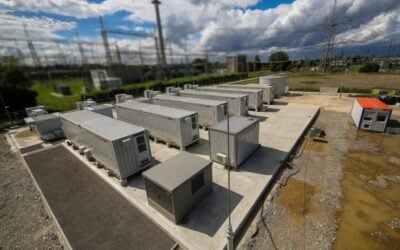
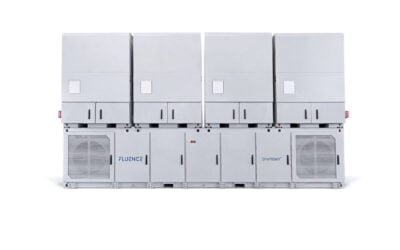
BESS equipment to the Föhren project was supplied by vertically integrated battery and BESS manufacturer Hithium. Hithium supplied 11 units of its 5MWh containerised BESS solution, following visits by Schoenergie and independent experts for factory acceptance tests between September 2024 and April 2025.
In a May announcement, Hithium noted that in addition to being a first grid-forming project in Germany, the BESS design is also novel in that the enclosures feature solar PV arrays mounted on top, providing auxiliary power for cooling.
The advanced inverter power control systems (PCS) that enable the Föhren BESS to deliver grid-forming system stability services were supplied by SMA.
SMA supplied seven units of its Medium Voltage Power Station (MVPS) with its Sunny Central UP-S inverters and SMA Power Plant Manager.
SMA senior business development manager Aaron Gerdemann wrote a technical paper for our journal PV Tech Power (Vol.39), which explored grid-forming technologies as alternatives to traditional solutions for safeguarding the grid.
SMA also supplied inverters to Europe’s biggest grid-forming BESS project to date, developer-investor Zenobē Energy’s Blackhillock 300MW/600MWh asset in Scotland, UK. The first 200MW/400MWh phase of Blackhillock went online at the beginning of this year.
Blackhillock and other BESS projects—including another of equivalent size by Zenobē in Scotland currently in construction—were awarded funding support through the UK’s National Energy System Operator (NESO) in its Stability Pathfinder competitive solicitations for new resources to replace thermal generators for more than just capacity.
NESO is now moving ahead with procuring inertia and other system stability services through forthcoming tenders. A key difference with the Föhren project and efforts in the UK and Australia around grid-forming is that Föhren is distribution-connected and not connected to the transmission network.
Fraunhofer ISE noted in a July update on the SUREVIVE project that Germany’s government has also identified that inverter-based resources could contribute to grid stability. SUREVIVE will run until mid-2028.
In a LinkedIn post, SMA claimed that Föhren BESS is the first grid-forming large-scale project in continental Europe. However, it appears that a 7.5MW/11MWh system with ultra-fast synthetic inertia capabilities from utility RWE was first past the post, when went online in the Netherlands in June, shortly after Energy-Storage.news reported an update on its progress.