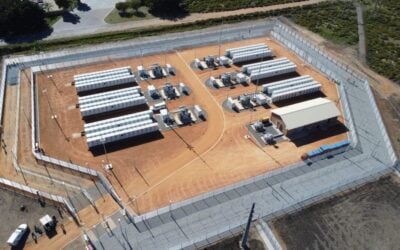
Another recent LG Chem-supplied storage system at Feldheim, Germany, helping the small village in its aim to go “100% renewable”. Image: LG Chem.
Steag, a major power generator which constructs, plans and operates power plants, is spending US$100 million on acquiring 90MW of large-scale energy storage to help stabilise Germany’s grid.
Korean chemicals company LG Chem will supply batteries, while automation company Nidec ASI, formerly known as Ansaldo Sistemi Industriali, will supply and install the complete storage systems, including controls and energy management.
Six lithium-ion battery-based systems, each of 15MW, will be deployed in North-Rhine Westphalia, in the northwest of the country and in Saarland, in the south, three in each region. They will provide primary control reserve, balancing the grid’s frequency within the tight boundaries that it needs to be kept in.
Unlike fossil fuel power plants which must be run continuously or need time to fire up, battery storage systems can respond via their control and management systems automatically to demands from the grid to ramp up or stand down within fractions of a second. Facilities in the market must provide that primary control power for up to 30 minutes.
Try Premium for just $1
- Full premium access for the first month at only $1
- Converts to an annual rate after 30 days unless cancelled
- Cancel anytime during the trial period
Premium Benefits
- Expert industry analysis and interviews
- Digital access to PV Tech Power journal
- Exclusive event discounts
Or get the full Premium subscription right away
Or continue reading this article for free
Germany’s competitive market for frequency regulation is increasingly turning to battery-based systems for this increased efficiency, while the use of less thermal power plants obviously also greatly reduces carbon emissions. Tenders to take part are held on a weekly basis, with major energy storage and solar companies including Younicos and Belectric already also involved in this market.
Furthermore, some of the fluctuations in the grid are caused by adding variable renewable power to the grid. With Germany having an installed base of nearly 40GW of solar PV alone, the Steag-commissioned battery plants will also help in this regard. The storage systems can take power from the grid as well as feed it in.
The new projects will be built on the site of existing power plants, which Steag claimed would keep investment costs low, with the facilities likely to share some infrastructure. They are expected to be completed and connected between mid-2016 and early 2017.
Steag said it is “aiming to take on a pioneering role in the establishment of battery storage and marketing of the energy stored in those batteries”.
“Storage facilities and the creation of flexibility are essential elements in the implementation of the energy transition in Germany. STEAG has therefore decided to make this investment in large-scale batteries for deployment on the control power market, without making use of grants or subsidies,” Steag’s chairman of the board Joachim Rumstadt said.
“Moreover, we believe that renewable energies will have to take a more responsible role in ensuring security of supply and, therefore, will have to provide more firm capacity on the energy-only market. Combined with extensive commercial and technical expertise in energy, which we can draw on, battery systems will be one key to resolving this issue.”
Alt Daber solar farm in Germany already has a grid-balancing energy storage system co-located with it. Image: Belectric.