
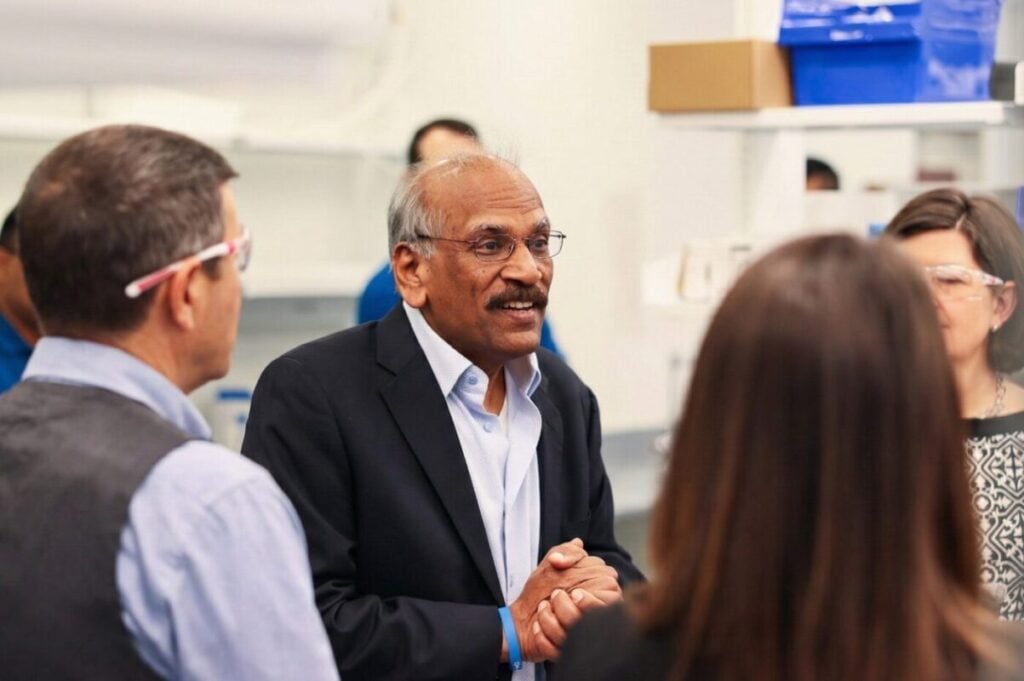
Mukesh Chatter, CEO of US sodium-ion battery startup Alsym, on the prospects for non-lithium alternative technologies in 2026 and beyond.
While many see sodium-ion as the closest possible competitor or perhaps complement to lithium, some startups have struggled with the cycle life and energy density limits from the tech side and finding funding and creating scale on the production side.
When US sodium-ion (Na-ion) startup Alsym first featured on Energy-Storage.news a couple of years ago, the company was still emerging from stealth mode. A Guest Blog from CEO Mukesh Chatter in February 2024 argued for the need to diversify battery storage supply chains and technology options, without revealing the company’s key ingredients.
Even through the closing of a US$78 million Series C funding round a couple of months later, as we wrote in an ESN Premium piece at the time, the company remained tight-lipped, only letting it be known that its battery chemistry was non-lithium-based and cobalt-free.
Try Premium for just $1
- Full premium access for the first month at only $1
- Converts to an annual rate after 30 days unless cancelled
- Cancel anytime during the trial period
Premium Benefits
- Expert industry analysis and interviews
- Digital access to PV Tech Power journal
- Exclusive event discounts
Or get the full Premium subscription right away
Or continue reading this article for free
Then, in October last year, Alsym launched its “non-flammable, non-toxic, and cost-effective” Na-Series energy storage battery, positioning it as a solution for data centres, electrification, and renewable energy applications. In another ESN Premium piece, CEO Chatter said supply chain independence from Chinese imports—which the lithium-ion industry remains largely beholden to—was an increasing focus for Alsym.
What did 2025 mean for the energy storage industry from your company’s perspective and the bigger picture?
2025 was a reality check for the energy storage industry. High-profile battery fire incidents, particularly Moss Landing in the US, made it clear that performance alone is not enough if it comes at the expense of safety and community trust.
Utilities and fast-growing load centres, such as data centres, increasingly need storage sited close to demand, often in dense commercial and industrial areas where safety and permitting standards are the most stringent.
The conversation shifted from simply adding capacity to deploying storage that is safe enough to live where the grid needs it most, which is near people, infrastructure, and critical services.
What do you think 2026 will hold, in terms of both things to look forward to and in terms of challenges ahead?
Following lithium-ion fire incidents and tighter permitting standards, regulators and local authorities will increasingly treat non-flammability as a baseline requirement, particularly for projects near residences, schools, and critical infrastructure.
At the same time, rising electricity demand and grid constraints will make storage deployment more urgent, not less so.
This combination will push the market toward less flammable systems like sodium-ion batteries that can deliver grid-scale performance while adding safety. Non-flammable, high-performance systems such as Alsym’s sodium-ion ‘NFPP+ Series’ technology turn safety from a risk factor into a license to operate.
How should our readers think about the promise and potential of newer technologies such as sodium-ion?
Sodium-ion is not a one-to-one replacement for lithium-ion. It is an expansion of what is possible for energy storage.
Today, many projects are delayed or rejected because they are too risky to site near schools, hospitals, data centres, or dense urban infrastructure.
Non-flammable chemistries such as Alsym’s NFPP+ remove that permitting wall without sacrificing performance, enabling “storage-anywhere.”
In practice, that is the difference between a project that stays on paper and one that actually gets built in a city centre or critical load zone.
Versatility is another promise of newer non-lithium technologies.
Higher C-rates, longer cycle lives, wider operating temperature range, etc., remove some of the operational limitations of lithium-ion that didn’t matter as much when the entire market was 2-to-4-hour use cases, but now it’s moving into longer durations and new data centre-level use cases. Markets are changing rapidly, and new solutions are needed that can adapt with them.
What are the most significant barriers to the adoption of new battery technologies, and how is Alsym working to overcome them?
The biggest barriers are high upfront costs in part due to relatively expensive raw materials, poor performance, and the challenge of scaling manufacturing without building entirely new infrastructure. Many promising chemistries stall because they cannot bridge the cost and performance gap from lab to grid.
Alsym addresses this by using abundant, domestically available materials, including sodium and iron that are not subject to geopolitical volatility, both enabling and stabilising the supply chain from day one.
Our batteries are also compatible with existing lithium-ion manufacturing facilities and processes. This allows us to leverage installed factory capacity rather than starting from scratch, accelerating deployment while reducing capital risk.
Ensuring new and existing market needs are being addressed as well is important. In one case, Natron (which went out of business last year – Editor), for example, held a lot of promise but pursued a technology that had a niche set of use cases, like short-duration backup. While that’s certainly a need, the more use cases you can cover, the better.
The Energy Storage Summit USA will be held from 24-25 March 2026, in Dallas, TX. It features keynote speeches and panel discussions on topics like FEOC challenges, power demand forecasting, and managing the BESS supply chain. For complete information, visit the Energy Storage Summit USA website.