Pivot Power will collaborate with manufacturer and system integrator redT on what is claimed to be the world’s first grid-scale hybrid battery energy storage project to use a combination of lithium-ion and vanadium technologies.
Pivot Power is a relatively new company that has quickly risen to prominence in the UK over the past few months with a plan to deploy 2GW of energy storage and a network of EV chargers.
Pivot will lead a consortium of companies which will develop a £41 million (US$53.89 million) ‘SuperHub’ in Oxford, England, incorporating grid-scale batteries, high speed EV chargers and hundred of ground source heat pumps for local homes.
The project is one of four unveiled by the UK government today (3 April 2019) and will be supported by a £10 million grant from UK Research and Innovation.
Try Premium for just $1
- Full premium access for the first month at only $1
- Converts to an annual rate after 30 days unless cancelled
- Cancel anytime during the trial period
Premium Benefits
- Expert industry analysis and interviews
- Digital access to PV Tech Power journal
- Exclusive event discounts
Or get the full Premium subscription right away
Or continue reading this article for free
The consortium comprises Oxford City Council, Habitat Energy, Kensa Contracting, redT and the University of Oxford.
The entire project has been tagged at £41 million and will establish what the consortium also claims to be the world’s largest commercial hybrid energy storage system at 50MW, incorporating technologies outside of the standard lithium-ion.
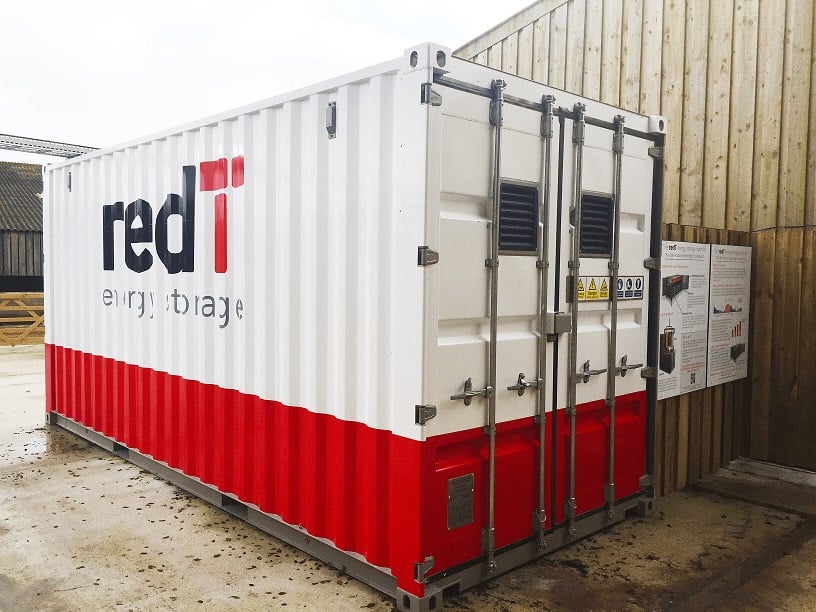
RedT, which recently announced a landmark C&I solar-plus-storage programme with Statkraft, will supply 5MWh of flow machines, which will be ‘hybridised’ with a 48MW/50MWh lithium-ion battery system connected at the transmission level.
RedT also confirmed the storage system is to support a local EV charging network consisting of around 100 ultra-rapid and fast chargers.
The hub will meanwhile become one of Pivot Power’s 45 so-called SuperHubs, which combine large-scale battery storage and rapid electric vehicle charging points at convenient destinations for consumers.
Pivot Power unveiled its plans for a multi-billion-pound UK-wide network of battery storage and EV charger installations to much fanfare last year.
Matthew Boulton, COO at Pivot Power, said the project was the start of his company providing the mass charging network needed to “kick-start an electric vehicle revolution” in Oxford, while simultaneously helping the city’s decarbonisation objectives.
“We are hoping to encourage all sorts of other Oxford groups – residents, commuters, bus companies, logistics operators – to take advantage of the power we are bringing to the south of the city and switch to electric vehicles,” he said.
Various industry sources and analysts have commented that combining lithium for high power applications and flow batteries for capacity or energy applications could have potential, developments have not been forthcoming. redT’s CEO Scott McGregor talked up the potential of combining vanadium and lithium at scale in 2017 to Energy-Storage.news.
Shortly after that, the company supplied a 300kW / 1MWh flow machine system to a commercial project at Monash University, Australia at which it was paired with a 120kW lithium-ion battery system. The Pivot Power project however, is on a much larger scale and will provide a wider range of applications as well as being grid-tied from the very beginning.
In June 2017, Navigant Research forecast that by 2026, 2.1GW of hybrid projects using multiple energy storage technologies will be deployed. These hybrids could encompass a range of technologies, applications and configurations. In November 2018, a project was unveiled in Niedersachsen, Germany, combining 4MW / 20MWh of sodium-sulfur NAS battery storage from NGK Insulators with 7.5MW / 2.5MWh of lithium-ion batteries, each performing different grid-balancing roles.
Watch redT’s Scott McGregor explain how the previous hybrid project at Monash University came together.
Additional reporting by Andy Colthorpe.