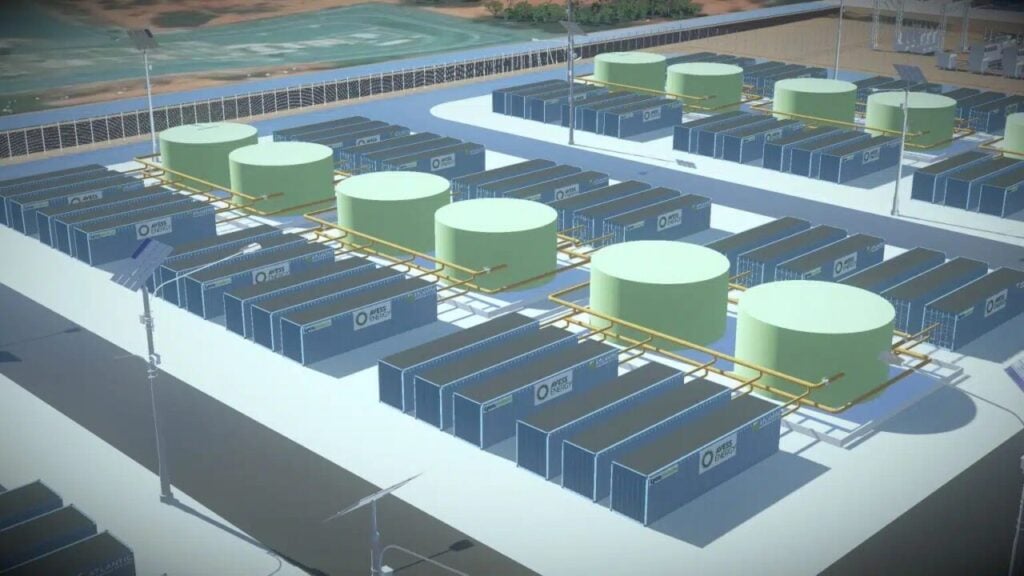
A Western Australian government initiative to deploy the largest vanadium redox flow battery (VRFB) project outside China is a “pivotal moment,” one technology provider has said.
In late November, the state government launched the first stage of an expression of interest (EOI) for a 50MW/500MWh (10-hour duration) VRFB energy storage project, to be built in Kalgoorlie, around 600km northeast of the Western Australia (WA) capital, Perth.
The project, backed by AU$150 million (US$97 million) of government funding and administered by the Department of Energy and Economic Diversification (DEED), requires the use of flow battery technology manufactured within WA, using locally sourced and processed vanadium.
Western Australia Premier Roger Cook of the Labor Party had made the delivery of the project in the mining town of Kalgoorlie one of his campaign pledges on the trail for reelection at the beginning of this year. The project is designed in part to replace the role of the 57MW West Kalgoorlie Power Station gas power plant, due for decommissioning next year.
Try Premium for just $1
- Full premium access for the first month at only $1
- Converts to an annual rate after 30 days unless cancelled
- Cancel anytime during the trial period
Premium Benefits
- Expert industry analysis and interviews
- Digital access to PV Tech Power journal
- Exclusive event discounts
Or get the full Premium subscription right away
Or continue reading this article for free
“This is a pivotal moment for Australia’s vanadium industry, battery manufacturing industry, and diverse energy consumers,” a spokesperson for Perth-headquartered vanadium flow battery company AVESS Energy told ESN Premium.
The “breakthrough” project will be the largest VRFB to date outside of China, as well as the first large-scale VRFB project in Australia to connect to either of the country’s biggest electricity markets: the National Electricity Market (NEM) which covers the southeastern and eastern part of the country and the Wholesale Electricity Market (WEM), which covers parts of Western Australia including the South-West Integrated System (SWIS) into which the Kalgoorlie project will be delivered.
The spokesperson said AVESS Energy expects the Kalgoorlie project to “unlock the expansion of vanadium flow battery (VFB) deployments in Australia and across the region.”
The company is making a Stage One EOI submission—where market capabilities and other metrics of interested parties will be assessed—in a consortium with other companies based in WA. These are Atlantic Vanadium, which AVESS said is a “shovel-ready vanadium producer,” and design and project delivery engineer Lycopodium.
Kalgoorlie project necessitates fast-tracked manufacturing and supply chain development
AVESS bought a majority stake in KORID Energy, a South Korean vanadium flow battery tech company, in 2023, gaining access to KORID’s battery stack technology. KORID featured in Energy-Storage.news in early 2020, when it and Canadian metals exploration company Margaret Lake Diamonds signed an agreement to investigate the possibility of building a VRFB factory in the northeast US.
The WA company then unveiled its first commercial-scale VRFB installation in early 2024, utilising a 50kW module made with two 25kW KORID Energy stacks, with a 5-hour discharge duration.
It is currently also deploying a prototype 50kW/200kWh system for vanadium developer partner Atlantic Vanadium, at the latter’s Windimurra Vanadium Project, around 500km northwest of Kalgoorlie.
“As an Australian VFB company, AVESS has been focused on onshoring the manufacturing of its globally competitive cell-stack, while developing its battery pack assembly capabilities,” the spokesperson told ESN Premium.
However, while it has been pleased with its efforts to develop a modular solution based on the 25kW stack, the company will launch a utility-scale configuration product that leverages the cell-stack IP to meet the Kalgoorlie project’s proposed size, as well as other grid-scale project opportunities in the future.
“The biggest technical challenge lies in the fact that a plant-style VFB system of this scale has never been attempted before in Australia. While there is a plethora of engineering and construction capabilities, there is also limited exposure to plant-style VFB,” the AVESS spokesperson said.
“Commercially, the challenges will be in the scale of cell-stack manufacturing and battery pack assembly. To supply the required components for the Kalgoorlie VBESS with local content, manufacturing facility expansion would have to be fast-tracked. The same can be said for vanadium electrolyte supply, with more than 30 million litres required to support energy storage to 500MWh.”
Western Australia will feature at the upcoming Energy Storage Summit Australia 2026, which returns to Sydney on 17-18 March 2026. It will feature on the ‘State of the Nation: Policy and Regulatory Impact‘ panel discussion.
Technology ready for ‘multi-decade storage asset life’
Although the majority of vanadium used commercially today comes as a recoverable byproduct of steel production in China, Australia is, in fact, home to around a third of the world’s recoverable primary vanadium reserves. The metal is also utilised in various other industries, including steel rebar fabrication and aerospace.
The government of Queensland, located on the opposite side of Australia, has long sought to capitalise on this key advantage, with access to vanadium anticipated as a potential pain point in supply chains, should the technology gain traction worldwide.
Western Australia’s focus on local companies limits the field of potential competitors. Australian Vanadium, an ASX-listed vanadium exploration and processing company, is also headquartered in the state, built a vanadium electrolyte factory there with government funding support and is establishing a vertically integrated VRFB business through a dedicated subsidiary, VSUN Energy.
VSUN Energy commissioned a 78kW/220kWh trial project for WA utility Horizon Power in 2024 as one of several pilots for long-duration energy storage (LDES) technologies. Horizon Power supplies power to a largely dispersed and remote network of communities.
Meanwhile, the country’s largest flow battery installation to date, a 2MW/8MWh system paired with a 6MWp solar PV plant, is in rural South Australia, delivered by Anglo-American tech provider Invinity Energy Systems.
The Kalgoorlie project’s expected commercial operation date (COD) of 2029 means that a participant could yet set up operations in WA.
The vanadium redox flow battery (VRFB) was first invented in Australia, at the University of New South Wales (UNSW) in the early 1980s, after early development work was discarded by the US space agency NASA. Since then, China has dominated technology developments and deployments in the space, driven by supportive policies.
This leadership by China has come at the expense of “supply chain resilience and domestic manufacturing capabilities,” for providers in other countries, the AVESS spokesperson said.
VRFBs are an “ideal technology for Australia’s bushfire-prone and drying climate,” the spokesperson said, due to the lack of fire risk associated with the aqueous electrolyte liquid that, unlike lithium-ion (Li-ion) batteries, cannot experience thermal runaway.
Vanadium flow battery stacks are also degradation-free over many cycles, versus Li-ion BESS installations, where increased power and cycling demand could result in voided warranties and rapid degradation of battery health, the representative said.
“All components, including electrolyte, are serviceable. This means that the Kalgoorlie vanadium battery energy storage system (VBESS) will exhibit a 10-hour duration from commissioning to a multi-decade storage asset life. This provides a robustness and economic benefit that means that the cost of every kilowatt-hour provided over the life of the VBESS may be cheaper than the limited kilowatt-hours of a similar Li-ion BESS.”
Additional reporting by George Heynes.
The Energy Storage Summit Australia 2026 will be returning to Sydney on 17-18 March 2026. To secure your tickets and learn more about the event, please visit the official website.