Zinc hybrid cathode battery and storage system maker Eos Energy reasserted its vision for 2026 and beyond in its Q4 and full-year 2025 financial results.
The company released its Q4 and full-year 2025 financial results on 26 February. Eos highlighted a 7x year-over-year revenue growth, but shortly after the announcement, its stock price still fell approximately 40%.
Q4 results
For Q4 2025, Eos’ quarterly revenue was US$58 million, a 90% increase as compared to Q3. The company recorded a gross loss of US$54.4 million and a net loss attributable to shareholders of US$120.5 million.
The adjusted EBITDA loss reached US$71.5 million, up from US$44.6 million in the same period last year.
Try Premium for just $1
- Full premium access for the first month at only $1
- Converts to an annual rate after 30 days unless cancelled
- Cancel anytime during the trial period
Premium Benefits
- Expert industry analysis and interviews
- Digital access to PV Tech Power journal
- Exclusive event discounts
Or get the full Premium subscription right away
Or continue reading this article for free
As of 31 December 31, total cash, including restricted cash, was US$624.6 million. The order backlog reached US$701.5 million, equivalent to 2.8GWh, marking a 9% increase from the previous quarter.
Full-year 2025 results
Eos reported 2025 revenue of US$114.2 million and a gross loss of US$143.8 million. Adjusted gross loss was US$128.5 million.
Net loss attributable to shareholders was US$969.6 million, mainly due to US$746.8 million, or 77%, of non-cash expenses. These included fair value accounting adjustments, capital structure optimisation, stock-based compensation, and depreciation. Adjusted EBITDA loss was US$219.1 million, compared to US$156.6 million in 2024.
In November 2025, Eos announced its Q3 quarterly financials, which also showed the company operating at a loss. Company leadership was clear that profitability would take time and be dependent on market adoption of long-duration energy storage (LDES) and the scaling of automated mass production.
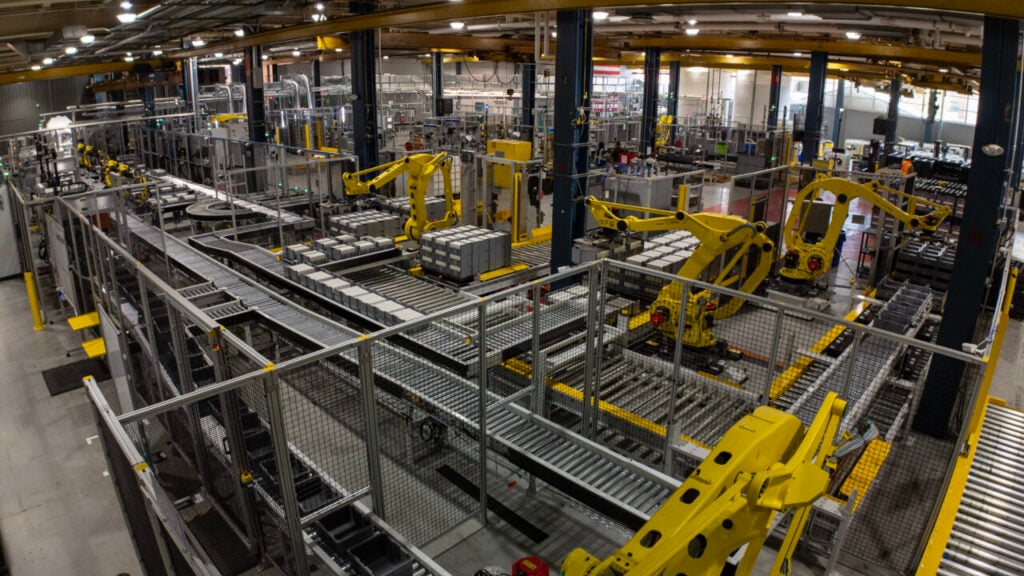
With its Q3 announcement, it highlighted expanding its manufacturing presence in Marshall Township, Pennsylvania, where it is establishing lines with an up to 8GWh annual capacity, and developing a software hub in Pittsburgh.
Eos revealed a planned US$352.9 million investment in new manufacturing lines and the relocation of its headquarters from New Jersey to Pennsylvania a few weeks earlier. Additionally, the company announced it would receive approximately US$22 million in financial support from the Pennsylvania state government.
The company previously expressed doubt about its ability to continue operating, but in the Q4 2025 and full-year financials, it stated, “Given the Company’s current cash position and ongoing margin improvements, management has concluded that substantial doubt regarding the Company’s ability to continue as a going concern no longer exists.”
Joe Mastrangelo, Eos’ CEO, maintained that “2025 was a structural turning point for Eos. We accelerated production, expanded annual capacity to 2GWh, delivered record quarterly revenue, strengthened our cash position to over US$600 million, and secured more than US$240 million in fourth quarter bookings across diversified markets.”
Mastrangelo continued, “While disappointed in not meeting revenue expectations, execution improved significantly as 2025 progressed, and we exited the year with clear operational momentum.”
For 2026, the CEO said Eos is focused “on disciplined scale and margin improvement — driving manufacturing efficiency, improving unit economics quarter-over-quarter, and converting our backlog into high-quality revenue. With a strengthened balance sheet and improving cost profile, we believe we are positioned to transition from accelerated growth to sustainable value creation.”
Eos projects revenue for the entire year of 2026 to range from US$300 million to US$400 million.
Energy Storage Summit USA will be held from 24-25 March 2026, in Dallas, TX. It features keynote speeches and panel discussions on topics like FEOC challenges, power demand forecasting, and managing the BESS supply chain. ESN Premium subscribers can get an exclusive discount on ticket prices. For complete information, visit the Energy Storage Summit USA website.