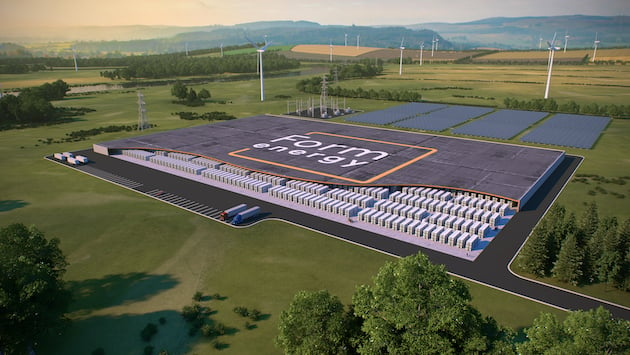
The US federal Department of Energy (DOE) will offer up to US$100 million for pilot-scale long-duration energy storage (LDES) projects utilising non-lithium technologies.
A Notice of Intent was issued by the DOE’s Office of Clean Energy Demonstrations (OCED) earlier this week (2 July), seeking energy storage demonstration projects with 10-hours or more maximum discharge duration at full rated power.
The OCED will potentially fund a minimum of three and a maximum of 15 projects with between US$5 million to US$20 million available per project. Under the cost-share rules, non-federal funding must comprise at least 50% of the required capital spending.
A competitive solicitation will be held, which the office expects to launch in late summer or early autumn. Applications must be from teams that include an LDES technology provider while involvement by utilities, facility owners and operators, developers, financiers and other key stakeholders will be encouraged.
Try Premium for just $1
- Full premium access for the first month at only $1
- Converts to an annual rate after 30 days unless cancelled
- Cancel anytime during the trial period
Premium Benefits
- Expert industry analysis and interviews
- Digital access to PV Tech Power journal
- Exclusive event discounts
Or get the full Premium subscription right away
Or continue reading this article for free
The Notice of Intent can be read on the OCED Funding Opportunity Exchange.
The funds are being made available through a total US$505 million DOE programme aimed at validating new energy storage technologies including non-lithium-based electrochemical, thermal and mechanical solutions and more effectively integrating energy storage into the energy sector for the benefit of customers and communities.
The DOE’s LDES portfolio work has been enabled by the Bipartisan Infrastructure Law passed early in President Joe Biden’s term in office, supporting and promoting US manufacturing and economic competitiveness in key strategic industries, including energy.
The 2021 law prefaced the passing in August 2022 of the Inflation Reduction Act (IRA) and where the latter aims to support clean energy technologies through tax credit incentives, the Bipartisan Infrastructure Law makes targeted decisions to support key projects, companies and consortia.
The pilot programme the new funding will come under advances “a diverse set” of LDES technologies towards commercial viability and initial demonstrations at utility-scale for earlier-stage technologies.
The DOE LDES portfolio is also hosting a demonstration programme for more advanced technologies to prove out their commercial viability and facilitate their commercial adoption. Another programme will put demonstration projects on government facilities in collaboration between the DOE and the Department of Defense.
Read more of Energy-Storage.news’ coverage of the LDES space.