Software-focused energy storage system integrator FlexGen’s bid to acquire assets from bankrupt rival Powin has been approved in court.
The US Bankruptcy Court for the District of New Jersey, which has presided over Powin’s Chapter 11 proceedings, approved FlexGen’s deal to buy “a substantial portion of Powin’s businesses,” FlexGen said yesterday (6 August).
With it, North Carolina-headquartered FlexGen acquires all of Powin’s IP, which includes hardware, software and information technology systems.
It has also bought Powin’s spare parts inventory, while Powin projects in the field will be hooked up to FlexGen’s Remote Operations Center (ROC) and the FlexGen energy management system (EMS) and controls software, HybridOS, will be made available to Powin customers.
Try Premium for just $1
- Full premium access for the first month at only $1
- Converts to an annual rate after 30 days unless cancelled
- Cancel anytime during the trial period
Premium Benefits
- Expert industry analysis and interviews
- Digital access to PV Tech Power journal
- Exclusive event discounts
Or get the full Premium subscription right away
Or continue reading this article for free
The news follows FlexGen being named as a stalking horse bidder in late June, making a US$27.5 million debtor-in-possession drawdown term loan available.
In May, Powin notified authorities in Oregon, where it is headquartered, that it could be in danger of laying off employees and ceasing operations within two months, a couple of weeks before leadership filed for Chapter 11 protection.
Although the company had delivered international projects in territories as diverse as Australia, Taiwan and the UK, Powin had cited industry headwinds impacting its US business as accelerating factors in its financial struggles.
Those headwinds included the ongoing US import tariff negotiations. Like most of its industry peers, Powin has relied on the supply of battery cells from China, from OEMs including CATL, EVE Energy and Gotion.
In a recent interview for ESN Premium, Drew Leibowitz, managing director of energy storage consulting firm Powerswitch, noted that Powin had been a pioneer of the battery energy storage system (BESS) industry, deploying its first projects as a developer and system integrator in the mid-2010s, before pivoting away from the development business.
Nobody was making integrated BESS solutions at that time, and Powin was among the first ranks of integrators buying in lithium-ion cells and packaging them into complete turnkey systems.
“They prided themselves on cells, as opposed to a lot of the firms that brought in racks and bigger components, and they prided themselves on their battery management system (BMS) being one of the key aspects,” Leibowitz said.
The biggest challenge for Powin came when the same battery OEMs that supplied its cells became manufacturers of turnkey systems, Leibowitz said.
For instance, FlexGen has a multi-year 10GWh deal with CATL for the Chinese manufacturer’s EnerC BESS units, which feature CATL’s own lithium iron phosphate (LFP) cells.
Hitachi Energy wants Powin’s 20% stake in PCS maker EKS
FlexGen’s purchase went through via an auction held at the end of July. Alongside FlexGen, logistics firm Mainfreight made a claim to buy up US$3 million-worth of credit bill collateral.
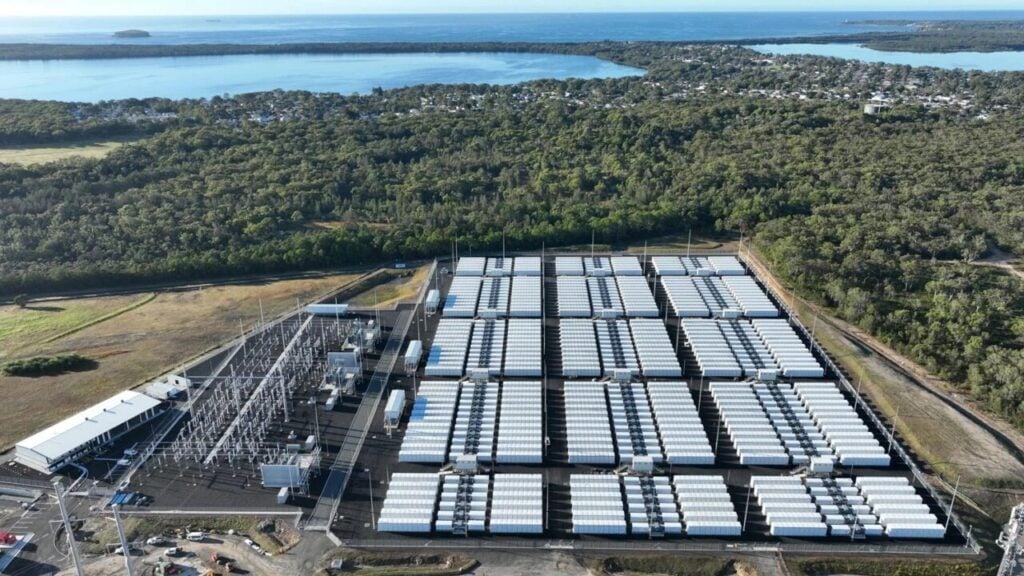
Through the auction, Hitachi Energy also bid to buy out Powin’s remaining 20% stake in EKS Energy, the Spanish power conversion system (PCS) manufacturer. Powin had acquired EKS in 2022 and worked with its technology on projects including the recently-inaugurated 850MW Waratah Super Battery in Australia for developer Akaysha Energy, before selling to Hitachi Energy a year later.
After courts ruled that the debtors could sell the remaining 20% to raise money through the bankruptcy process, Hitachi Energy was the only bidder, with that deal now subject to a sale hearing. Hitachi Energy would pay a fixed price of US$15 million, according to a term sheet.
The full notice of winning bidders, including the list of Powin IP and inventory FlexGen will now take ownership of, is available to view online (PDF).
“With this acquisition, we will continue to deliver the reliability and intelligence the grid, data centres and communities need to thrive in a world of growing energy needs,” FlexGen CEO Kelcy Pegler said.
“FlexGen’s proven financial strength means we’re a capital-light software and services partner that will remain in business to deliver on our customer promises,” FlexGen CFO Gary Cristini said.
“We thank Powin for their early-mover role in shaping the dynamic and important grid-scale battery market and honour our commitment to carry on that legacy and deliver exceptional uptime, reliability and customer success.”
Energy-Storage.news has reached out to FlexGen to discuss the deal in more detail.