
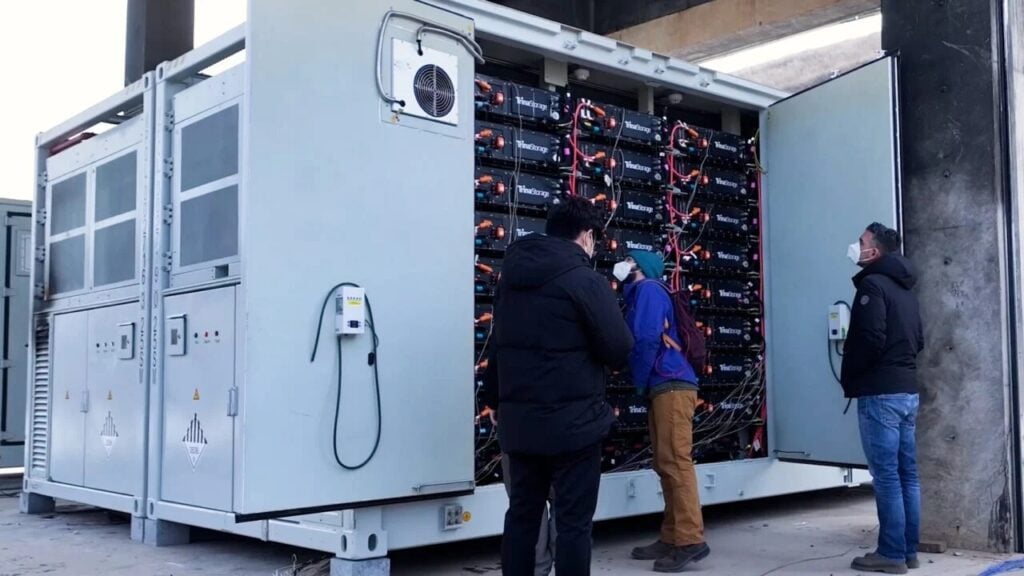
ESN Premium discusses the sixth edition of the key industry safety standard, UL9540A, with Dana Parmenter, commercial VP of industrial at standards organisation and Nationally Recognized Testing Laboratory (NRTL) CSA Group.
There are currently at least 150 local governments across the US that have stopped energy storage project developments, according to consultancy Carina Energy, a renewable energy services provider which has been tracking them.
While there is some nuance to the implementation of these moratoriums on battery storage—some appear to be blanket halts to all activity over set periods, others are temporary while local authorities having jurisdiction (AHJs) learn more about the technology—most, if not all, have in common the fact that the chief concern named is around fire safety.
The onus is on the industry, including manufacturers, system integrators, and developers, to ensure the highest levels of safety and maintain open lines of communication on standards and best practices with the communities that will ultimately host their assets.
Try Premium for just $1
- Full premium access for the first month at only $1
- Converts to an annual rate after 30 days unless cancelled
- Cancel anytime during the trial period
Premium Benefits
- Expert industry analysis and interviews
- Digital access to PV Tech Power journal
- Exclusive event discounts
Or get the full Premium subscription right away
Or continue reading this article for free
Within that framework, perhaps the two standards and codes that play the biggest role in the US (and increasingly elsewhere in the world) are UL9540A and NFPA 855.
Shift from cell and module propagation to full system-level testing
The US National Fire Protection Association’s NFPA 855, Dana Parmenter explains, is the fire code that developers must strictly adhere to. UL9540A, on the other hand, is the standard that forms “the basis for safety.”
However, prior to the new, sixth edition of UL9540A, which Parmenter said on its release a few weeks ago “establishes a new precedent in the industry,” some industry sources had commented over the past few years that the test, which assessed what happens when thermal runaway occurs in a battery cell or module, had limitations in defining how safe a system is.
Under previous iterations of UL9540A, a cell would be forced into thermal runaway, and the likelihood of a resultant fire propagating to other cells or modules would be assessed. While there is no pass/fail criteria for UL9540A as such, manufacturers typically freely shared their data. This is fed into evaluations by stakeholders, including developers, investors, and AHJs.
“The most significant change in the sixth edition is the formal incorporation of large-scale fire testing (LSFT) at the system level,” Parmenter says.
LSFT, as regular readers will know, sees a complete BESS unit set on fire with all detection and suppression equipment disabled. Again, the behaviour of the unit and the possibility of propagation to other units, other equipment, or buildings nearby is assessed. The new 2026 edition of NFPA 855 makes LSFT mandatory.
“The previous editions [of UL9540A] focused primarily on cell, module and unit-level behaviour, but the sixth edition now explicitly requires testing that demonstrates whether a fire will propagate between energy storage system units, and that really matches the broader trend you see in the industry and the code in NFPA 855 towards real-world installation scenarios. This is starting to account for things like spacing and fire spread, specific enclosure behaviour.”
While that focus on cells and modules remains important, the test was “really leaving a lot of uncertainty from a safety standpoint,” around how a system would fare in a “fully engulfed situation,” Parmenter says.
Going beyond cell-to-cell or module-to-module propagation testing comes from a growing recognition that not all fire risks to BESS are posed by thermal runaway caused by defects or damage within the cell.
For example, two BESS fires that occurred in New York in 2023, which led the state to become the current leader in local government BESS moratoriums, were caused by water ingress through improperly sealed enclosures. In other words, a manufacturing defect unrelated to the cells or modules.
Standards, therefore, need to constantly evolve. Parmenter says it’s important to note that some of the previous incidences of BESS failure and fire would be unlikely to happen if legacy systems met today’s standards.
It also means that once a product is certified to meet those standards, the manufacturer has to produce all units the same way, without modifications.
“You’re not allowed to update it or switch out a component. That is a controlled document and a certified system, so any changes to that known, tested design would require retesting to prove that it’s safe,” Parmenter says.
While this makes it more complex to customise units, even a seemingly innocuous and simple change, without evaluation, could introduce risks that compromise safety.
“So, by complying, by being certified, by being inspected and monitored, there’s a greater assurance that these products are actually being produced and installed the way they were designed and identified to be the safest.”
Pass/fail criteria
One other aspect of UL9540A that has changed is the inclusion of pass/fail criteria in the new edition. Previously, testing would be carried out to assess the likelihood of a thermal runaway event propagating, but while the data produced might be clear enough to indicate whether the thermal event cascaded into a full-blown fire, there was no pass-or-fail.
At Energy-Storage.news, we’ve seen occasional examples of companies claiming their products had ‘passed’ UL9540A with flying colours. While they may have been justified in proclaiming the test showed no propagation, those companies likely got a stern rebuke from UL for their wording.
“This is something we can credit that maybe UL9540A has [now] fixed,” Parmenter says.
“From a technical point of view, there was propagation criteria in there, and they (manufacturers) can demonstrate that they exceed the expectation for propagation, so these units can be within certain distances.”
That could make results a little difficult to interpret, he says, but the incorporation of pass/fail criteria that prohibit units in which propagation is observed into the UL9540A safety standard is encouraging.
Codes and standards together create more complete safety ecosystem
That is not to say the industry has not already been conducting full system-level testing, including LSFT. Industry best practices are typically ahead of the standards and code development processes, which eventually adopt them.
For example, CSA:ANSI 800, a standard developed by CSA Group for testing and evaluating BESS performance, includes LSFT protocols in line with NFPA 855 2026, along with data collection on other safety aspects, such as heat release and gas dissipation.
Fire protection engineers (FPEs) can then use that data to produce studies showing an installation is safe.
Before it became an American National Standards Institute (ANSI) accredited standard (for the US and Canada), CSA TS-800:24, as it was then known, was a technical performance specification.
“CSA TS-800:24 was actually the test criteria that was building up to the ultimate standard, which became the CSA:ANSI 800 as it is now. How this manifested itself before the standard and before the test specification is that AHJs were saying, ‘Gosh, we’re not really sure how we feel about this installation. How do I know it’s safe to install at this site? What happens if it propagates? Is this neighbourhood at risk?’
“AHJs really started asking for more information. To answer those questions, an immense amount of data is needed, and that’s what started early on, leading to the full burn test, because you have to do it to actually gather the data to model it.”
This had led to different AHJs, US states and even cities creating their own requirements or interpretations of testing and data, in the absence of a common standard.
CSA:ANSI 800 was developed, Dana Parmenter says, “to establish that understanding, to gather data that an FPE could use to do the appropriate modelling to satisfy AHJ questions about site installations.”
“Otherwise, you’re having to have an FPE or an AHJ interpret loads of different tests of all different types with all different measures, and there’s no way to really get consistency and understanding how they differ from each other.” As it is, the industry’s safety ecosystem now consists of NFPA 855 helping set the rules, UL9540A proving the system is safe from propagation and CSA:ANSI 800 is helping engineers design safe installations, which provides, he says, “the whole picture”.
‘We want safe products’
More rigorous testing and data collection increase costs and complexity for manufacturers and developers, but clearly, they have skin in the game to ensure it happens.
While Dana Parmenter says he does not want to comment on specific legislation being proposed by states, or the moratoriums being put in place around the country, he notes that although fire incidents do draw negative attention to battery storage, they are becoming increasingly rare even as the US installed base grows rapidly.
“What we see pretty consistently is that a lot of the decisions being made are obviously, especially in a political or a legal realm, looking out for their constituents and for safety, and ultimately, that’s what we’re doing as well. Our goal is we want safe installations. We want safe products. We want no risk to property or people, and importantly, first responders.”
You can learn more about LSFT in the Energy-Storage.news webinar sponsored by CSA Group, ‘Evolving large-scale fire testing requirements for battery energy storage systems,’ from November 2024.