SSE Renewables, Matrix Renewables, Drax and Voltaria have all progressed large-scale BESS projects in the UK, all-in-all totalling 1.8GWh of new capacity.
SSE Renewables commissions 150MW/300MWh Ferrybridge BESS in West Yorkshire
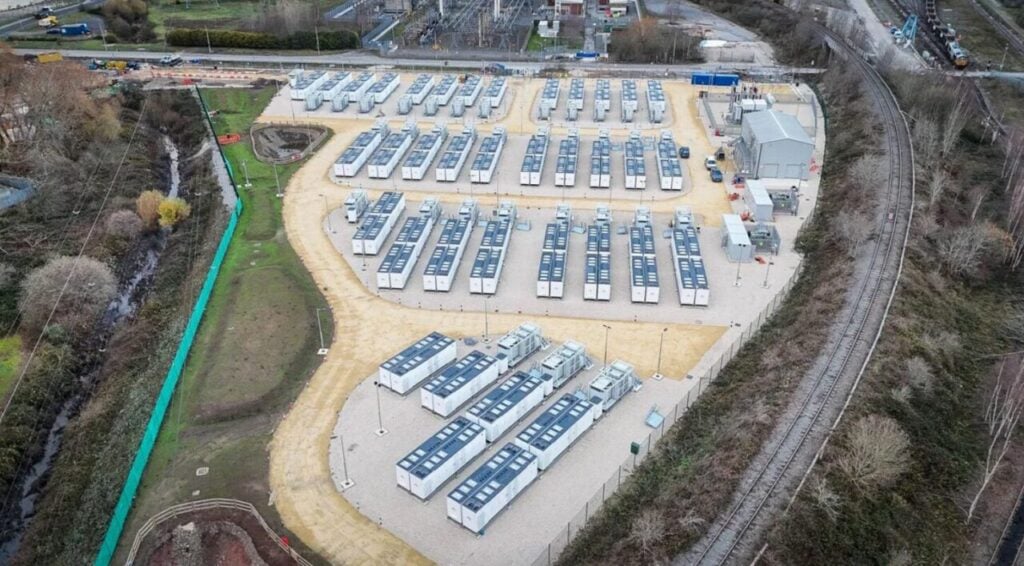
Developer SSE Renewables has reached commercial operations at the 150MW/300MWh Ferrybridge Battery Energy Storage System (BESS) project in West Yorkshire, northern England.
The project was built on the site of the former 2GW Ferrybridge coal-fired power station, which was decommissioned in 2016.
The newly commissioned BESS project is designed to store electricity and release it back to the grid when demand is highest, according to SSE. The company added that by adding rapid-response energy storage, the project will help balance supply and demand as well as support the efficiency and reliable operation of the UK’s grid.
Try Premium for just $1
- Full premium access for the first month at only $1
- Converts to an annual rate after 30 days unless cancelled
- Cancel anytime during the trial period
Premium Benefits
- Expert industry analysis and interviews
- Digital access to PV Tech Power journal
- Exclusive event discounts
Or get the full Premium subscription right away
Or continue reading this article for free
Construction of the Ferrybridge project began in August 2023 and saw the installation of 136 battery units supplied by Chinese manufacturer Sungrow. Both companies will also partner on another BESS project in Yorkshire, with Sungrow providing 320MW/640MWh of its PowerTitan liquid-cooled BESS units to the Monk Fryston project.
See the full original version of this article on Solar Power Portal here.
Matrix Renewables taps EDF for optimisation of 1GWh Scotland BESS
IPP Matrix Renewables has partnered with power firm EDF for the optimisation of its 500MW/1,000MWh Eccles BESS in Scotland.
EDF will provide route-to-market (RTM) services and optimisation for the battery energy storage system (BESS) project once it becomes operational.
It is scheduled to begin commercial operations in summer 2027, and will be Madrid-headquartered Matrix’ first standalone BESS in the UK.
Matrix acquired Eccles and another identically-sized Scotland BESS, called Kilmarnock, in April 2025. It then appointed Tesla as BESS and engineering, procurement and construction (EPC) provider for the Eccles project in December.
Matrix said it is located along key transmission corridors between Scotland and England. While GB has only one national electricity price, helping to solve regional imbalances is remunerated via the balancing mechanism (BM). And the biggest regional imbalance of all on the grid is the bounty of wind power in Scotland but most demand being in England, and insufficient transmission infrastructure to transport it south.
See the full original version of this article on Solar Power Portal here.
Drax orders 420MWh of BESS from Canadian Solar’s E-Storage
Solar PV firm Canadian Solar’s energy storage solutions subsidiary, E-Storage, will deliver 420MWh AC of BESS across two projects for Drax Group. The projects will join the renewables company’s FlexGen portfolio.
The two installations include a 60MW/120MWh installation in Marfleet, England, and a 150MW/300MWh installation in Neilston, Scotland. The installations are expected to begin in Q3 of 2026 and early 2027, respectively.
Lee Dawes, chief operations officer of Drax Group, said: “This is our first investment in short-duration storage, and these assets will complement our existing generation portfolio.”
See the full original version of this article on Solar Power Portal here.
Voltaria enlists Rolls-Royce as EPC for 43MW/86MWh Scotland project
System integrator Rolls-Royce has started construction activities as part of an engineering, procurement, and construction (EPC) contract from BESS owner-operator Voltaria Helios Energy Storage for a project in Falkirk, Scotland.
It is the first large BESS by Rolls-Royce in the UK and the firm will provide its mtu EnergyPack solution with a capacity of 43MW/86MWh. The project will connect to the grid in 2026 and come online in 2027, and Rolls-Royce will also maintain the system for 15 years.
Rolls-Royce is a power solutions firm, separate to the well-known luxury car brand, which is owned by the BMW group.