
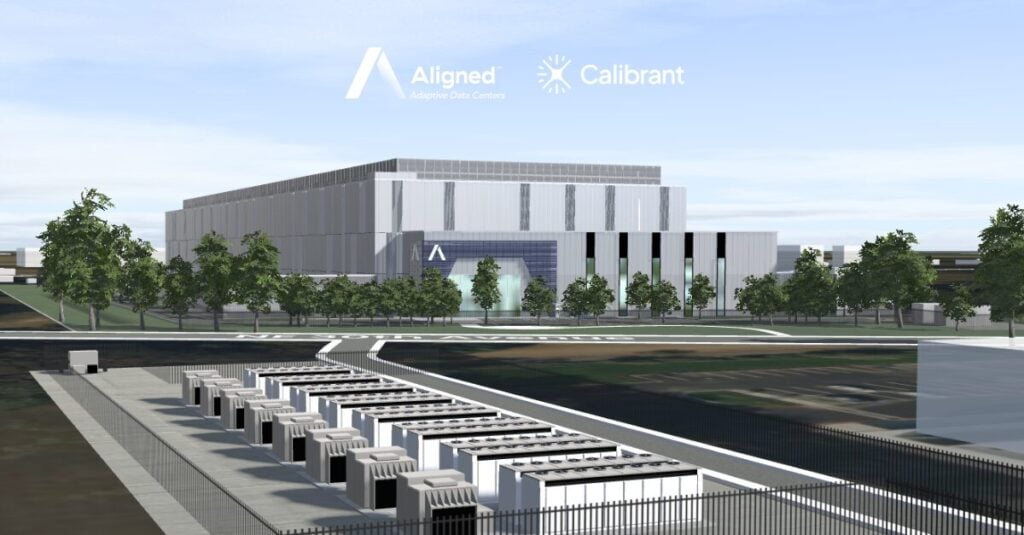
Calibrant’s BESS for a new data centre in Oregon, US, was hailed as the first of its kind, but what are the details beyond the headline? We caught up with Calibrant’s CCO to discuss the practical, commercial and technical specifics of the project.
Calibrant Energy will deploy a 31MW/62MWh battery energy storage system (BESS) at Aligned Data Centers’ campus in the Hillsboro, Oregon, US, it announced in October. Aligned said it will be the first BESS that is purpose-built to accelerate interconnection and bring a large-scale data centre online.
A peak power constraint
Unpacking this in conversation with ESN Premium, Calibrant CCO Matt Barnes explained that in this case, the constraint that the BESS will alleviate is less about physical wires and transmission lines and more about the 72MW-demand data centre’s possible impact on the overall grid.
“The data centre is already built but was waiting on utility power that was potentially years out. The BESS enables [utility] PGE to serve the customer in a more accelerated time frame, because the delays were about the data centres’ load during peak hours. The BESS will essentially make the data centre a more flexible form of load,” Barnes said.
Try Premium for just $1
- Full premium access for the first month at only $1
- Converts to an annual rate after 30 days unless cancelled
- Cancel anytime during the trial period
Premium Benefits
- Expert industry analysis and interviews
- Digital access to PV Tech Power journal
- Exclusive event discounts
Or get the full Premium subscription right away
Or continue reading this article for free
“The site got its initial power earlier this year, and now the BESS will be built and enable it to ramp up to full power. That ramp-up period is fairly normal for data centres anyway.”
PGE to dispatch it, with ‘no additional costs for ratepayers’
The specific mechanism by which it will do this for utility PGE (Portland General Electric) is through the PGE’s Dispatchable Standby Generation (DSG) programme, whereby PGE can call upon resources during critical grid periods.
In those instances PGE effectively becomes the dispatcher, Barnes said, utilising DSG assets’ controllable flexibility to maintain reliable service without causing additional stress on the grid.
In a case study paper, Calibrant said it was helping Aligned turn its data centre ‘from a potential grid liability into a dynamic grid asset’.
Barnes said that it’s also important to emphasise that ratepayers are not paying anything for the project, as the cost is entirely being borne by Aligned and Calibrant together. Calibrant is building and operating it while Aligned will fund it.
“It will actually reduce net overall cost by spreading the fixed costs of the grid over more hours in the year, it’s one of the first projects done in this way,” Barnes said.
He added that the use cases will evolve over time, indicating that the BESS will do more than just peak demand management for PGE.
Technology and configuration
The BESS is going to be located on the same site as the data centre but actually ended up front-of-meter (FTM), rather than behind-the-meter (BTM) as might be assumed to be the case when a BESS is deployed alongside a large industrial load centre.
“Whether it would be BTM or FTM flipped a few times during the planned. We prioritised speed over perfection, and in this case FTM made more sense. The difference between the two is only 6-10 feet of distance,” Barnes said.
“In many cases it is faster to interconnect BTM, because of the longer utility studies required for FTM. A BTM project is not exporting to the grid, so the only scenarios to be modelled are ‘load’ and ‘not load’. But in this case, PGE said it could complete the studies for an FTM project just as fast, and an FTM project enabled a slightly simpler set of engineering to be done too.”
In terms of the technology itself, the BESS will be provided by Tesla alongside locally-made Tier 1 transformers, ensuring compliance with domestic content aspects of the investment tax credits (ITC) for energy storage.
“The critical piece for this project was to move quickly, so it was important for it to be domestic and to have that supply chain certainty baked in,” Barnes said.
Barnes also pointed to the maturation of BESS as a reason why this is happening now. “Five years ago data centres wouldn’t have let you put large-scale BESS on their facilities, it’s now accepted as a mature enough technology.”
New solutions needed for era of ‘incredible load growth’
In a recent webinar hosted by Aligned, title A path to faster data center deployment, Barnes and executives from Aligned and PGE discussed at length how the key to the project was close collaboration between the three organisations and an openness to trying new solutions.
“Nothing like this had been done before, so the way we worked through that was by having partners that were willing to work together through uncertainty, with a shared goal, and together making phased commitments that didn’t require 100% signed documents. That was critical,” Barnes told us.
“As we see this moment of incredible load growth, it necessitates solutions that are a bit different from what’s been done before, there is not enough time to do it without new solutions that stretch the bounds.”
Barnes also pointed to a letter from Secretary of Energy Chris Wright directed to the Federal Energy Regulatory Commission (FERC) just a few days after the project announcement, instructing the regulator to take steps to ‘rapidly accelerate the interconnection of large loads, including data centers’.
The seventh point in Wright’s letter stated that ‘…the interconnection study of large loads that agree to be curtailable and hybrid facilities that agree to be curtailable and dispatchable should be expedited‘.
“Not all agree with this principle,” Barnes said. “But it is a great one to put out into the public discourse. Pair that with our project, and you see clear tailwinds for a solution like this project.”
The Energy Storage Summit USA will be held from 24-25 March 2026, in Dallas, TX. It features keynote speeches and panel discussions on topics like FEOC challenges, power demand forecasting, and managing the BESS supply chain. For complete information, visit the Energy Storage Summit USA website.