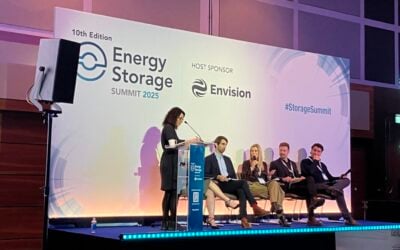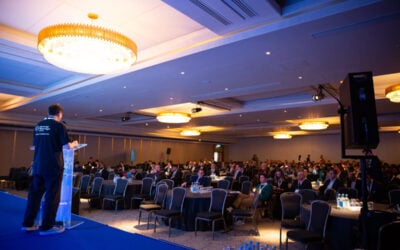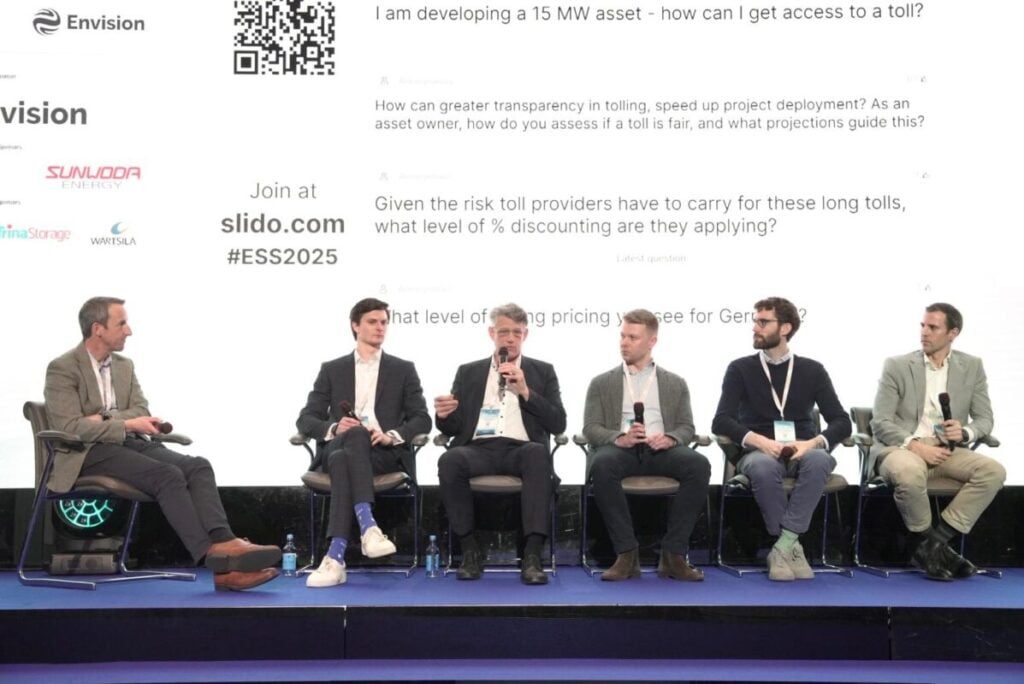
“To toll or not to toll seems to be the question. Rather the question you should be asking is with whom and how much,” a panellist at the Energy Storage Summit EU in London said today (19 February).
Mikko Preuss, VP strategy and commercial at German battery energy storage system (BESS) operator and VPP aggregator terralayr was speaking alongside other storage investors, operators and optimisers on the ‘Hedging Projects Through Tolls: A Glimpse into the Future?’ session on Day Two of the event.
A toll is an agreement between an energy storage project owner and an offtaker, where the offtaker pays the owner a fee to ‘rent’ the project and in return can control and monetise it in the electricity market. Adam Carver, senior manager commercial and origination at BESS owner-operator Eku Energy explained why they exist.
“One of the biggest cost of projects is the cost of capital. Having the element of a toll or a swap on part of a project or portfolio minimises that cost of capital. Different structures can cater to different risk appetites,” Carver said. “It’s been more popular outside of the UK, and I expect that trend to continue.”
Try Premium for just $1
- Full premium access for the first month at only $1
- Converts to an annual rate after 30 days unless cancelled
- Cancel anytime during the trial period
Premium Benefits
- Expert industry analysis and interviews
- Digital access to PV Tech Power journal
- Exclusive event discounts
Or get the full Premium subscription right away
Or continue reading this article for free
“The profile of storage tolls can look like a typical infrastructure PPA, and that project finance is one of the cheapest types of capital around,” added Ben Potter, COO at ‘CO2 Battery’ firm and (more recently) owner-operator and toll ‘giver’ Energy Dome.
Preuss then pointed out that although tolling agreements reduce revenue risk for the owner, they bring other challenges: “De-risking revenues on the one hand might create more risk. Committing to an offtake brings up risk around outages and availability. It also brings in counterparty risk by bringing in such a long-term partner.”
Kieron Stopforth, head of flexibility for utility and renewables investor Octopus Energy, gave some insights into the topic gleaned from his experience taking on the biggest toll (and first of any real scale) seen in the UK BESS market last year with a large portfolio from Gresham House.
“The deals that work are when one party, the battery owner, is trying to reduce their cost of capital and on the other side, the leaser or toller of the asset has a broader strategic reason to do so,” he said.
“In times of high volatility our balancing costs go up, and that is also when battery revenues rise. The asset owner is getting more contracted revenues, and we are getting more exposure to volatility. The mix of those two things are incredibly complementary.”
Mikko added that tolling contracts are not ‘off the shelf’, and require a lot of legal work, though Stopforth said this is not always the case.
“Tolling can be a much more simple structure than revenue share. We got everything through heads of terms in six weeks with the Gresham House deal,” Stopforth.
“For example, it has no big selection process with 15 optimisers throwing their hat in the ring and you trying to guess which one is best etc. There is a role for tolling where, with the right set up, contractually it can be incredibly simple.”
In response to an audience question about how to assess whether a toll was fair and what kind of discounting to expect from the taker, Carver and Stopforth said it was a hard exercise and got harder the longer the tenor of the toll went.
“Expecting a toll to be priced at your p50 merchant revenue view is probably a bit unrealistic. That’s because the toll taker is taking risk, potentially over 10 or 15 years, so they have to take that into account,” Carver said.
Stopforth meanwhile added that the length was important: “It’s hard to land on the exact right price when looking ahead. The question is what kind of megawatts of batteries do we need. The tenor makes a big impact on how you need to think about risk.”
Octopus’ deal was only two years long. Shell and Penso Power entered a seven-year toll for a project later, and Energy-Storage.news has been told longer ones are expected in the market in future .
The session was moderated by Mark Futyan, who holds advisory and board positions at investor Equitix and developer Anesco, where he was formerly CEO.