Lessons will be learned from an overheating incident at a thermal energy storage demonstration unit to which fire crews were called, the company behind the technology has said.
Emergency services were sent out to the site of startup MGA Thermal’s 5MWh demonstration unit in the Hunter Valley region of New South Wales, Australia, on 6 October after a “dangerous heat build-up” was declared shortly after 5am local time.
While the state Fire and Rescue New South Wales (FRNSW) said in a media update that morning that it expected a “protracted incident” with a road closure in place and evacuations of surrounding facilities, at 4:02pm it said the heat build-up had been stabilised.
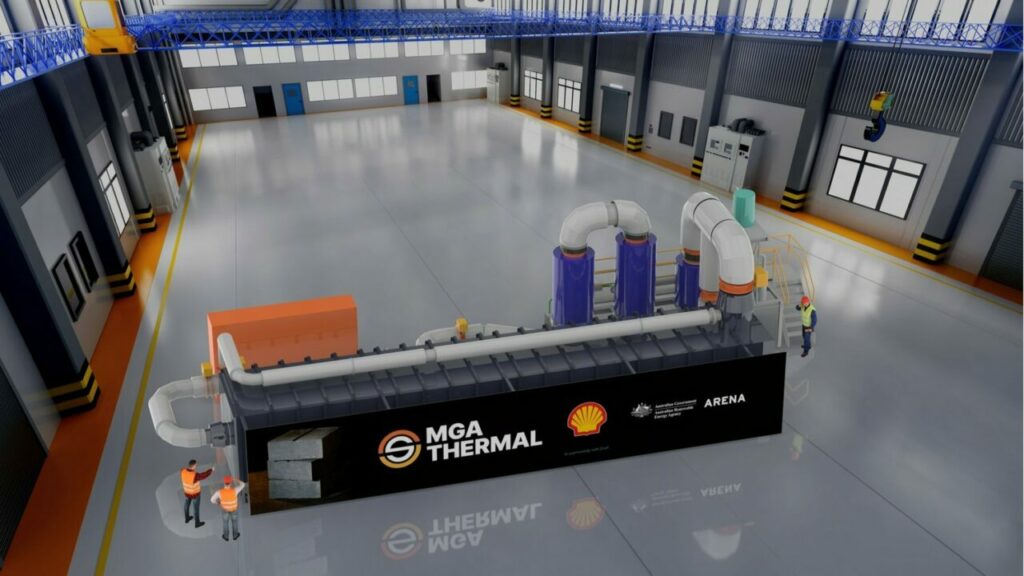
The demonstration plant is equipped with MGA Thermals’ brick-shaped ‘Thermal Blocks’ or ‘MGA Blocks’. These use a miscibility gap alloy (MGA) material from which the company takes its name. Metal alloy particles disperse through a matrix material, melting as the blocks are heated, while the matrix material remains solid and holds the particles in place.
Try Premium for just $1
- Full premium access for the first month at only $1
- Converts to an annual rate after 30 days unless cancelled
- Cancel anytime during the trial period
Premium Benefits
- Expert industry analysis and interviews
- Digital access to PV Tech Power journal
- Exclusive event discounts
Or get the full Premium subscription right away
Or continue reading this article for free
It stores energy as heat during this solid-to-liquid phase change, releasing the energy as the blocks cool and solidify once more. MGA Thermal claims this design can enable low cost storage of energy for heating or electricity.
One of its target markets is for the use of heat in industrial processes, a notoriously hard to decarbonise sector and one that a variety of other thermal energy storage providers are also addressing.
Its investors include Shell, and MGA Thermal recently closed a funding round having raised AU$8.5 million (around US$5.54 million at the time) as reported by Energy-Storage.news in August. It also secured AU$1.27 million for its megawatt-hour scale demonstrator from the Australian Renewable Energy Agency (ARENA).
Commissioning of its demonstration unit had begun at the beginning of October, designed to test the ability of MGA Thermal’s technology on an industrial scale, using a combination of the thermal blocks and thermal energy storage (TES) system technology to create storage and on-demand dispatching of renewable energy.
The demo unit has 0.5MW output to its 5MWh capacity, meaning it can handle applications requiring up to 10-hour storage durations.
The goal of the demonstration project is to test both potential and limitations of the technology as it goes to a much bigger scale than lab-based prototypes and it is important to note that no industrial processes were connected to it at the time of the incident.
“Our primary focus has been to ensure that the demonstration unit and everyone in the vicinity remains safe. No one was injured and no further property damage occurred,” MGA Thermal told Energy-Storage.news via a spokesperson following the incident.
“Everyone followed appropriate emergency procedures and we’re thankful for the quick and comprehensive support of emergency services to help contain and manage the overheating.”
While the unit was successfully cooled to well within normal operating conditions in the couple of days after the incident – during which time it is understood fire crews were on standby and observing – the operation of the unit has been temporarily suspended while company investigations take place.
“It is a reminder that we are working on cutting-edge technology, innovating new large-scale energy storage, and the importance of in-house trials,” the MGA Thermal spokesperson said.
“The learnings will help accelerate the development of our thermal energy storage (TES) system, and MGA Thermal remains committed to moving our company forward, with investor support in place. The market need for industrial decarbonisation solutions and long-term energy storage solutions for solar, wind and other renewable energy sources remains evident and significant. Our MGA technology is a crucial piece of that puzzle. We are continuing to work toward our vision of making 24/7 renewable energy a reality.”