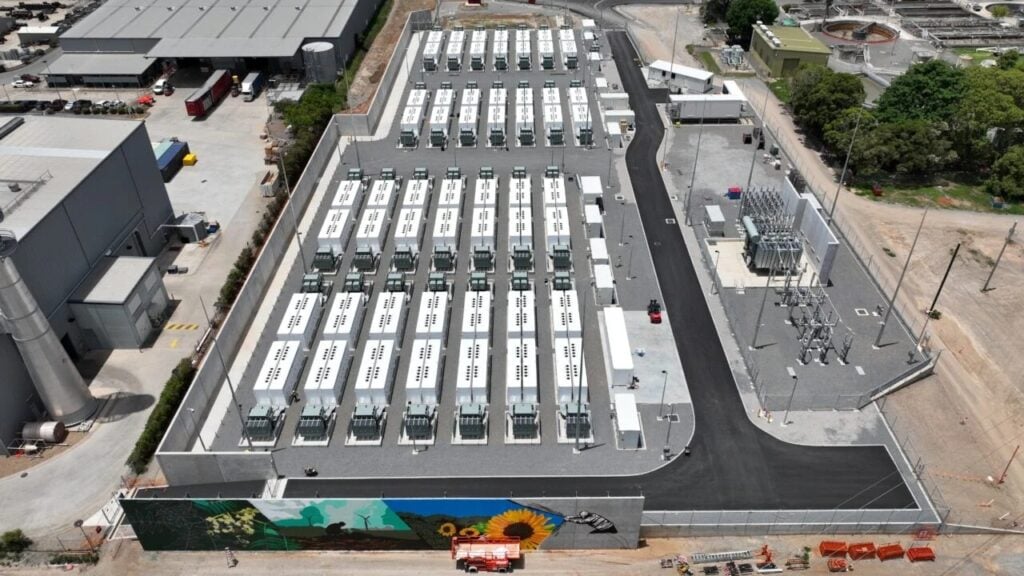
Tesla reported company-high energy storage deployments and revenue growth from its energy division in 2025, but expects “low-cost competition” and policy factors to affect margins this year.
A results release, earnings call, and SEC filing last week largely focused on Tesla’s shift in strategy towards greater focus on robotics and artificial intelligence (AI).
Releasing Q4 and full-year results for 2025, the company said 2025 marked a “critical year” for Tesla as it continues to transition from “a hardware-centric business to a physical AI company.”
Tesla reported a 3% year-over-year decline in annual revenue to US$94.8 billion, from US$97.7 billion in 2024, a 38% decline in income from operations from US$7 billion in 2024 to US$4.36 billion. There was also a 9% year-over-year decline in adjusted EBITDA, to US$14.6 billion from US$16.1 billion.
Try Premium for just $1
- Full premium access for the first month at only $1
- Converts to an annual rate after 30 days unless cancelled
- Cancel anytime during the trial period
Premium Benefits
- Expert industry analysis and interviews
- Digital access to PV Tech Power journal
- Exclusive event discounts
Or get the full Premium subscription right away
Or continue reading this article for free
The company produced and sold fewer vehicles last year than in the year before, contributing to a 10% decline in total automotive revenues.
Meanwhile, its operating expenses jumped 23% year-over-year amid increased focus on areas including AI, full self-driving (FSD), the autonomous Robotaxi and what CEO and self-styled ‘Technoking’ of Tesla, Elon Musk, said is a change in the company’s mission statement from accelerating the global sustainable energy transition to what Musk called “amazing abundance.”
“We’ve updated the Tesla mission to amazing abundance, and this is intended to send a message of optimism about the future. I think we’re most likely headed to an exciting, amazing era of abundance. And I think with the advent or with the continued growth of AI and robotics, I think we actually are headed to a future of universal high income, not universal basic income, but universal high income,” Musk said in his opening remarks on the investor call.
Musk then announced the company would discontinue the Model S and Model X EVs and dedicate factory space to the Optimus robot.
This year will be Capex-intensive, Musk said, with Tesla planning to invest in excess of US$20 billion in 2026. CFO Vaibhav Taneja claimed it could be funded by a combination of cash on hand and service revenue, including Robotaxi.
“We’ll be paying for six factories namely: the [lithium] refinery, LFP factories, Cybercab, Semi, a new Megafactory, the Optimus factory. On top of it, we’ll also be spending money for building our AI compute infrastructure, and we’ll continue investing in our existing factories to build more capacity. And then also the related infrastructure, along with it. And we’ll also further expand our fleet of Robotaxi and Optimus.
Megapack ASP decline slowed energy segment revenue growth
Alongside that, the US electric vehicle (EV) and energy equipment manufacturer reported 14.2GWh of energy storage deployments for the fourth quarter of last year and 46.7GWh during the full year.
CFO Taneja noted that its energy segment—which also includes solar PV equipment and energy generation but is heavily weighted towards energy storage—achieved quarterly gross profit records.
Energy generation and storage revenue stood at US$3.371 billion for the quarter, an 18% year-over-year increase from US$2.85 billion in Q4 2024.
It also earned close to US$12.8 billion in annual revenue from the segment, marking 26.6% year-over-year growth due to “higher deployments in all regions” and continued demand for both the residential Powerwall and utility-scale Megapack battery energy storage system (BESS) products, although again, that demand is weighted greatly in favour of Megapack and reflected in the company’s BESS manufacturing capacity and ramp up.
“Tesla’s proportion of energy generation and storage to total revenue in 2025 increased to 13%, compared to the 10% share in 2024,” Solar Media Market Research analyst Charlotte Gisbourne told Energy-Storage.news today.
“This is likely driven by the increased Megapack deliveries in addition to the fall in automotive revenue.”
Gisbourne also said that the declining average selling price (ASP) of Megapacks impacted the business division’s revenue, which grew only 27% even as deployments increased 29% year-over-year.
“This is also a marked decrease from the revenue growth the business segment experienced in 2024 of 67%. The segment did see gross margin improvement, however, rising up to 29.8%.”
However, for 2026, although the company expects increasing deployments off the back of the launch of Megapack 3 and the 20MWh Megablock solution, its backlog is apparently strong and its activities diversified across global regions, the CFO warned that margin compression is expected due to “increased low-cost competition, impacts to market from policy uncertainty and the cost of tariffs,” Taneja said.
LFP factory, ‘advanced’ lithium refinery in early ramp phase
As mentioned, the presentations and earnings call focused heavily on topics other than energy, with no analysts asking specific questions about the segment.
Musk did mention in his remarks that Tesla believes the potential of solar PV is underestimated and touted the idea of the company building a terawatt-scale solar production base. Devoid of the same kind of publicity afforded to its AI-driven activities, Tesla launched and began manufacturing a new “residential retrofit solar panel” last year.
It should be noted that Tesla’s solar deployments have largely declined in most quarters through the past decade since the company acquired US solar installer SolarCity in 2016, with Musk’s cousins Lyndon and Peter Rive, who ran SolarCity, exiting the business shortly after the acquisition.
Meanwhile, in the company’s 10K filed with the US Securities and Exchange Commission (SEC), Tesla noted that it will continue to increase production and capabilities of its BESS range, including ramps at Megapack ‘Megafactories’ in Shanghai, China, and Lathrop, California, and build a new Megafactory in Houston, Texas.
It will be crucial for the company to maintain adequate cell supply for its BESS lines, Tesla said. Whereas for automotive applications, the company makes its own cells and buys from Panasonic via the pair’s co-owned Gigafactory in Nevada, in the stationary storage sector it is dependent on imported cells from suppliers including Chinese manufacturer CATL.
In July last year, Tesla said it would start making lithium iron phosphate (LFP) cells in the US at the beginning of 2026, amid increasing demand for BESS products and new tax credit eligibility rules that strongly favour domestic content.
In its investor presentation, Tesla said its initial 7GWh annual production capacity for LFP from the Nevada Gigafactory is in its ‘early ramp’ phase.
Its new lithium refining facility in Texas, which aims for 30GWh annual production capacity, was also described as at its ‘early ramp’ phase. Musk claimed it is “the most advanced lithium refinery in the world,” using “an entirely new process that is fundamentally more efficient and more advanced than anything else in the world.”
The CEO said the same principle would apply to a new 10GW cathode factory in Texas. CFO Taneja noted that the energy division facilities would comprise a significant portion of the 2026 Capex spend.
“Cell manufacturing in the US has become a key talking point when it comes to the future of the energy storage market in the country,” Solar Media Market Research’s Charlotte Gisbourne told Energy-Storage.news.
Tesla is currently one of two energy storage suppliers rated AAA in the Battery StorageTech Bankability Ratings Report that the analyst’s team produces and updates quarterly. The other top-rated company is Sungrow.
In the ‘Risk Factors’ section of its Form 10K, Tesla noted that supplementing third-party cells with in-house supply over the long term would mitigate supply chain risks, enable higher volume manufacturing and reduce costs.
“However, our efforts to develop and manufacture such battery cells have required, and may continue to require, significant investments, and there can be no assurance that we will be able to achieve these targets in the timeframes that we have planned or at all,” the company said in its SEC filing.
Earnings call transcript by Seeking Alpha.