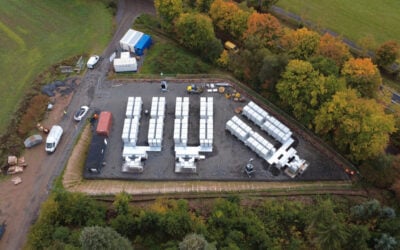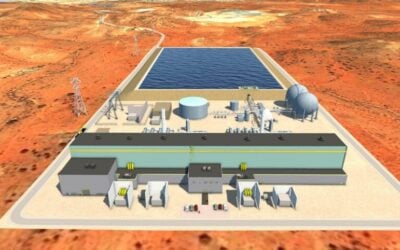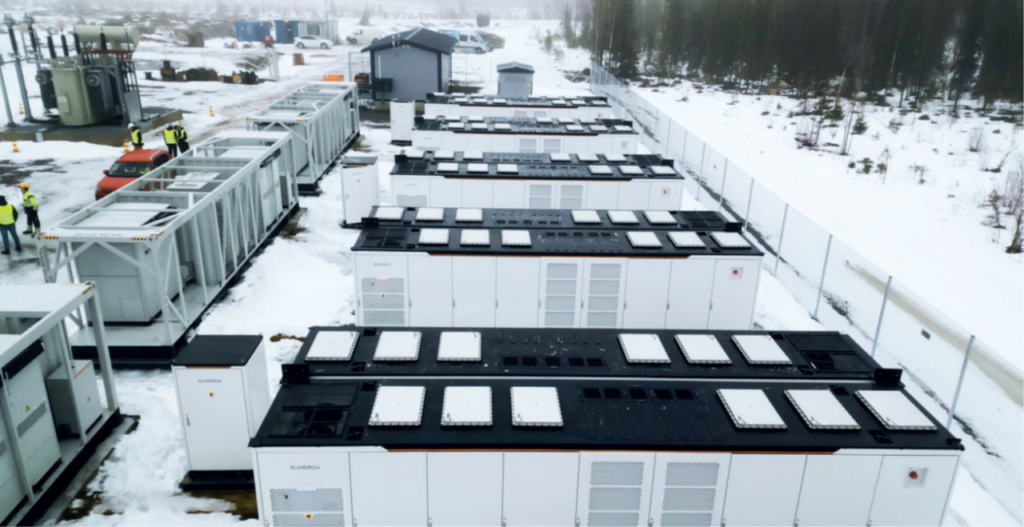
The energy storage arm of Chinese solar PV inverter manufacturer Sungrow has deployed a large-scale battery system at a site less than 100km from the Arctic Circle.
Sungrow announced the successful deployment of the lithium-ion (Li-ion) battery energy storage system (BESS) in Simo, Finland, around 785km north of the capital Helsinki.
A spokesperson for the company said the northern project operates in “one of the harshest climates on earth. “
The 30MW/60MWh (2-hour duration) system, featuring 26 units of Sungrow’s PowerTitan 1.0 lithium iron phosphate (LFP) BESS containers, is required to deliver high reliability and efficiency even under the region’s challenging extreme weather conditions.
Try Premium for just $1
- Full premium access for the first month at only $1
- Converts to an annual rate after 30 days unless cancelled
- Cancel anytime during the trial period
Premium Benefits
- Expert industry analysis and interviews
- Digital access to PV Tech Power journal
- Exclusive event discounts
Or get the full Premium subscription right away
Or continue reading this article for free
Construction began in May 2024, with the project connecting to a newly constructed substation operated by transmission system operator (TSO) Fingrid in nearby Simojoki.
The Simo project’s developer is a joint venture (JV) between Saudi-owned Fotowatio Renewable Ventures (FRV) and Finnish independent energy storage company Amptank. In announcing the JV’s strategic collaboration in November 2024, FRV said the project could later be expanded to 200MWh capacity.
The FRV Amptank JV is developing further projects of short and long-duration energy storage (LDES) at various locations.
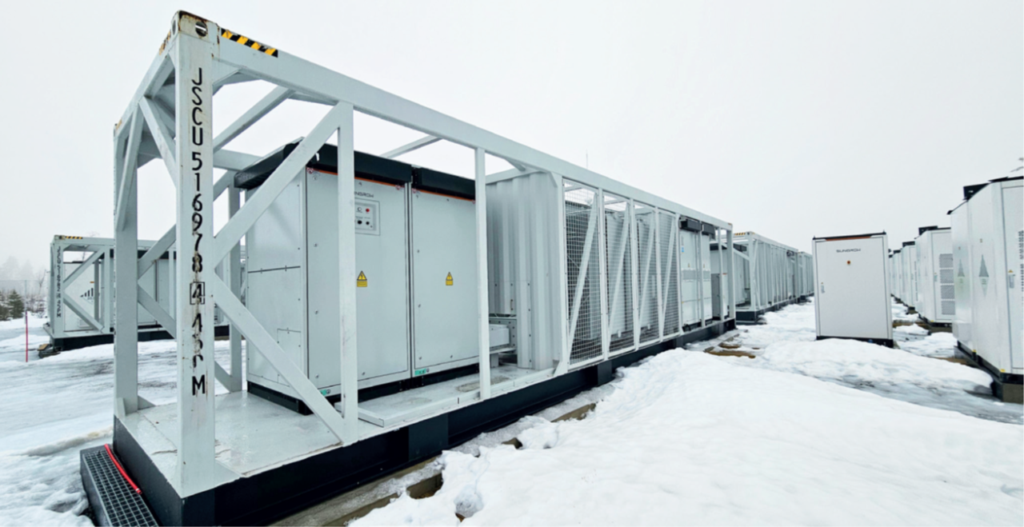
Sungrow’s liquid-cooled 20-foot PowerTitan BESS units are pre-assembled in shipping containers before delivery to project sites and are designed to require minimal maintenance over a long lifespan. This allows for speedy installation and back-to-back setup of containers without performance loss, the company claimed.
“There were two main reasons why we selected Sungrow. The first was technical reliability. Sungrow’s technology convinced us that it would perform reliably under all conditions,” Amptank chairman Hannu Koivusalo said.
“The second key factor was long-term reliability, specifically maintenance, servicing, and related support, where Sungrow offered us a very competitive package.”
Last October, Amptank sold a majority stake in a project of the same size and capacity even further north to UB Renewable Energy Fund (AIF), an arm of wealth management fund United Bankers.
As reported by Energy-Storage.news, that project, at Fingrid’s Kellarijanka substation in Kemijarvi about 220km north of Simo, is expected to go into operation before the end of this year.
Both will be among Finland’s larger BESS projects to date, with the country seeing a wave of activity linked to its participation in Nordic ancillary services markets for grid stabilisation.
In a 2023 interview with Energy-Storage.news, executives at power solutions firm Merus said the market in Finland is being further driven by rapid deployment of wind power and the limitations of the existing pumped hydro energy storage (PHES) fleet—traditionally the provider of ancillary services to the grid—to respond quickly to fluctuations in electricity supply and demand.
In November last year, Merus inaugurated a 30MW/36MWh project which was claimed as the country’s biggest to date, which has obviously been superseded by the FRV Amptank project.
However, bigger projects, including a 55MW/110MWh grid-forming project by investor NTR with BESS technology provider Fluence, and a 70MW/140MWh project by a consortium led by Swedish developer Ingrid Capacity are in construction or late stage development, among others.