
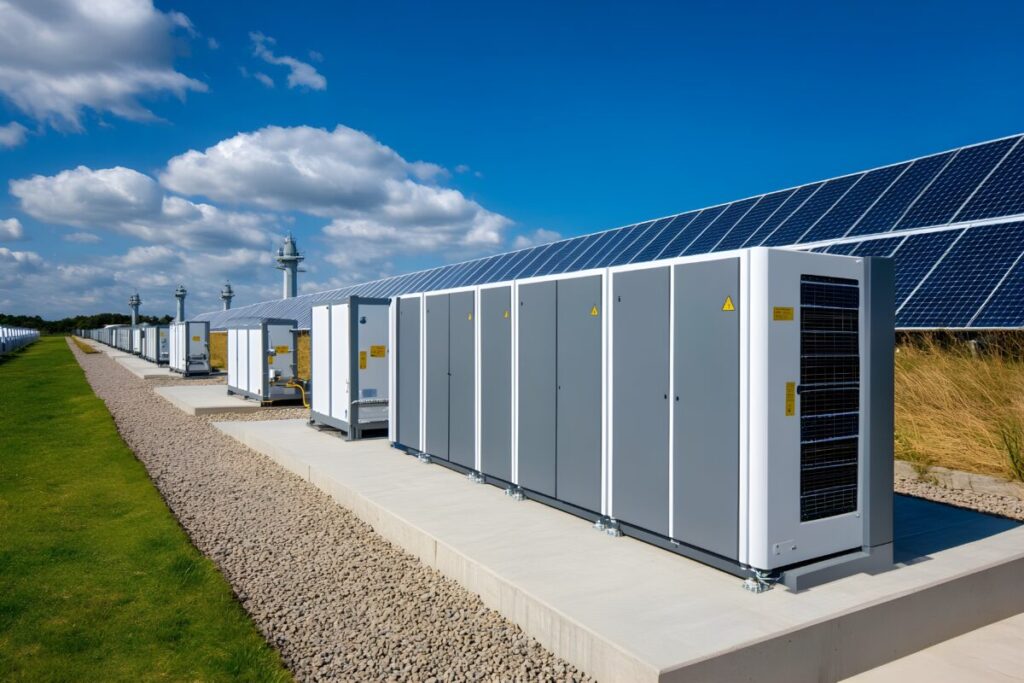
The early life of a battery storage asset sets the stage for a lifetime of operational success, writes Cedric Brehaut, Chief Product Officer at PowerUp.
Commercial operation date (COD) is a milestone worth celebrating. Construction is complete. The system is energised. Revenue models assume predictable dispatch and stable performance.
Yet for many battery energy storage systems (BESS), the first few months after COD tell a different story.
Frequent alarms. Recurring issues. Intermittent shutdowns. Unexplained underperformance. Availability that fluctuates week to week. Operators often describe this phase as one where each week brings a new issue to be understood and resolved.
Try Premium for just $1
- Full premium access for the first month at only $1
- Converts to an annual rate after 30 days unless cancelled
- Cancel anytime during the trial period
Premium Benefits
- Expert industry analysis and interviews
- Digital access to PV Tech Power journal
- Exclusive event discounts
Or get the full Premium subscription right away
Or continue reading this article for free
These problems are rarely catastrophic. But they create instability during the very period when confidence in performance should be highest.
This critical phase in the asset lifecycle deserves a name. Erin Kivlehan, SVP of Asset Management at Radian Generation, a leading renewable portfolio management services provider, refers to it as the BESS “stabilisation period.”
And the difference between expected steady-state performance at COD and actual early operational behaviour is what many operators experience as the stabilisation gap.
Why Stabilisation Is Structurally Difficult
Early instability is not simply bad luck. It is often the result of structural realities in how BESS assets are built and operated.
System complexity is significant. A modern BESS integrates cells, modules, racks, battery management system (BMS), energy management system (EMS), power conversion systems (PCS), HVAC, SCADA, and market dispatch. Electrochemical behaviour, firmware and control logic, and dispatch strategies interact in nonlinear ways once the system operates under real market conditions.
Manufacturing variability also plays a role. Reliability engineering studies that show failure rate versus time are typically plotted as a ‘bathtub curve,’ where deviations are more likely to occur in the early life of an asset than after that steady or stabilised state has been reached.
Independent factory audits provide context. In its 2024 BESS Quality Risks report, Clean Energy Associates (now Intertek CEA) found that 15% of inspected systems had thermal management defects and 6% failed capacity tests prior to shipment.
These findings do not imply systemic failure across the industry, but they underscore that integration variability is real. When exposed to full dispatch cycles and environmental stressors, it is not surprising that BESS systems experience early operational challenges.
Commissioning has inherent limits as well. Financial pressure to reach COD can compress timelines. Tests are conducted under defined scenarios and cannot replicate the full range of real-world dispatch patterns and seasonal conditions.
Commissioning also represents a handoff between organisations with different objectives. Developers and EPCs focus on reaching COD. Asset managers focus on long-term performance, yet they are rarely central decision-makers in commissioning processes.
Verify your system’s condition with PowerUp’s Independent Health Audit, which can be performed during commissioning to uncover and address ahead of COD handoffs.
Once in operation, complexity increases further. BMS, EMS, SCADA, APM platforms, and advanced analytics software all generate metrics and alerts. BMS threshold alarms identify clear safety limit violations. Advanced analytics surface hidden issues and emerging conditions. Yet operators are still left asking: ‘What is actually happening? Which signals matter? What action is proportionate?’
Paul Zavesoff, VP of Asset Management at GridStor, a leading grid-scale BESS developer and independent power producer, described it this way at the Battery Asset Management Summit in San Diego:

“In operations, nothing is ever perfectly clean. Surprises emerge from different layers of the system. The entire development-to-operations chain is about mitigating risk. The sooner you stabilise that risk, the sooner the asset becomes predictably profitable.”
Stabilising that risk requires more than visibility. It requires interpretation and disciplined follow-through.
The Missing Interpretation & Decision Layer
The stabilisation period reveals a structural gap that many operators are only beginning to formalise. While advanced analytics are essential to modern BESS operations, they are not yet universally deployed across fleets. Even where they are in place, their value depends on how effectively insights are interpreted and acted upon.
Successfully closing the stabilisation gap requires three capabilities working together:
- Advanced analytics to surface hidden issues and emerging conditions.
- Expertise to interpret insights on battery behaviour and make informed decisions under uncertainty.
- Structured follow-through until steady state is demonstrable.
Achieve stability faster through PowerUp’s Stabilization Acceleration Service.
Advanced analytics provide an essential foundation. Rooted in electrochemistry and data science, they identify issues that are difficult to detect with BMS and traditional tools, including cell and rack imbalances, abnormal voltage, resistance and temperature patterns, and emerging conditions that would otherwise remain invisible until they materially impact performance. Without this signal-to-insight layer, stabilisation remains reactive and underinformed.
But surfacing insights alone is insufficient. Stabilisation depends on interpreting insights, driving structured decisions and accountable actions, and confirming that corrective measures have truly resolved underlying conditions.
Many asset management teams face a structural constraint. Some still lack advanced battery analytics altogether. Others have deployed such analytics but lack sufficient electrochemical expertise or bandwidth to translate insights into decisions and action, especially during early operations when the volume of issues can be overwhelming. Few organisations have fully institutionalised this combined analytics-and-interpretation approach during early operations.
PowerUp structured its model around this reality, combining advanced battery analytics with packaged expert oversight to help asset owners move from signals to stable performance without building a full team of electrochemical experts internally. The approach is designed to augment existing asset management, performance engineering and O&M teams with specialised battery expertise and structured decision support, particularly during the stabilisation period when volatility is highest.
Across the industry, asset owners and operators increasingly see this combination of analytics and engineering expertise as essential. As Sander Jacobs, co-founder and Chief Commercial Officer at Renewance, explains:
“Advanced battery analytics platforms like PowerUp’s Battery Insight® enable our skilled field service technicians to operationalise the provided insights through early resolution of BESS issues and automatically optimised maintenance plans, ensuring maximum system uptime, so our clients can get the most value out of their industrial batteries — from commissioning through end-of-life.”
In this framing, stabilisation becomes a managed discipline that combines advanced analytics for visibility with expert interpretation and structured follow-through to deliver predictable performance.
Stabilisation Speed as a Competitive Advantage
As BESS assets and portfolios grow in scale and financial importance, stabilisation speed is emerging as a differentiator.
Reaching COD quickly remains important. But transitioning rapidly from early volatility to predictable performance may matter even more. Revenue certainty, warranty alignment, and operational efficiency all benefit from a disciplined stabilisation phase.
Early instability does not exist in isolation. In multi-site portfolios, volatility compounds across assets. Lessons captured during early stabilisation can improve outcomes fleet-wide and strengthen long-term reliability.
In mature infrastructure sectors, early-life performance has long been recognised as critical to lifetime outcomes. Energy storage is reaching that same inflection point. COD marks the start of commercial operation. Stabilisation marks the start of consistent operational performance.
For asset owners and operators, closing the stabilisation gap is no longer simply about resolving early issues. It is about protecting revenue, building confidence, and establishing the foundation for long-term performance in a rapidly scaling market.
PowerUp is your complete path to reliable battery performance and safety
About the Author
Cedric Brehaut is Chief Product Officer at PowerUp, a provider of advanced battery analytics for energy storage (BESS) and e-mobility. He brings more than 25 years of experience in software and 18 years in clean energy, building products and services that improve the performance and lifecycle value of solar and storage assets. Previously, Cedric served as VP of Product at Stem, where he led product across business lines, including Asset Performance Management (APM), Energy Management System (EMS), and market optimisation platforms. He helped build SunEdison’s asset management business and later led Product at Omnidian. Cedric also founded Solichamba and has advised software and technology vendors, developers, manufacturers, O&M providers, and investors across the renewable energy ecosystem. He authored widely-cited market reports with GTM Research (now Wood Mackenzie). Cedric holds an MS in Engineering from IMT Atlantique and an MBA from the University of Nantes.