
While the global energy storage industry still competes on capacity, price and homogenised hardware, Sigenergy, a China-based solar and storage firm with AI at its core, is redefining the industry’s next chapter with its new gigafactory.
On 13 March 2026, the Sigenergy Nantong Smart Energy Center was officially inaugurated. Covering 136,000 square metres with a RMB500 million (US$72.75 million) investment, it boasts a planned annual capacity of over 300,000 inverters and energy storage packs.
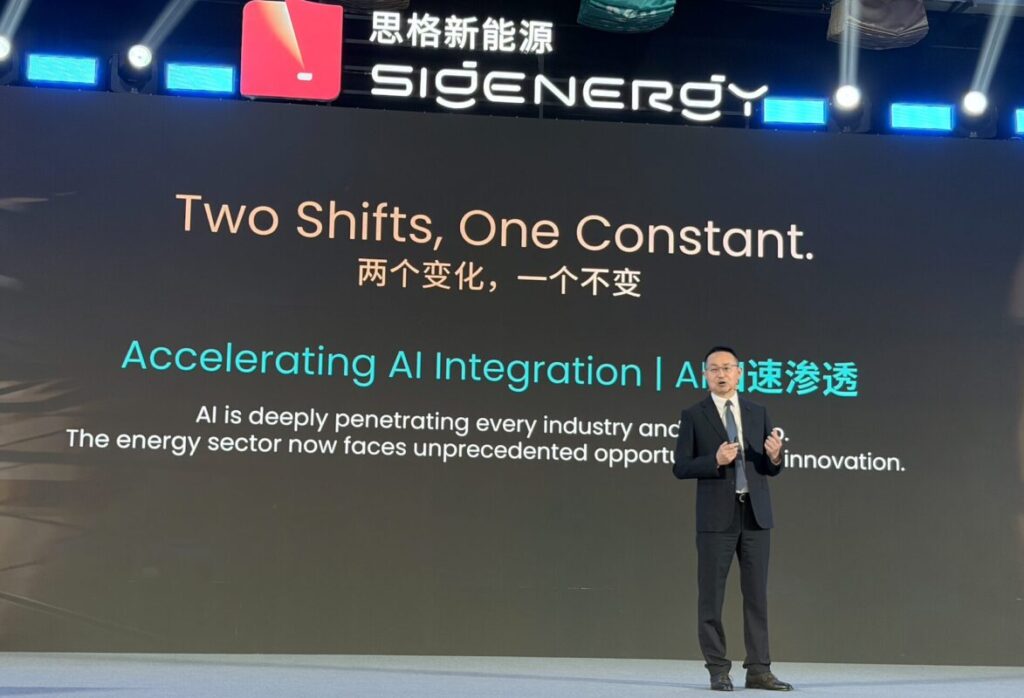
As the only industry player whose founder has an AI background, Sigenergy’s founder, CEO Tony Xu, noted at the opening ceremony: “In the new energy sector, we never follow trends or compete on scale. Instead, we embed AI into the core of energy systems, transforming them from merely ‘functional’ to ‘intelligent, collaborative, and evolving.'”
“This smart factory in Nantong is more than just an expansion of production capacity; it serves as the cornerstone for Sigenergy’s AI strategy to take root globally. It demonstrates our commitment to moving beyond low-cost internal competition and advancing into the global high-end market through high-end manufacturing and technological innovation.”
Try Premium for just $1
- Full premium access for the first month at only $1
- Converts to an annual rate after 30 days unless cancelled
- Cancel anytime during the trial period
Premium Benefits
- Expert industry analysis and interviews
- Digital access to PV Tech Power journal
- Exclusive event discounts
Or get the full Premium subscription right away
Or continue reading this article for free
‘AI in All’ and the Global Benchmark Gigafactory for Energy Storage
At the opening ceremony, Sigenergy launched its ‘AI in All’ strategy, integrating AI deeply into products, software, manufacturing and energy management to drive energy systems from “operable” to “thinking, collaborative and self-optimising.”
Interpreting this strategy, Tony Xu said: “For Sigenergy, AI is not an add-on but an underlying capability across product design, system operation, energy dispatch and user interaction. Our proposal of ‘AI in All’ is not about chasing technological trends. It responds to the renewable energy industry’s growing complexity—PV, energy storage and grid coordination involve multi-dimensional variables beyond traditional algorithms. Only AI can handle these complex scenarios, enabling intelligent, efficient and sustainable energy systems.”
Explaining the factory’s positioning, Tony Xu emphasised: “Traditional factories focus on ‘producing products’; the Nantong centre focuses on ‘building a smart manufacturing ecosystem.’ We integrate AI and automation into R&D, production, warehousing and delivery, achieving ‘faster speed, better quality and fewer errors’—the true value of future smart manufacturing.”
Through the command centre, managers can view global production data simultaneously. After production plans are issued, material outbound, equipment adjustment and process switching are fully automated, no manual intervention needed.
Supported by a full-link smart collaboration system, the Nantong centre achieves top industry efficiency: one energy storage pack comes off the production lines every 15 seconds and one inverter every 21 seconds.
“This efficiency is not just about speed; it is supported by AI, automation and logistics coordination,” Xu said.
“We never compromise quality for speed: a full-link quality management system covers incoming materials, production, testing, ageing, and shipment, achieving a 99.9% maximum first-pass yield, ensuring high efficiency and quality go hand in hand.”
Full-Scenario New Products Launched: Covering Residential, C&I, and Utility
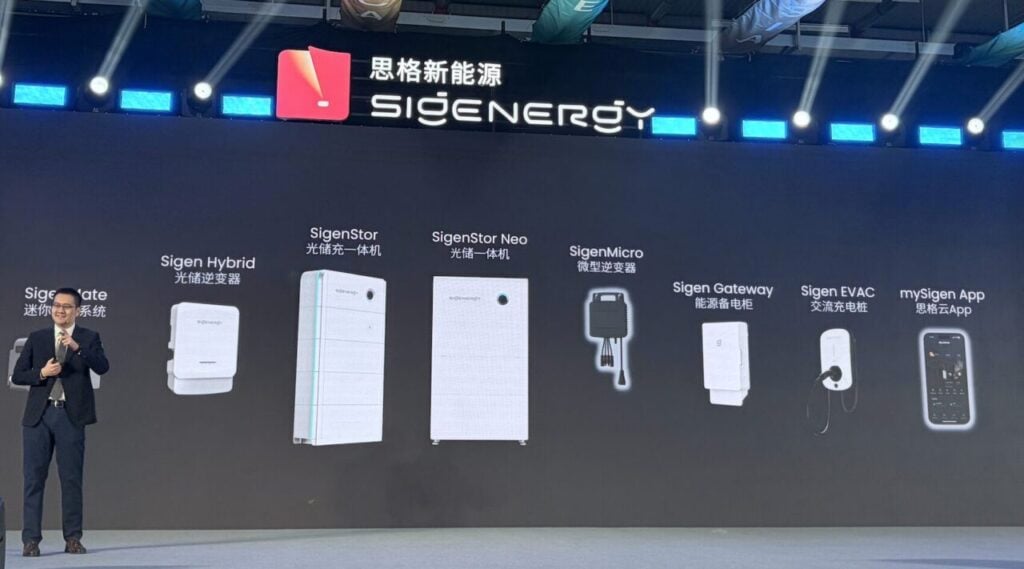
Backed by the Nantong centre’s smart manufacturing capabilities, Sigenergy launched new products covering residential, commercial & industrial (C&I) and utility scenarios, completing its portfolio from home energy systems to utility-scale large infrastructure.
“Our product innovation is driven by real market needs, not innovation for innovation’s sake,” Xu explained. “The global energy market is diversifying and becoming smarter: residential users want simple, smart experiences; C&I enterprises need stable supply; power plants need efficient, cost-saving solutions. Our new products address these core pain points.”
For residential use, Sigenergy launched the new SigenStor Neo home energy system. Building on its modular architecture and circular light-ring design, it integrates PV inverter, battery PCS, energy management system (EMS), gateway and battery pack, with enhanced integration and home scenario adaptability.
“Residential energy storage focuses on user experience,” Xu said. “Many users are overwhelmed by complex equipment. SigenStor Neo simplifies form through integration and uses AI to enable ‘learning capabilities’—it adapts to household electricity habits, optimises charging/discharging and cuts costs, acting as a personal energy assistant for simple, intelligent management.”
Tony Xu is highly optimistic about the C&I energy storage market, believing it holds enormous growth potential. Sigenergy will roll out scenario-specific modular solutions for industrial parks, commercial complexes and more.
Notably, for the utility segment, Sigenergy released a ground-mounted inverter with a maximum single-unit output of 500kW. It supports 1650V DC input and 1000V AC systems, features up to 18 MPPTs, and integrates advanced arc fault detection and intelligent O&M.
When analysing development trends in the large-scale power plant market, Tony Xu stated: “The global utility PV market is undergoing a crucial transformation. Pure PV projects are becoming increasingly scarce, while PV-storage integration has become the mainstream. For instance, in many European countries, pure PV curtailment rates reach 80% due to limited grid absorption. Energy storage systems must be paired to improve returns. Our inverter uses AI solar forecasting—combining equipment, plant and meteorological data for accurate predictions—to optimise dispatch and reduce O&M costs. We also enhance power density to lower system costs, boosting power plant returns and service life.”
On core innovation barriers, Tony Xu emphasised: “Many see our hardware but overlook our core advantage—cloud-native system architecture. From the company’s inception, we designed a system supporting five to 10 years of development, adopting an AI-leading architecture with computing power far exceeding traditional inverters. While increasing costs 5-10 times, it enables continuous AI-driven evolution and free long-term upgrades. Hardware can be imitated, but this cloud system and architecture are our true technical barriers. They are the key to our success in industry competition.”
Deep Global Cultivation: Sigenergy’s Presence in 80+ Countries Combines with High-End Market Breakthroughs
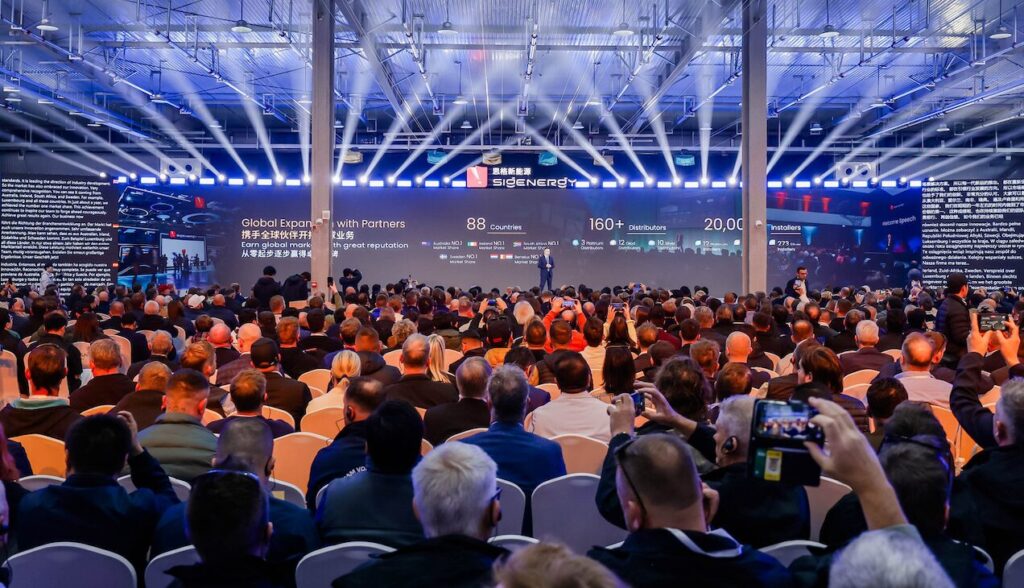
Nearly 2,000 partners and customers from over 50 countries attended the opening ceremony, including over 1,500 international clients—60-70% of whom were CEOs and/or founders, and over 90% of whom were visiting China for the first time—reflecting Sigenergy’s strong global business foundation.
Currently, Sigenergy operates in over 80 countries, with 100 core distributors and 20,000+ installer partners, and will further expand its global reach.
Addressing global industrial policy changes—such as Europe’s local manufacturing push and tightening US trade barriers—Xu outlined Sigenergy’s global strategy: “We adopt ‘core manufacturing in China + flexible overseas layout.’ China’s new energy industrial chain, cost advantages and technology are irreplaceable, so it remains our manufacturing hub—the Nantong centre embodies this core manufacturing capability.”
“We will closely monitor EU and US policy changes to maintain overseas manufacturing flexibility. Once policies stabilise, we can quickly launch production to ensure global compliance and supply chain resilience. US market scale is expected to grow several-fold this year. Leveraging Nantong’s capacity and overseas partner channels, we will further expand globally.”