
In this second part of our interview with Wood Mackenzie energy storage analysts, we look at risk factors and mitigation across the European and US markets.
In Tuesday’s first part of this interview with Allison Weiss, global energy storage lead and Anna Darmani, principal analyst EMEA, at Wood Mackenzie, we discussed the diminishing appetite for investment in merchant projects in both Europe and the US and the emerging contract structures that investors are increasingly preferring to see.
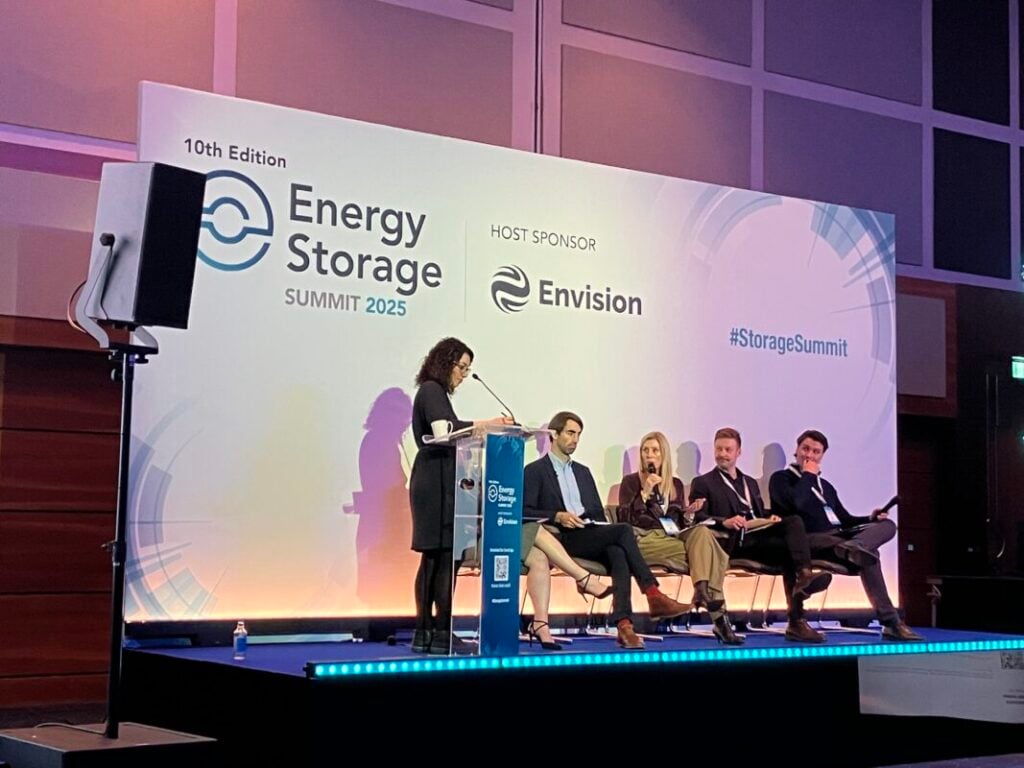
Speaking with ESN Premium at the Energy Storage Summit 2026 in London last week, our conversation continued with a deeper exploration of the policy and regulatory issues that continue to impact both markets.
The talk spans everything from Germany’s grid fee reforms, to interconnection queues, data centres as a driver of load growth, to the role of deployment targets in driving activity.
Try Premium for just $1
- Full premium access for the first month at only $1
- Converts to an annual rate after 30 days unless cancelled
- Cancel anytime during the trial period
Premium Benefits
- Expert industry analysis and interviews
- Digital access to PV Tech Power journal
- Exclusive event discounts
Or get the full Premium subscription right away
Or continue reading this article for free
Risk appetite defines investment preferences
In both markets, Weiss says, there are regulatory risks that market structures may change, for example, how energy storage can play into capacity markets. These changing factors “can really impact total project IRR,” if they come unexpectedly in the middle of a project’s development or lifecycle.
So how does an analyst in Europe advise clients to think about which markets are the ‘hottest’ or where the fundamental drivers are surfacing to stand up a business case for storage?
It depends, Anna Darmani says, on the risk appetite and profile of developers and investors.
“There are some places where they prefer to go to a niche market because the competition is a bit lower, but as a result, the chance of getting into the market, faster building, getting awarded [contracts] is higher, for example. Versus some others, they prefer to settle on a lower IRR, go for a capacity market [contract] and be sure of what’s going to happen next.”
While European countries may share some common electric system characteristics and even power markets, there is also a big variety of route-to-market options within the continent, according to Anna Darmani.
“Germany and the UK, I would say, are the hottest markets [in Europe], but you should really have an appetite for merchant project development, because most of your revenue is going to come from that,” she says, whereas in other regions like Italy, market entrants will want to secure the certainty of contracted revenues.
Meanwhile, Eastern Europe saw “amazing” volatility over the past year, suggesting potential for high merchant revenues, but the market overall still lacks confidence in the regulatory environment, leaving developers in need of some sense of security to finance projects. Darmani expects the region to “slowly catch up” and reach the maturity required to drive forward more market-based projects, but emphasises again that Europe sees very different routes-to-market from country to country.
Regulation & policy decisions can loom over the entire market
One example of a regulatory decision-making process affecting market prospects in real-time is the ongoing grid fee discussion in Germany. While it remains among Europe’s hottest markets, as identified by Darmani and other sources at the 2025 edition of the Energy Storage Summit, its immediate future is perhaps imperilled due to a recent decision by the federal network regulator, the Bundesnetzagentur (BNetzA).
BNetzA determined, as part of a wider reform of fees for using the electricity grid, that it may remove the grid fee exemption for energy storage facilities, which was set to be in place until 2029. But it also may not, and Energy-Storage.news heard from Fluence’s manager in Germany, Julian Jansen, that the announcement immediately “took the wind out of the sails” of a buoyant market.
Anna Darmani says the uncertainty over grid fees has been hanging over the market for more than a year, and the developers of more than 700GW of projects in Germany’s development pipeline “don’t know what the grid fee is going to look like in three years from now.”
Germany has more instances of negative pricing than any other European market, making the need for energy storage obvious, as the country’s government and regulatory authorities have already recognised, but the ongoing grid fee uncertainty “tells you there is something not working there,” the analyst says.
“They have to make a decision, and hopefully that will be in favour of battery storage, and [hopefully] it will be a sensible decision. They have to clarify to market participants how it’s going to look in three years from now. Forget about the final outcome. It’s [been] one year of uncertainty,” Darmani says.
“Regulatory uncertainty is a huge burden on developers, and we definitely have our share of that in the US as well,” Allison Weiss says.
“We see less storage coming online this year in 2026 than we had in 2025. A lot of that is just that things did not get signed when tariffs were bouncing around, and then we had the ‘One, Big, Beautiful Bill Act’ (‘OBBA’) passed, and so people had to move very quickly to try to get stuff safe harboured before the FEOC restrictions went in place.”
Although Wood Mackenzie observed much more activity toward the tail end of 2025, there was a period mid-year when contracts were not being signed, and financing decisions were not being made, creating significant delays in the market, Weiss says.
Setting targets matters, following through matters more
Neither Europe nor the US should be considered a single, homogeneous market space. For example, there are now 11 US states that have energy storage targets or goals, varying from those that have put those targets as mandatory for utilities to fulfil with Virginia being one example, to those that are seeking to promote in-market programmes like New York, to those that have set ‘aspirational goals’ rather than solid policy targets, like New Jersey.
At the same time, Europe comprises dozens of separate policymaking entities, 27 of which are EU Member States. The Joint Research Centre (JRC) of the European Commission (EC) recently identified that progress has been very mixed in setting energy storage and electric system flexibility targets—introduced in the EU’s Electricity Market Design Reform process. Member States still have some time to follow through on the assessments that will create those targets, but there is still some sense of urgency.
“We see a spread on those [US] state targets. It really matters if they have the bite to them to really enforce,” Weiss says, adding that Wood Mackenzie thinks New York, for example, will be late to reach its 6GW by 2030 deployment policy target, because of the lengthy time taken to come up with a suitable support programme for utility-scale energy storage in particular.
While the scheme, the Index Storage Credit Mechanism, is now in place in New York, getting those contract awards aligned with working through the grid connection queue will be challenging.
On a general side note, that’s something Europe and the US have in common and Weiss says interconnection queues “are a huge problem” that is slowly being tackled, “but not as fast as one might hope.”
Meanwhile, Anna Darmani pushes back on the idea that too little is being done by European Union countries in adopting energy storage targets.
“Two years ago, there were seven European countries that had an energy storage target. By now, there are 17. So, we have improved quite a bit. I think in a year from now, it will be very different,” Darmani says.
When Darmani began analysing the market around five years ago, Wood Mackenzie was looking at just five markets in Europe, “and nothing was happening in any of them,” except the UK. This time last year, it had identified a 20GW pipeline of projects in development.
According to Wood Mackenzie’s most up-to-date figures, 50GW of utility-scale battery projects are contracted to come online across the continent over the next five years.
“I know there is still room for improvement, but it’s also moving quite fast. Let’s admit that. A lot of commitments are still being made to this industry because the need is there,” Darmani says.
“The need is recognised. They [policymakers] just have to make their minds up faster about the need and then the regulation, etc. They know what they should do, but it takes time to get it done.”
Data centre load growth and new opportunities
Of course, one big industry macro-topic that hasn’t been touched on in the conversation is the coming of data centres as a key driver of load growth, and therefore, by extension, a major market driver for energy storage, even as the US federal government largely turns its back on supporting renewable energy growth and favours fossil fuels and nuclear where it can.
Data centre load growth coming online is a “huge driver” for the total outlook in the US, Weiss says, even amid uncertainty on the federal incentives side and near-term supply chain cost increases driven by FEOC and other policies like Section 301 import tariffs on batteries, and so on.
Data centres are also pushing developers to look at new areas of the country, or more specifically, the grid. For instance, Virginia holds most of the data centre developments in PJM, the US’s biggest transmission and wholesale market region, but other places within PJM, such as Ohio, might have more room to connect data centres and build new generation, most likely natural gas.
From a technology standpoint, Allison Weiss says gas-plus-storage is a common technology combination if data centres need to be partly or entirely self-contained in their energy supply.
“Texas is definitely a big area where they have a route to fast [grid] connection, where you’re not necessarily guaranteed full power all the time, and so then people can be connected to the grid, but also build generation on site to supplement and get to the full power that they’re looking for,” Weiss says.
“Again, they have plenty of gas lines in Texas, but because data centre training load has such high ramping, they need to pair it. If it’s going to be largely supplied on site, it can’t just be gas. It needs to be balanced with storage or something else.”
How US load connects to energy supply will vary from region to region, or even utility by utility, because while generation comes online through the Independent System Operator (ISO), the load comes online through the utility, enabling individual arrangements.
In Oregon, Wood Mackenzie has noted that some data centres have come online with some front-of-the-meter (FTM) energy storage onsite that allowed them to get grid-connected more quickly, because the utilities could see through studies that system needs could still be met even with the increased load, by adding battery storage.
Mitigate what risks you can
Ultimately, no industry, no investment, is without risk. Whether in Europe, the US, or indeed anywhere else in the world, there will always be elements beyond immediate control.
Anna Darmani says that for both suppliers and developers, choosing the right partner is very important for delivering successful projects throughout their operating lifecycles. This is perhaps especially true for attracting financing into merchant projects, but it holds true in any case, the analyst says.
Warranty terms are increasingly important, with longer-term warranties making it easier to get projects financed.
In the US, state policies will help prop up renewable energy growth even as the industry faces challenges on the federal side, Weiss says, and in the long-term, power plant retirements and load growth mean renewables paired with storage will be “a very important part of the picture going forward for power markets.”
“We see that solar-plus-storage is a very economic choice for providing long-term flexible power and capacity,” Weiss says.
“But, because batteries rely on volatility as the core revenue driver, there’s always going to be a lot of uncertainty around exact revenue levels.”
At the same time, Weiss says that policy can create even more risk than simply the fundamental drivers of weather and competition with gas for balancing supply and demand through growing shares of variable renewable energy (VRE).
Read Part 1 of this interview with Wood Mackenzie analysts Allison Weiss and Anna Darmani, published 4 March.
You can read more of our coverage from, and relating to, the Energy Storage Summit 2026, here.
Energy Storage Summit USA will be held from 24-25 March 2026, in Dallas, TX. It features keynote speeches and panel discussions on topics like FEOC challenges, power demand forecasting, and managing the BESS supply chain. ESN Premium subscribers can get an exclusive discount on ticket prices. For complete information, visit the Energy Storage Summit USA website.