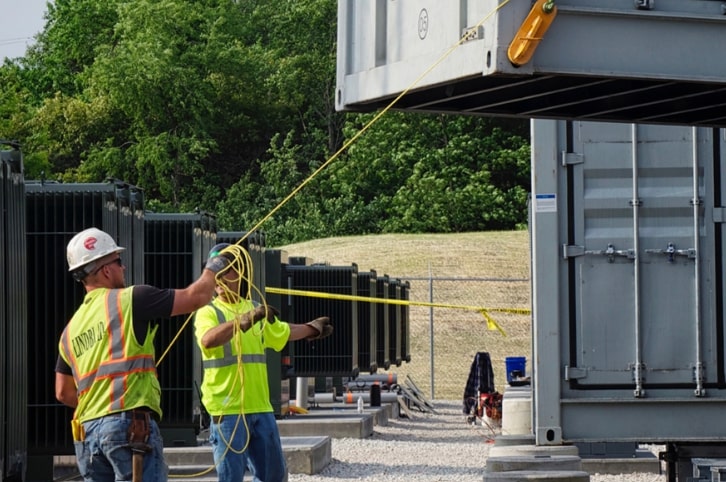
PJM has awarded 23 battery energy storage system (BESS) resources, totalling 2.2GW, with interconnection agreements (IAs) in its first transition cycle (TC1) of the reformed interconnection process.
The Regional Transmission Organisation (RTO) PJM serves regions across 13 US states and the District of Columbia.
As reported by energy industry data platform Modo Energy, the BESS resources include 10 standalone batteries and 13 hybrid or collocated batteries.
The majority of the projects are likely to come online between 2028 and 2030, and developers have paid as little as nothing to as much as US$50 million in interconnection cost deposits.
Try Premium for just $1
- Full premium access for the first month at only $1
- Converts to an annual rate after 30 days unless cancelled
- Cancel anytime during the trial period
Premium Benefits
- Expert industry analysis and interviews
- Digital access to PV Tech Power journal
- Exclusive event discounts
Or get the full Premium subscription right away
Or continue reading this article for free
PJM load growth
A recent report from the US Energy Storage Coalition (ESC), stated that PJM faces an urgent near-term requirement for affordable capacity to accommodate large loads expected through 2032.
Limited supply availability, ongoing interconnection backlog issues, and high resource costs are expected to limit capacity options for PJM to meet its projected 19% peak load rise from 2025 to 2030.
The study indicates that large amounts of dispatchable resources, including energy storage and natural gas, will be crucial for maintaining resource adequacy and managing weather-related risks in PJM.
Sustainability group Rocky Mountain Institute (RMI) also wrote in November, that PJM “desperately needs to add electricity generation to meet surging demand. PJM is home to ‘data centre alley’, and thus its ability to serve the rapid rise in new large loads requested by data centres has great bearing on American economic competitiveness.”
RMI further stated, “PJM’s interconnection bottlenecks are slowing the deployment of new, low-cost generation, driving up costs for consumers, and hindering the emergence of a new economic industry in the region. Unleashing the thousands of resources waiting in its queue — with the support of the same modern technologies fueling the demand for power — is the best way for PJM to address the dual challenges of resource scarcity and rising rate pressures on consumers.”
In September, PJM announced the completion of the TC1 interconnection studies.
The RTO then sent out draft agreements for 130 new service requests to be completed or withdrawn by the end of the year.
The agreements encompass 128 new generation service requests, totalling an estimated energy output of around 17.4 gigawatts, which includes 8.4GW of capacity. The projects are composed of 56% solar, 25% wind, 10% storage, 5% hybrid, and 3% natural gas by output.
In July 2023, PJM started adopting a new, improved process for generation interconnection aimed at more quickly advancing projects most likely to proceed.
Since then, PJM has reviewed around 160 GW of generation interconnection projects. The RTO claims that the interconnection transition queue has been reduced to about 46GW, with all projects scheduled for processing by the end of 2026 during transition cycle 2 (TC2).
The application deadline for TC1 of PJM’s updated interconnection process is 27 April 2026. The organisation also claimed that moving forward, it will typically take one to two years to finalise generation interconnection agreements, with PJM exploring options to reduce this time.
Outside of TC1, about 46GW of generation projects had signed grid connection agreements by June.
In 2025, PJM connected approximately 2.1GW of new generation capacity, including 2,033MW of solar, 55MW of wind, and 29MW of coal.
TC1 results
The largest project is RWE’s 500MW ‘Fourth Quarter’ battery in Maryland. Most batteries have a four-hour duration, with only two projects—‘Liberty II’ and ‘French Creek’—offering the longest storage times of 10 hours.
The updated interconnection process has significantly improved both completion rates and processing times compared to PJM’s previous serial queue system.
Though only 35% of the total submitted capacity, including 16% for batteries, received final agreements, this marks an improvement over the previous system’s overall completion rate of 20% and 14% for storage.
The entire TC1 process took 668 days, significantly shorter than the over five years typical of the previous system. It mostly adhered to its planned 1.7-year timeline, aside from a three-month pause in early 2025.
Independent power producers (IPPs) remain the primary drivers of PJM’s battery projects, with firms like RWE (555MW), EDP (four projects), and Jupiter Power leading development efforts.
Dominion stands out as the only utility with two 75MW projects, helping it reach a total of 400MW of utility-owned battery capacity, including previous Fast Lane projects.
Interconnection costs for TC1 battery projects varied widely, from no upgrades needed in some cases to over US$50 million in others. The average cost was US$190-per-kW, but individual projects ranged from under US$15-per-kW to over US$400-per-kw.
Interestingly, higher costs do not always translate to better revenue from energy arbitrage, as some projects with high upgrade expenses may focus on capacity markets, regulatory compliance, or state incentives instead of solely maximising merchant energy arbitrage.
Commercial operation dates for the 23 batteries range from May 2027 to February 2030. This reflects the common uncertainty between securing interconnection agreements and reaching commercial operation, owing to permitting, construction, and financing risks.
The ‘Fourth Quarter’ project is especially notable for the mid-Atlantic region. It will add significant storage capacity to an area with quick growth in demand from data centres and large loads. This could create considerable arbitrage opportunities and help reduce regional congestion.
A panel discussion on meeting load growth in the US will be held on 24 March 2026 at the upcoming Energy Storage Summit USA 2026 event in Dallas, Texas. For full details, visit the Energy Storage Summit USA website.