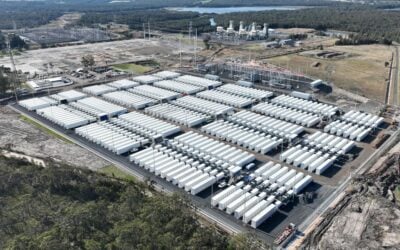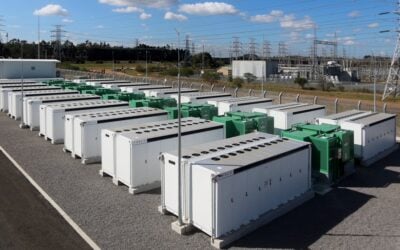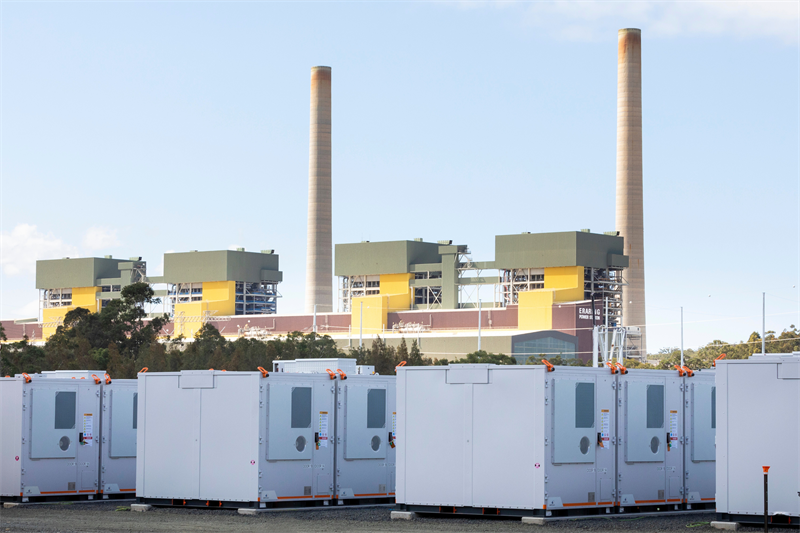
Utility Origin Energy has hired Wärtsilä to expand its battery storage installation at the Eraring coal power plant site in New South Wales, Australia, to 3,160MWh capacity.
Integrated generator-retailer (‘gentailer’) Origin is building what will be Australia’s largest battery energy storage system (BESS) project, as part of the company’s transition plan for Eraring Power Station.
At 2,880MW generation capacity, Eraring Power Station is the country’s biggest single-site coal-fired power plant. Its closure has been a big talking point of climate and energy security debates, and in 2022, Origin said that a 700MW BESS would be deployed at the site, that would mitigate the closure’s impacts, along with other resources, including expansion to the company’s aggregated virtual power plant (VPP).
In May 2024, the New South Wales (NSW) government granted Origin Energy a temporary extension to its operating life, from the planned shutdown this year to August 2027, under certain agreed-upon conditions, including capping financial losses it can claim back and paying back profits.
Try Premium for just $1
- Full premium access for the first month at only $1
- Converts to an annual rate after 30 days unless cancelled
- Cancel anytime during the trial period
Premium Benefits
- Expert industry analysis and interviews
- Digital access to PV Tech Power journal
- Exclusive event discounts
Or get the full Premium subscription right away
Or continue reading this article for free
In fact, Origin had brought forward its original retirement date from 2032 to 2025, with CEO Frank Calabria stating in 2022 that “cleaner and lower-cost generation, including solar, wind and batteries,” were making coal plants uncompetitive in the National Electricity Market (NEM).
However, the Australian Energy Market Operator (AEMO) voiced concerns about a possible shortfall of capacity, were the plant to close this year.
Stage 1 of the battery project commenced construction of a 460MW/920MWh system in 2023, following a two-year procurement process. At that time, Origin planned a further near-term 240MW expansion but stated that it was possible the site could be expanded to achieve a 700MW output with a 2,880MWh capacity (4-hour duration).
The company received approval in July last year to construct the 240MW/1,030MWh second stage, which is being equipped with grid-forming advanced inverters to aid network stability, bringing the total planned capacity to more than 2GWh.
Last month, Origin Energy was granted AEMO approval of NEM connection agreements for a 300MW/650MWh grid-forming BESS project at Mortlake Power Station in Victoria.
Wärtsilä appointed for all four stages of Eraring project
Construction then commenced on that portion in October 2024. The energy storage division of Finnish marine and engine power plant technology provider Wärtsilä was appointed for the first two phases of the project. Two months after Stage 2 began construction, Origin then contracted the company for a third 700MWh stage which doubled the facility’s duration from 2-hour to 4-hour.
Wärtsilä announced yesterday that it has been appointed for Stage 4, delivering the company’s Quantum series of large-scale BESS solutions, and controlling the site’s energy flows and dispatch with its GEMS Digital Energy Platform energy management system (EMS) and controls software.
Construction will begin this month, with an expected completion date in early 2027. Wärtsilä said it now has a 5.8GWh portfolio of BESS projects in Australia that are delivered, in construction, or under contract.
The project is Australia’s largest approved battery storage project to date by capacity in megawatt-hours, or indeed, gigawatt-hours, although in megawatt terms of output to the grid, Waratah Super Battery (850MW/1,680MWh), also in New South Wales, is larger.
Waratah Super Battery is currently nearing full operation, although a recent transformer failure during testing has set the project back.
Meanwhile, several other gigawatt-hour-scale battery storage projects are at various stages of development across Australia. For example, Quinbrook Infrastructure Partners’ proposed Gladstone State Development Area (GDSA) Energy Hub Project in Queensland would feature a 780MW/6,240MWh (8-hour duration) BESS in combination with gas turbines.
The Energy Storage Summit Australia 2026 will be returning to Sydney on 17-18 March 2026. To secure your tickets and learn more about the event, please visit the official website.