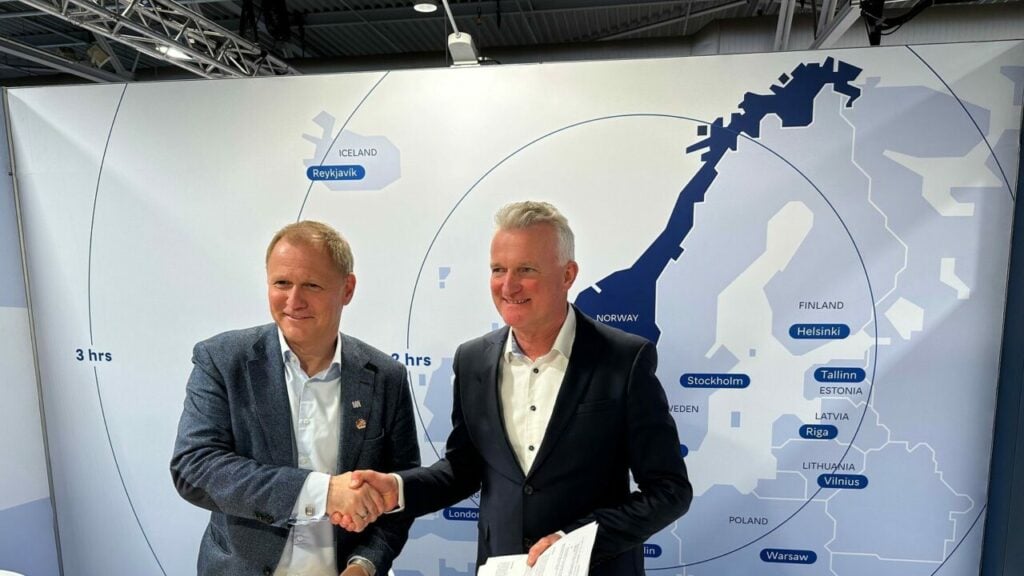
Morrow Batteries, one of several startups committed to producing lithium-ion batteries at gigawatt-hour scale from factories in Scandinavia, has secured a 5.5GWh offtake deal.
The strategic offtake deal will see the Norway-headquartered manufacturer sell lithium iron phosphate (LFP) batteries over seven years to another startup, Nordic Batteries, which assembles and manufactures portable energy storage systems, battery modules, and racks.
Nordic Batteries will initially make battery packs and storage systems customised for maritime and “demanding” industrial applications using the first commercial volumes of BEV2 brand LFP batteries Morrow delivers. It will also develop modules based on the cells.
Meanwhile the pair will also cooperate in sales and marketing, as well as exploring the possibility of joint production of modules. The offtake deal progresses a partnership formed with a Memorandum of Understanding (MoU) signed last year.
Try Premium for just $1
- Full premium access for the first month at only $1
- Converts to an annual rate after 30 days unless cancelled
- Cancel anytime during the trial period
Premium Benefits
- Expert industry analysis and interviews
- Digital access to PV Tech Power journal
- Exclusive event discounts
Or get the full Premium subscription right away
Or continue reading this article for free
Morrow is building its first battery gigafactory in Arendal, Norway. It expects to begin production in the third quarter of this year and send the first cells to customer Nordic before the end of 2024. Nordic expects to have the first pilot line of its automated battery assembly line with 1GWh annual production capacity online in the second quarter of this year.
The company has so fair shipped cells from its Customer Qualification Line (CQL), including samples shipped to customers including Nordic Batteries for testing and validation since late last year.
Stationary ESS market quicker to access than EV, Morrow COO says
As noted in an Energy-Storage.news Premium interview with Morrow COO Andreas Maier in March, the startup is primarily targeting the stationary energy storage system (ESS) market as part of its go-to-market strategy.
Speaking with ESN Premium at the Benchmark Mineral Intelligence Giga Europe conference held in Sweden, Maier said that the ESS market is much quicker to access, with lower barriers to entry than automotive, with Morrow signing offtakes with system integrators working in the commercial and industrial (C&I) and residential space, such as Eldrift.
Morrow is able, like fellow Scandinavian gigafactory startups Northvolt in Sweden and Freyr in Norway, to harness cheap and abundant renewable energy to decarbonise its production.
In terms of supply chain, it still sources cathode active material (CAM) from China, but according to COO Maier is considering production of CAM for LNMO (lithium nickel manganese oxide) batteries, if those find a place in the market. The supply chain for LNMO is much easier to source within Europe, he said.
Morrow and Nordic Batteries signed their new deal at the Hannover Messe trade fair in Germany this week.