While lithium-ion enjoys the most media and customer interest at the moment, alternative technologies for storing energy could become competitive – if investors are willing to take them on to the extent that manufacturing efforts can be greatly scaled up.
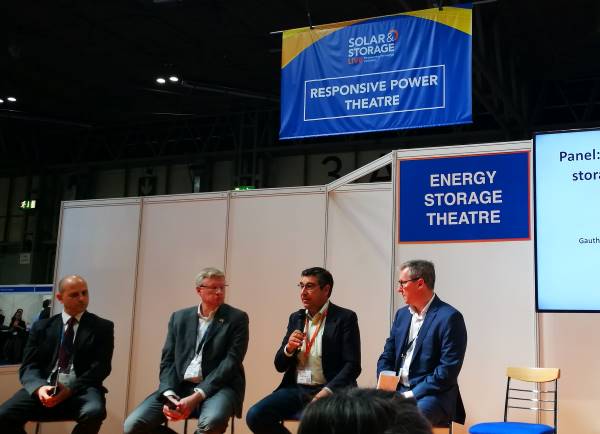
That was according to a panel of industry representatives from different, ‘long duration’ energy storage technology companies, speaking in the Energy Storage Theatre strand today at this week’s Solar & Storage Live show in the UK.
David Brown, CEO of Broadbit, a manufacturer of novel sulfur dioxide chemistry-based battery system, liquid air energy storage company Highview Power’s chief design officer Nic Castelluci and Gauthier Dupont, director for power business (batteries) at NGK Insulators, maker of the sodium sulfur (NAS) battery spoke at the panel session: ‘Storage tech comparison, the best storage solution for different projects’.
While the latter has already deployed 4GWh of its batteries to energy storage projects around the world since 2002, NGK’s NAS batteries still come from “one small factory,” Dupont said.
Try Premium for just $1
- Full premium access for the first month at only $1
- Converts to an annual rate after 30 days unless cancelled
- Cancel anytime during the trial period
Premium Benefits
- Expert industry analysis and interviews
- Digital access to PV Tech Power journal
- Exclusive event discounts
Or get the full Premium subscription right away
Or continue reading this article for free
“We didn’t yet capture the benefits of economies of scale. Today, all of the investment more or less is going to lithium-ion. There is no, or very low investment in other technologies. If you made a Gigafactory for our batteries, we would reduce the cost by 50% – easily.”
Broadbit’s David Brown said that his batteries, for which the main raw materials are salt, coal and sulfur dioxide (aka ‘rotten eggs’), could achieve costs of US$70 per kWh if it could establish a ‘megafactory’. A Gigafactory-scale manufacturing operation could drive that down to US$50, he said.
Meanwhile Highview Power’s Nic Castelluci said that his company’s technology runs warmed liquid air through large turbines. This means that many of the actual components used can be taken ‘off the shelf’ from other industries which also use them.
All of the panelists argued for the various merits of their technologies. However, there was a collective view agreed upon that while aspects such as safety and potential for safe disposal or recycling at end of life make each different technology a potential player in various markets, ultimately, customers’ questions and concerns centre on costs relative to other solutions.
In tandem with the need for investment runs the importance of creative real-world business cases for longer duration energy storage systems, capable of storing several hours of energy, the panel, chaired by zinc bromine flow battery company Gelion Energy’s chairman, concluded.