The number of sites pairing renewable energy with energy storage in the US more than doubled from 2016 to 2019 and the trend is expected to continue, according to the US Energy Information Administration (EIA).
The EIA releases its inventory of electric generators on a monthly basis, with the next edition set to be published later today (26 May). Among the findings of its last edition were that in 2016 there were 19 sites pairing solar or wind with batteries, which leaped to 53 paired sites by 2019. By the end of 2023, the EIA already believes there will be another 56 such projects.
However, there’s still a lot of room for further growth: only 2% of total solar capacity is paired with battery storage, only 1% of wind, while around 25% of battery storage capacity is installed as part of a hybrid, co-located project. The top three applications for utility-scale batteries at renewable energy plants – according to figures provided from 2018 – were in storing excess wind and solar, in providing frequency regulation and then peak shaving.
The EIA found a geographic concentration of hybrid renewables-plus-storage projects in just a handful of states. Perhaps surprisingly, Texas leads the top 10 list for operating and planned renewables-plus-storage capacity, with Nevada coming in second and California third. While the EIA gave a top 10 list chart, it found that 90% of the total operating capacity of such projects is in just nine US states, with 10 facilities alone accounting for over half of that capacity.
Try Premium for just $1
- Full premium access for the first month at only $1
- Converts to an annual rate after 30 days unless cancelled
- Cancel anytime during the trial period
Premium Benefits
- Expert industry analysis and interviews
- Digital access to PV Tech Power journal
- Exclusive event discounts
Or get the full Premium subscription right away
Or continue reading this article for free
Renewable generation projects and battery storage projects are getting bigger in megawatt terms, the EIA found. By late 2023, average renewable capacity at proposed US facilities will go from 34MW to 75MW and the average battery storage capacity from 5MW to 36MW.
In April, Energy-Storage.news reported that a study from the Lawrence Berkeley National Laboratory and the Electric Power Research Institute (EPRI) found the US already has 4.6GW of utility-scale hybrid resource capacity online, with a further 14.7GW in the “immediate development pipeline”. A massive 69GW of hybrid, generation coupled with energy storage projects sit in the interconnection queues of Regional Transmission Organisations (RTOs) and Independent System Operators (ISOs).
In related news, ENGIE EPS, the microgrid and energy storage division of the major European utility, revealed that its proposed hybrid large-scale solar-plus-storage project was selected by Hawaiian Electric (HECO) as one of 16 solar-and-battery or standalone project proposals through a competitive solicitation process.
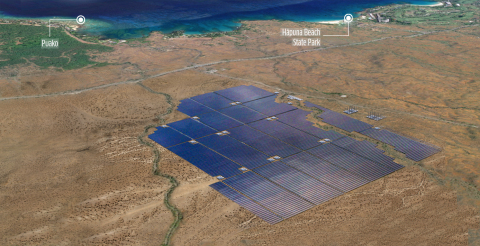
ENGIE said its subsidiary – which it acquired in 2018 – has now entered contract negotiations with the utility for the planned 60MW(AC) solar PV and 240MWh battery storage project on Hawai’i Island. ENGIE EPS will be supplier of the battery storage systems as well as system integrator, creating the full storage solution for the project, which is in Puako near Waikoloa Village. The HECO procurement included around 460MW of solar and 3GWh of energy storage in total. The utility said it will announced details of awarded projects by mid-June, although it is understood that this includes two projects that the utility will self-build. ENGIE EPS said in March that despite some big project awards and a rise in revenues for 2019 of 29% from 2018, it was not able to commit to a 2020 earnings target due to the impacts of the COVID-19 pandemic.