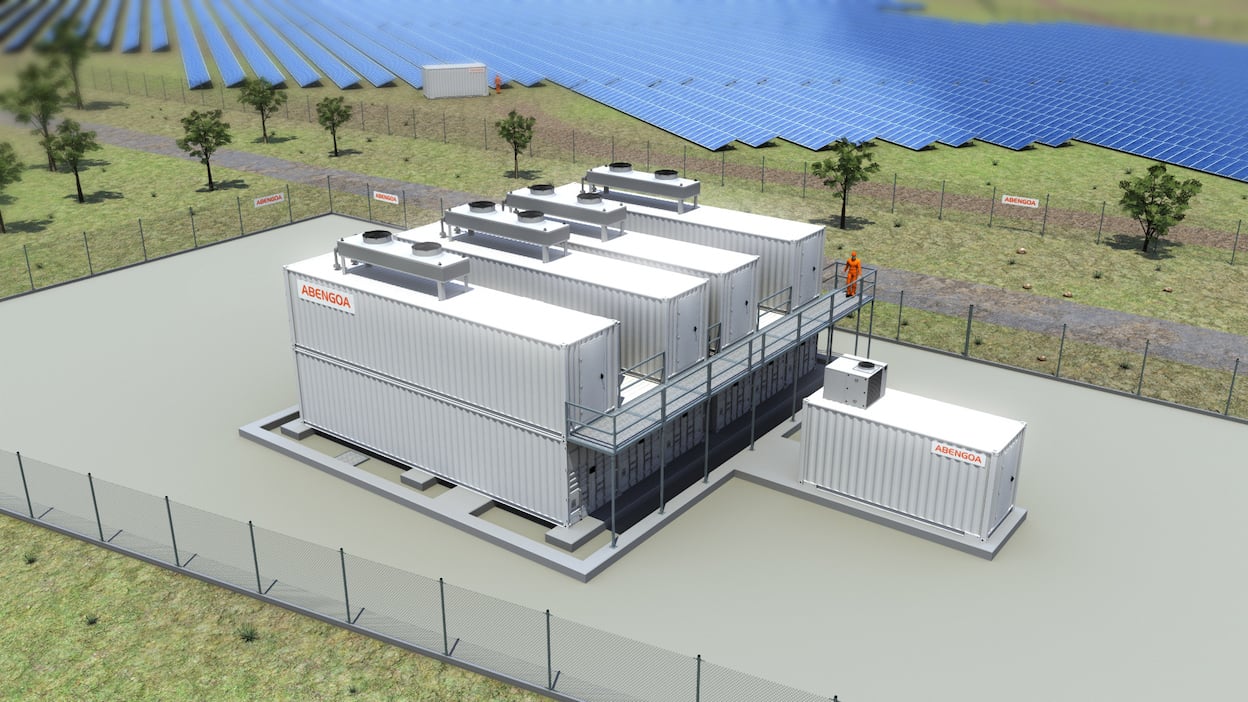
A solar-plus-storage microgrid being deployed at an alloys mine in South Africa will feature a vanadium flow battery energy storage system, using locally sourced vanadium electrolyte.
The micro, or mini-grid, will serve close to 10% of total electrical consumption required at the Vametco Alloys integrating vanadium mining and processing plant in the North West Province of South Africa.
Pairing 3.5MW of solar PV generation with the 1MW / 4MWh vanadium redox flow battery (VRFB) storage unit, the project will also serve to demonstrate the capabilities and benefits of VRFBs, according to Bushveld Minerals, the company behind the project.
Bushveld owns the Vametco mine and has appointed European infrastructure solutions company Abengoa as engineering, procurement and construction (EPC) partner on the project, with Abengoa also providing its proprietary energy management system technology to operate the microgrid.
Try Premium for just $1
- Full premium access for the first month at only $1
- Converts to an annual rate after 30 days unless cancelled
- Cancel anytime during the trial period
Premium Benefits
- Expert industry analysis and interviews
- Digital access to PV Tech Power journal
- Exclusive event discounts
Or get the full Premium subscription right away
Or continue reading this article for free
Abengoa said it has already commissioned 250MW of power generation projects with energy storage in Africa over the past 10 years, as well as being its fourth such project in South Africa. The Vametco project is, however, the first-ever commercial-scale hybrid project on the African continent to use VRFB technology, Abengoa said. Abengoa will install the Vametco Alloys project’s solar PV as well as integrating the system and providing maintenance after commissioning.
The vanadium flow battery provider to the project will be Enerox, which Bushveld also owns. Enerox produces systems under the brand name CellCube. Enerox CEO Alexander Schoenfeldt said that he expected the hybrid installation to “become a blueprint for many more to come”.
Vametco will provide 25 tonnes of vanadium oxide to be converted for use as electrolyte in the battery system. Bushveld said that the use of “locally mined and beneficiated vanadium” shows how “VRFB energy solutions can create more local value to South Africa than any other storage technology”.
Project expected to demonstrate opportunity for VRFBs while providing commercial returns
Bushveld believes the project will help prove that as the energy storage market trends towards longer durations of energy storage and emphasises the role batteries can play in improving reliability of power supply, VRFBs will have a key role to play. The project will also aid South Africa’s decarbonisation strategy, Bushveld claimed.
Being structured as an independent power producer with a long-term power purchase agreement (PPA) signed between Vametco and Bushveld, the project is also expected to provide commercial returns for shareholders, Bushveld said.
“The project demonstrates the commercial viability of solar plus VRFB storage solutions for commercial and industrial scale applications. This is occurring at a time when stationary storage deployments are gathering momentum and when in South Africa the government is making concerted efforts to lower regulatory hurdles for self-generation for commercial and industrial applications,” Bushveld Minerals CEO Fortune Mojapelo said.
“In showcasing the business case for solar plus long duration VRFB solutions, this project will open up significant opportunities for further VRFB deployments,” Mojapelo said, adding that the project could prove the commercial viability of vanadium battery storage for industrial applications internationally as well as in South Africa.
A term sheet has been obtained for long-term debt funding for the project. South African investment management company Thebe Investment Corporation has also signed a Memorandum of Understanding (MoU) to become a strategic equity partner in developing and funding the mini-grid.
The project has also now received environmental authorisation from the Department of Mineral Resources and Energy (DMRE) of South Africa for its construction. Bushveld said this was a “crucial project development step” towards the project obtaining a generation license from the South African energy regulator, alongside the signing of the PPA and appointing EPC partner Abengoa.
Once that generation license is granted, the project can achieve financial close for debt and equity funding, and construction can begin. Bushveld said it is confident that it will be able to go forward with it and has therefore already appointed its battery system supplier.
The wider opportunity for solar-plus-storage at mining operations has been seen, perhaps most recently with the commissioning of a hybrid microgrid project using lithium-ion batteries at Granny Smith Gold Mine in Australia, one of a number of such projects in the country. Meanwhile, to learn more about flow batteries for energy storage, read this technical feature article by a team of experts from CENELEST, a joint research venture between the Fraunhofer Institute for Chemical Technologies and the University of New South Wales.