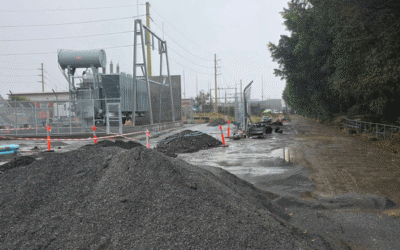
New Zealand’s fragmented electricity market structure is creating both opportunities and obstacles for industrial battery storage, as demonstrated by CentrePort Wellington’s upcoming deployment.
The 750kW/1.5MWh battery storage deployment, supported by an interest-free loan from government entity Ara Ake, aims to enable ambitious electrification plans without triggering costly grid infrastructure upgrades.
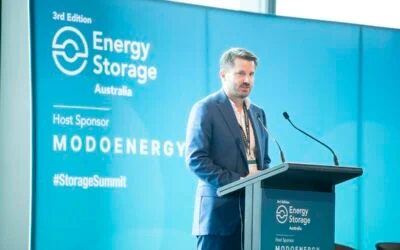
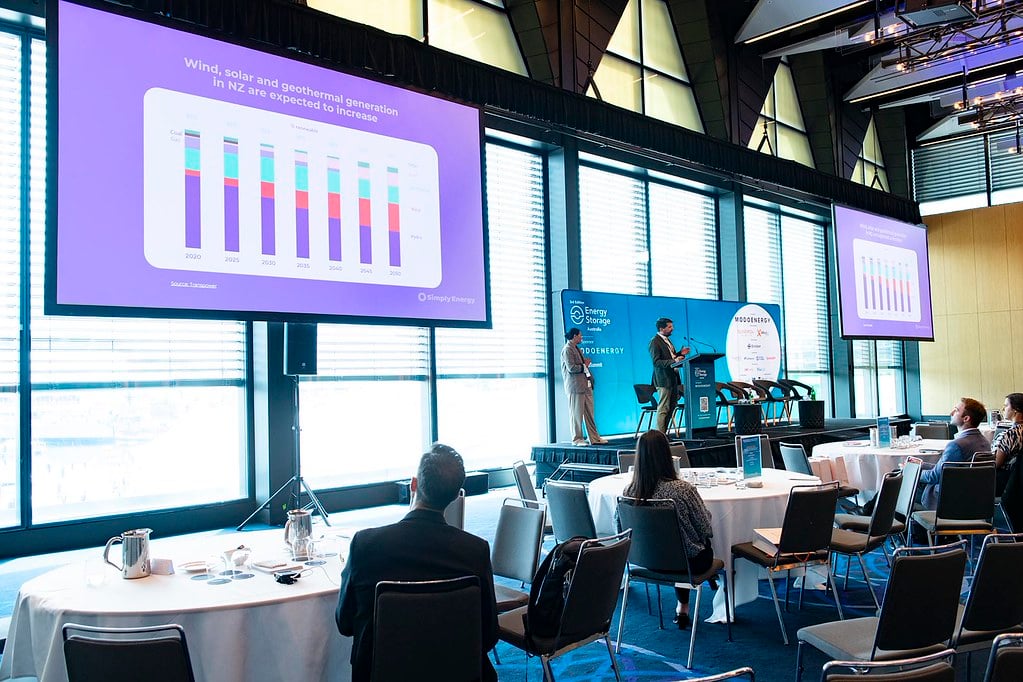
Speaking at the Energy Storage Summit Australia 2026 in Sydney last week, Tim Edmonds, head of advisory at Simply Energy NZ, explained that the port faces a capacity crunch as it pursues expansion over the coming years.
“They’re looking at 25MW of additional capacity required over the next few coming years,” Edmonds told attendees.
Try Premium for just $1
- Full premium access for the first month at only $1
- Converts to an annual rate after 30 days unless cancelled
- Cancel anytime during the trial period
Premium Benefits
- Expert industry analysis and interviews
- Digital access to PV Tech Power journal
- Exclusive event discounts
Or get the full Premium subscription right away
Or continue reading this article for free
“A lot of that’s to do with shore power for the ships, the capacity to be able to connect with the cruise ships or container ships when they’re sitting in the port rather than running on their fossil fuel.”
The infrastructure challenge that the port is currently facing is substantial.
“The local network is already at capacity, and the grid exit point is a fair way away. It’s under the main State Highway 1, so getting capacity to the site is really hard,” Edmonds said.
“It’s going to be at least NZ$20-$30 million (US$11.98-17.99 million) to get a new cable to the site.”
Yet the site’s load profile reveals opportunity. “The site’s already at capacity, but it is really a peak load. So, this is where batteries can come in,” he explained.
“We can get almost another MW of capacity there pretty easily by adding that battery storage system to help with some of those electrification projects.”
Stacking value in a low-volatility market
The project economics reveal the nuanced realities of battery storage deployment in New Zealand’s relatively renewable-energy-dominated, low-volatility market.
Simply Energy’s modelling showed the BESS delivering value across multiple revenue streams, though Edmonds acknowledged that “the project almost stacked up. It still wasn’t quite a positive net present value (NPV) on this project, but they really want to use this to learn because they will be able to then get more capacity and those projects going forward.”
Demand charge management represents the largest value component. Jade Jackson, head of energy transition at Simply Energy NZ, explained Wellington Electricity’s tariff structure.
“They’ve got a very strong morning and evening peak demand charge, so two hours of morning, two hours of evening. And that generally makes up about 60% of the network tariff for most customers,” Jackson noted.
The battery storage system also generates revenue from New Zealand’s reserves market, equivalent to Australia’s FCAS, though Edmonds noted: “When we modelled that, we did model a declining reserves market. And a lot of that’s from seeing what’s happening in Australia, and the same thing is starting to happen in New Zealand, because that market value is deteriorating.”
Wholesale market arbitrage presents a limited opportunity in New Zealand’s context. Edmonds said that New Zealand maintains a predominantly renewable energy mix, with renewables accounting for approximately 90% of overall generation.
During the recent summer period, this figure reached 96%. The nation’s extensive hydroelectric infrastructure offers substantial energy storage capacity, up to 4,000GWh, which fundamentally shapes the country’s electricity market characteristics and operational dynamics.
“Unlike Australia… quite an exciting market where you’ve got negative pricing for long periods and rest with intraday volatility, there’s the New Zealand market. We don’t have any negative pricing. We don’t really have much intraday volatility,” Edmonds added.
“We’ve got quite a bit of seasonal volatility. But for a battery, there’s not a lot of money in the wholesale market.”
CentrePort’s fixed-price contract further constrains arbitrage opportunities.
“They’re on a contract, so getting… not that much money, got a bit of shade in that price, which you can get a bit of value out,” Edmonds explained.
Navigating New Zealand’s fragmented metering landscape
Jackson highlighted a structural challenge that significantly impacts BESS value capture in New Zealand.
“In New Zealand, we actually have 29 different distribution network service providers (DNSPs), and that means there are 29 different pricing methodologies and pricing structures,” Jackson said.
This market fragmentation necessitates a thorough preliminary evaluation. Careful upfront analysis of microgrid placement is essential, particularly given that many installations are designed around specific customer needs.
Understanding client requirements and their on-site objectives is crucial to successful microgrid deployment.
In addition, Jackson stated that the regulatory environment adds complexity.
“Every five years, for the next five years, there is a price path put out for all of our networks, for DNSPs,” Jackson explained.
“It’s just really important when you’ve got 10-to-20-year assets to understand that today’s pricing may not be, or will not be, the pricing over the next 10 to 20 years. So, we need to understand and then use our modelling to really see whether or not you’re over- or underestimating those costs.”
Metering configuration proved critical to project success. Jackson highlighted how traditional metering systems create challenges through their connection points (ICPs).
These connection points isolate distributed energy resources, such as solar modules and batteries, significantly limiting opportunities for energy arbitrage and peak demand management when assets are separated behind these metering boundaries.
Jackson outlined several solutions. Physical metering changes involve “installing high voltage meters and just removing those multiple connection points, allowing things like solar and batteries, the peak demand management and allowing followers to be shared on the site.”
However, she cautioned that “the cost can be, that front cost can be quite prohibitive, depending on what the business case looks like.”
In addition, embedded networks provide a viable solution by enabling tenant choice in meter and retailer selection in New Zealand.
Jackson noted that at CentrePort, multiple tenants, including a stadium and ferry business, can independently negotiate their own commercial energy arrangements while sharing network charges across the embedded network infrastructure.
See more Energy Storage Summit Australia coverage and related content.