
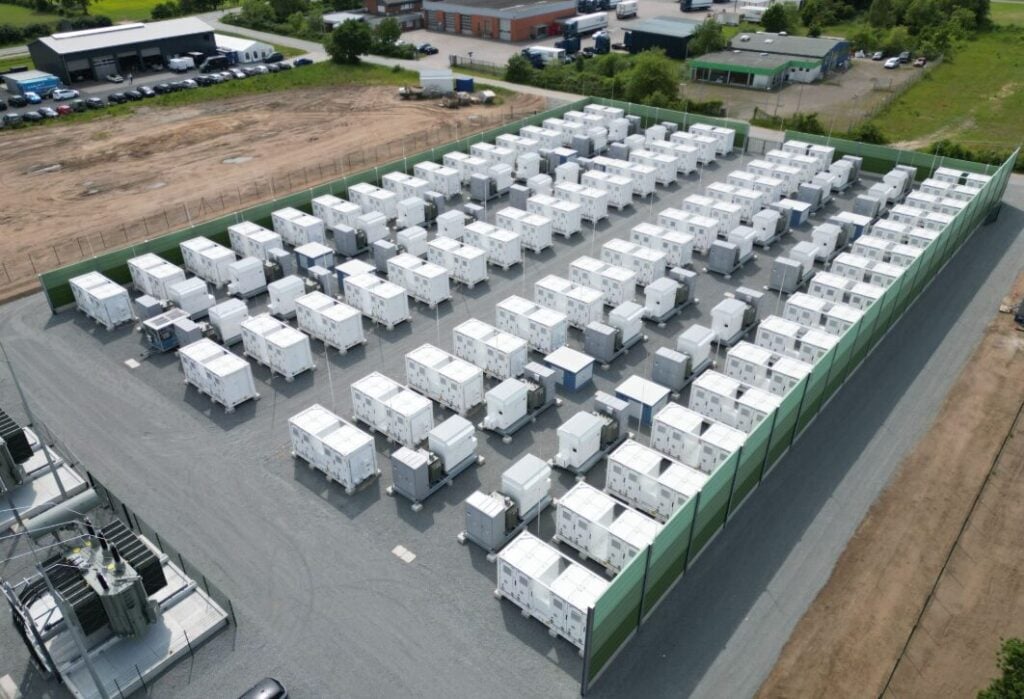
Germany’s BESS market is booming but is still far behind what it is needed for its energy transition. 2026 will be a key year in this regard with several key regulatory questions potentially clarified, writes energy transition comms executive Frederik König.
Germany stands out as one of the most dynamic markets for battery storage systems (BESS) worldwide, driven by its highly volatile electricity market and ambitious energy transition goals. With around 24GWh of storage capacity currently connected to the grid, a 22% from last year, the sector appears to be booming.
However, the impression of a storage miracle is deceptive, especially for large-scale storage systems with capacities exceeding 1MWh. Despite the sharp rise in connected capacity, the total installed large-scale storage volume of just 3.5GWh remains far below what is required for Germany’s energy transition.
Yet, large battery storage systems could represent a genuine alternative to gas, coal, and nuclear power plants, as illustrated by RWE’s planned 700MWh storage project at the former nuclear power plant site in Grundremmingen (Bavaria).
Try Premium for just $1
- Full premium access for the first month at only $1
- Converts to an annual rate after 30 days unless cancelled
- Cancel anytime during the trial period
Premium Benefits
- Expert industry analysis and interviews
- Digital access to PV Tech Power journal
- Exclusive event discounts
Or get the full Premium subscription right away
Or continue reading this article for free
According to German energy research institute Fraunhofer ISE, around 104 gigawatt hours of storage capacity will be needed by 2030, rising to as much as 180GWh by 2045. Almost half of this is expected to come from large-scale systems with a capacity of 1MWh or more. As of yet, these figures are still a long way off for Germany.
The four German transmission system operators – 50Hertz, Amprion, Tennet, and Transnet BW – have received nearly 700 grid connection requests for BESS, amounting to a cumulative capacity of 250 gigawatts. But if these projects will materialise remains uncertain. The current regulatory framework for BESS is still unclear and risks slowing – or even derailing – the growth that Germany’s energy transition so urgently needs.
The industry is facing considerable regulatory uncertainty
The amendment to the Energy Industry Act (EnWG) passed by the Bundestag in November 2025 was meant to be a breakthrough for the BESS sector.
For the first time, large-scale battery storage is recognised as privileged infrastructure under building law and in addition, the law explicitly reiterates the government’s goal to accelerate approval procedures as well as to standardise and digitise grid connection processes. The message seemed clear: from 2026 onward, the sector will finally receive the regulatory foundation it has been calling for for years.
But no sooner had the ink dried on the EnWG amendment than the policy course reversed. Just weeks later, the Bundestag adopted the Geothermal Energy Acceleration Act (GeoBG), significantly tightening the criteria for BESS projects to qualify for privileged status under building law and once again raising the bar for new developments.
Under the new rules, only storage facilities located within a 200-metre radius of substations or in the immediate vicinity of generation plants with a minimum capacity of 50MW remain eligible. The signal to the market is unmistakable: those who relied on yesterday’s legal framework are suddenly left out in the cold. When legislators introduce construction privileges and then promptly narrow them again, it calls into question the reliability of the policy framework conditions for the energy transition infrastructure.
The long-overdue amendment to the Power Plant Grid Connection Ordinance (KraftNAV) in December 2025 raises additional concerns. Seeking to tackle so-called “zombie battery storage facilities” –projects with grid connection requests that have no realistic prospect of implementation – the Federal Ministry for Economic Affairs and Energy (BMWE) announced the abolition of the “first come, first served” principle for projects of 100MW or more.
This raises a serious problem: Without transition periods or clearly defined replacement mechanisms, a regulatory vacuum emerged. Until a week ago, there was no defined procedure for grid connection, leaving project developers and grid operators unable to assess how queues would be processed in the future.
While Germany’s four transmission system operators have since published a proposal for standardised grid connection procedures for large-scale battery storage projects, this has not resolved the uncertainty. To fully harmonise grid connection practices across Germany, the ministry has announced a consultation on new criteria for the first quarter of 2026, extending the period of structural uncertainty by several months.
While the industry is investing billions, policymakers remain in permanent reaction mode: they promise planning security, only to revise it in the next piece of legislation; they create privileges, only to restrict them again in the following paragraph; they scrap key rules while vaguely pointing to future consultations. The result is a regulatory limbo that jeopardises precisely the investments that are indispensable for the energy transition.
That’s why the following section takes a detailed look at what lies ahead for BESS regulation in Germany in 2026, and what it means for project developers, investors, and hardware providers.
The end of EEG 2023 – The starting gun for a system shift
The most significant energy policy event of the coming year is not a new law, but rather a deadline: on 31 December 2026, the European Union’s state aid approval for Germany’s Renewable Energy Act (EEG) 2023 – the country’s core framework for subsidising renewable power generation – expires.
At that point, the system will be pushed to move away from predominantly generation-based subsidies toward a market design that places far greater emphasis on capacity and flexibility. In this new setup, flexibility will become the key currency of the power system.
That creates considerable pressure to act, mainly because the role of BESS in Germany’s energy system has so far only been partially clarified. While the Energy Industry Act (EnWG) defines battery storage as an “independent pillar,” the German Federal Court of Justice confirmed the financial reality in July 2025: storage facilities continue to be treated as consumers when it comes to construction cost contributions. This structural contradiction between energy industry objectives and regulatory practice must be resolved in 2026.
Capacity market framework takes shape
In November 2025, the German government reached an agreement on the core elements of its power plant strategy. New capacities seek to close short-term supply gaps, while Germany will transition from its current energy-only market to a capacity market design in the long term. Chancellor Merz recently announced an agreement in principle with the EU over the power plant strategy.
In 2026, Germany will launch tenders for 10GW of gas-fired capacity and 2GW of “technology-neutral” capacity – explicitly including BESS. A capacity market design is targeted for 2027. Accordingly, the key task for 2026 will be to nail down the framework for a capacity market and clarify the role of large-scale battery storage in it.
New rules reshape grid connections for BESS
In November 2025, the German Bundestag called on the federal government to deliver a draft regulation in the first quarter of 2026, with the goal of improving, standardising, and digitising grid connection processes for energy producers, consumers, and storage facilities alike.
Christian Schmidt, Head of the Electricity Department at the BMWE, announced the development of a “far-reaching grid connection package” to tackle the surge in applications – now demanding a more systematic and rule-based approach to grid connections and reservations.
This should close the regulatory gap left by the exemption of battery storage systems from the KraftNAV. Meanwhile, the ministry is exploring further tools to boost grid compatibility, including more grid-friendly plant operations (“grid traffic light”), shared grid connections (“cable pooling”), and new prioritisation mechanisms.
The aim is to overhaul grid connection procedures, so they no longer become a bottleneck for the energy transition. The corresponding amendment is scheduled to come into force at the start of 2027 and thus will need to be finalised by end of this year.
Clarification on grid fees
Battery storage systems commissioned until 4 August 2029 will be guaranteed a grid fee exemption for a period of 20 years from the commissioning date. However, as part of its broader grid fee reform process (“AgNes”), the Federal Network Agency has recently signalled that this exemption could be curtailed earlier than planned, potentially including assets already in operation, which has been met with strong criticism from industry representatives. Beyond that, the Federal Network Agency has published concrete proposals for a post-2029 framework.
A workshop held at the end of January 2026 signals a shift towards a more systematic contribution of BESS to grid financing while preserving incentives for grid-friendly operation. Under the proposed framework, grid financing would be based on a combination of an energy-based charge and a capacity-based charge for booked grid capacity over a fixed period, covering most grid operators’ funding needs, while a dynamic pricing component would incentivise grid-friendly operation and could open up an additional revenue stream for BESS operators over time.
The consultation period runs until the end of February 2026, with the Federal Network Agency (BNetzA) expected to publish a draft decision in May 2026, paving the way for regulatory clarity on future grid fee arrangements for storage by the end of 2026.
2026 is the make-or-break year for BESS in Germany
2026 will decide whether the present expansion in battery storage constitutes a genuine, sustainable development or merely a statistical aberration. Demand for BESS in Germany is rising, capital is flowing, and projects are stacked up at grid operators’ doors. What’s missing: a rock-solid regulatory framework that delivers long-term planning security and unleashes investment.
The pieces are all linked – the phasing out of EEG 2023, power plant strategy rollout, capacity market launch, grid connection and fee reforms. If we fail to resolve them by the end of the year, large-scale battery storage expansion could grind to a halt.
If policymakers achieve to clearly define storage and its role, to fairly integrate it into market and grid structures, and to reliably regulate connection procedures, then large battery storage facilities could become a cornerstone of the energy system by decade’s end.
2026 isn’t just another transition year, it’s the moment of truth for Germany’s BESS industry.
About the author
Frederik König is managing director of CC: Collective, a Berlin-based strategic communications and public affairs consultancy. CC: Collective is focused on the energy transition and has supported international energy companies in navigating market entry and regulatory developments in Germany.
The upcoming Energy Storage Summit 2026, focused on the UK and European markets, will take place 24-25 February at InterContinental London – The O2. Use the discount code ESN20 for a 20% discount, while ESN Premium users can get 30% off.