
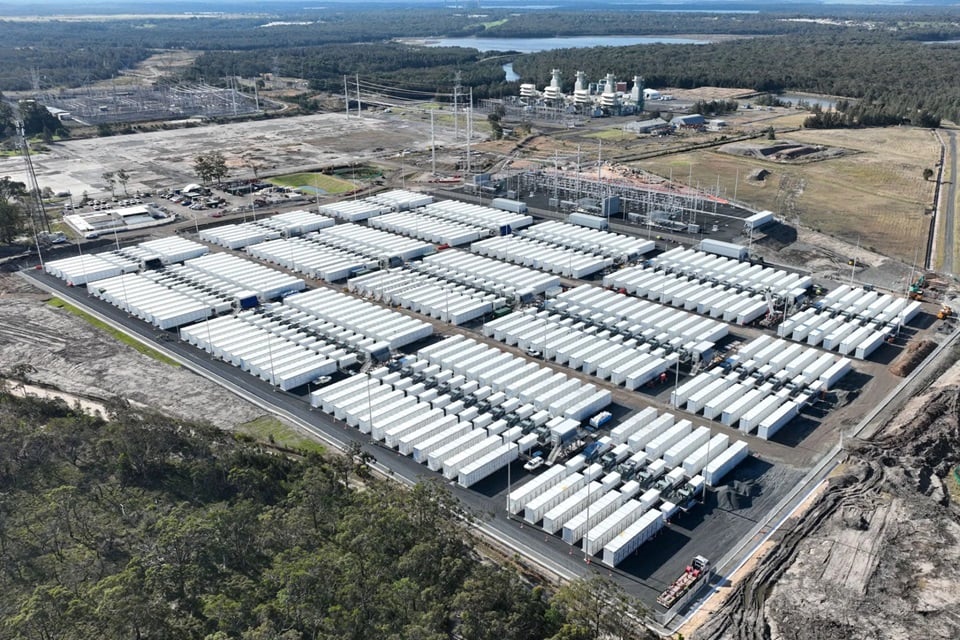
Climate Energy Finance’s Tim Buckley argues that geopolitical instability exposes Australia’s oil dependency and positions the country as a safe haven for international renewable energy capital.
Australia’s AU$50 billion (US$34 billion) annual dependence on imported oil and diesel has become a critical vulnerability that could paradoxically accelerate the nation’s battery storage and renewable energy transformation, according to Tim Buckley, founder and director of Climate Energy Finance.
Speaking on the sidelines of the Energy Storage Summit Australia 2026 in Sydney, Buckley warns that recent geopolitical developments, including China’s announcement that it would halt refined oil product exports and escalating US-Iran tensions, have exposed the fragility of Australia’s energy security and created an urgent case for domestic investment in clean energy infrastructure.
“We are, as a nation, enormously dependent on imported oil and diesel, AU$50 billion a year purchased mostly from the Middle East, oil and then refined in Singapore and China brought to Australia,” Buckley says.
Try Premium for just $1
- Full premium access for the first month at only $1
- Converts to an annual rate after 30 days unless cancelled
- Cancel anytime during the trial period
Premium Benefits
- Expert industry analysis and interviews
- Digital access to PV Tech Power journal
- Exclusive event discounts
Or get the full Premium subscription right away
Or continue reading this article for free
“And recently, we saw China say outright they’re not going to export any oil, any refined products. That’s a major threat to Australia’s energy security.”
The climate finance expert, whose public interest think tank operates without government or corporate funding, argues that sustained oil price spikes above US$100 per barrel should serve as a catalyst for the Australian government to accelerate investment in battery storage, electric vehicles (EVs), and firm renewable energy infrastructure, rather than retreating into short-term crisis management.
“There is always the risk that the government is a bit of a rabbit in a spotlight. We cannot use the current crisis. Now’s not the right time to talk about long-term policy. That’s the risk,” Buckley says.
“I would hope with the supermajority that the Albanese government has got, that they will show some real spine and realise that this is a great opportunity to actually invest in getting off our addiction to imported oil.”
Buckley emphasises that battery energy storage systems (BESS) are fundamental to any credible energy security response, given Australia’s world-leading wind and solar resources require firming to support electrification of transport and heavy industry.
“Australia has the best wind and the best solar in the world. We need to firm that up, and so we have the potential to deploy hundreds of billions of dollars in energy systems, Australian clean domestic energy, and that is the opportunity,” he says.
The pathway Buckley outlines involves leveraging high oil prices to accelerate deployment of EVs, heavy-duty electric trucks, and electrified mining equipment, all of which would require massive expansion of firmed renewable energy infrastructure and grid transmission capacity.
“That means you must build the firmed renewable energy infrastructure and the grid transmission, actually, to underpin all of that. So, a huge amount of onshore jobs, onshore investment and a reduction in our trade deficit, if we can actually get this right,” Buckley says.
You can see the video interview with Tim Buckley of Climate Energy Finance from Energy Storage Summit Australia here:
Australia emerges as a haven for international capital
While geopolitical instability typically increases financing costs, the Reserve Bank of Australia raised interest rates by 25 basis points in the days before the interview, with potential for further increases. Buckley argues that the turmoil in the Middle East is simultaneously reinforcing Australia’s attractiveness to international investors.
Australia currently receives approximately two-thirds of its capital for renewable energy transformation from international investors, and recent events have given those investors what Buckley calls “a massive reminder of geopolitical strategic risk.”
He notes that substantial capital has been flowing from China, Europe and America into the Middle East battery markets, which have been challenging Australia as one of the fastest-growing battery storage markets globally.
The Middle East has also been investing between US$5 billion and US$10 billion in new aluminium refineries powered by renewable energy.
“All of that would have been put on hold, and so global investors would, yet again, have a reminder. Geopolitical risk premiums in Australia are very low for a reason,” Buckley says.
“If you’re building major projects, whether it’s battery energy storage systems, hybrid systems, or whether you’re doing green iron, or call it blue iron, hydrogen, aluminium refineries in the Middle East… all of a sudden, you cannot actually get the product out of the Middle East to the global market.”
By contrast, Australia offers international investors a combination of low geopolitical risk, abundant capital, extensive land availability, low population density, and what Buckley described as “brilliant wind and solar onshore” resources, alongside a priority market for battery storage deployment.
“Australia is a great place to invest, despite our governments, and we have a lot going for us,” he says. “There’s a huge incentive for batteries in Australia.”
Domestic manufacturing: strategic focus over scale competition
When asked whether prolonged conflict could create opportunities for Australia to strengthen domestic manufacturing capabilities for solar modules, battery cells, and storage systems, Buckley offers a more measured assessment than many industry advocates.
“I’m probably a little less optimistic about the scope for direct manufacturing,” he says, noting that Australia is “a relatively small domestic market” compared to manufacturing operations in China that operate at scales significantly larger than Australia.
Currently, Australia imports between 95% to 99% of its solar modules, 100% of its batteries and 100% of its wind turbines. While one solar module manufacturing facility is being established in the Hunter Valley, Buckley cautions against pursuing a manufacturing scale that could undermine cost competitiveness.
He states that he has been working on a domestic content mandate for wind towers with the federal government and industry, but noted that Energy Minister Chris Bowen’s primary concern is avoiding cost increases that would make onshore wind less competitive with batteries and solar.
“Minister Bowen’s first point is we cannot allow wind costs to go up, because otherwise batteries, by solar, will actually outcompete wind. If we make onshore wind more expensive, demand will decrease. So, we’ve really got to balance that,” Buckley says.
Instead of attempting to compete with Asian manufacturing scale, Buckley advocates for a more strategic approach: deploying world-leading, low-cost technologies from North Asian trade partners within Australia to power domestic energy-intensive industries and value-added resource processing.
“At the end of the day, I see the opportunity as Australia taking the world-leading technologies, the low-cost world-leading technologies from our North Asian trade partners, deployed in Australia, and have an Australian future made in Australia, powered by domestic energy,” he says.
This could encompass data centres, green iron production, and aluminium processing, all of which require what Buckley describes as “hundreds of billions” in investment across Australia’s grid infrastructure, including Western Australia and the National Electricity Market (NEM).
Rather than pursuing base manufacturing at scale, Buckley argues that Australia should focus on mandating value-addition to mineral resources before export, a strategy employed by Indonesia, Zimbabwe, and Morocco.
“I’d like to see a little bit more resource value adding the way Indonesia is doing, Zimbabwe is doing, Morocco is doing. I’d love our government to actually mandate that we add value to our resources before we export them. That would be powered by an Australian, world-leading renewable energy firm by batteries,” he says.
This strategic positioning would leverage Australia’s competitive advantages without attempting to match the manufacturing scale of China and Korea, which Buckley notes already operate at scales “1,000 fold bigger than us [Australia].”
“We need to be strategic. We’re a smallish market, and there’s plenty of opportunity,” he concludes.
Interested in Australia? Read Energy-Storage.news’ Energy Storage Summit Australia coverage and related content.