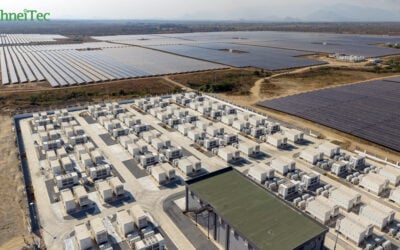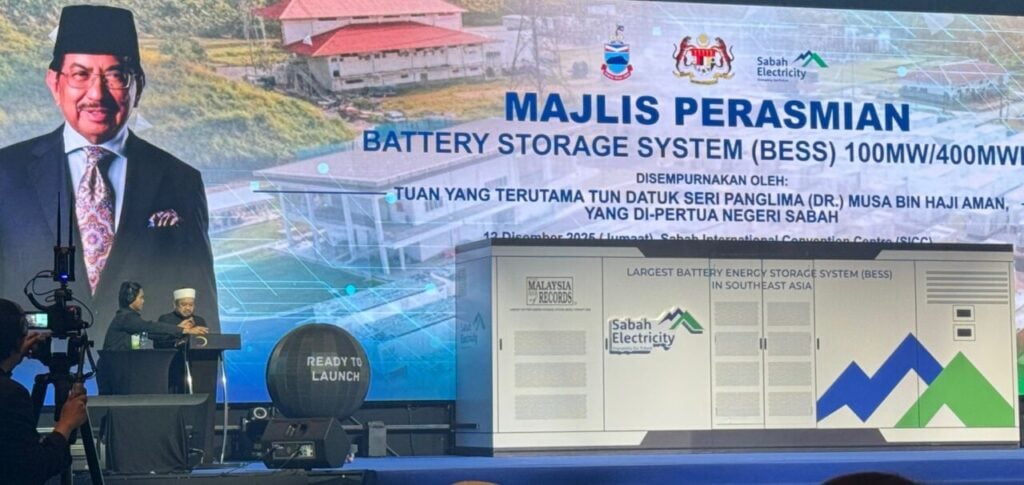
A 100MW/400MWh battery energy storage system (BESS), the biggest project of its kind by output in Southeast Asia, has been welcomed into operation in Sabah, Malaysia.
An inauguration ceremony was held this morning for BESS Lahad Datu, a project aimed at reducing power supply disruption risk on the eastern coast of Sabah, one of two Malaysian states on the island of Borneo.
The Sabah government said the attendance of state dignitaries marked the project’s launch, with prepared remarks read out on behalf of Sabah Chief Minister Hajiji Noor in a ceremony held at Sabah International Convention Centre.
“This achievement is an important achievement for Sabah as BESS Lahad Datu is the largest energy storage facility not only in this country but also in Southeast Asia, which is designed to improve grid stability, reduce dependence on diesel and support the integration of renewable energy in the state,” the minister said.
Try Premium for just $1
- Full premium access for the first month at only $1
- Converts to an annual rate after 30 days unless cancelled
- Cancel anytime during the trial period
Premium Benefits
- Expert industry analysis and interviews
- Digital access to PV Tech Power journal
- Exclusive event discounts
Or get the full Premium subscription right away
Or continue reading this article for free
As with ‘Australia’s largest BESS project’ at Eraring Power Station, at which an expansion has just been announced, BESS Lahad Datu is indeed the largest project of its type in Southeast Asia in megawatt-hour capacity, but in terms of megawatt output, the largest in the region is the Sembcorp 200MW system in Jurong Island, Singapore.
The Jurong Island BESS, which enabled Singapore to meet a government-set 200MW energy storage target in one project, was recently expanded to 326MWh capacity from the initially installed 285MWh that went into operation in early 2023.
The Sabah Chief Minister said BESS Lahad Datu, supervised by the state’s utility company, Sabah Electricity, is part of his government’s commitment to ensuring the stable, sufficient and affordable supply of electricity.
The project has been delivered in just over a year. In September 2024, Chinese solar PV inverter manufacturer Sungrow said that its energy storage system integration arm had signed a contract to supply BESS equipment by renewable energy company MSR-Green Energy (MSR-GE).
MSR-GE had won the project contract from Sabah Electricity a couple of weeks before signing its deal with Sungrow, having participated in a competitive solicitation. The project contract was reported to be worth RM645 million (US$156.53 million) at the time.
The Sabah government is implementing its Sabah Energy Master Plan and Roadmap 2040 (SE-RAMP 2040), after the federal government handed decision-maker powers to the state at the beginning of 2024. The plan and roadmap focus on energy security, affordability and environmental sustainability as their three core principles.
The government has so far approved around 1GW of new hydroelectric, solar PV and wind resources, and a recent solicitation for large-scale solar projects has seen enough capacity approved that by 2027, Sabah will have 350MW of utility-scale PV in operation, which Hajiji Noor said is equivalent to 23% of the state’s total generation capacity mix.
Sevenfold increase in electricity demand by 2030 forecasted
Unlike peninsular Malaysia, which has a well-developed electricity grid and natural gas grid that maintain stability of supply, Sabah requires increased reserve margin to cope with periods of peak demand and support the addition of new resources, including large-scale solar PV.
Chief Minister Hajiji Noor said energy storage must be deployed at strategic locations in Sabah to reduce power outages and enable the increased share of renewables.
A couple of months ago, heads of agreement were signed for Malaysia’s first dispatchable renewable power plant, in the other Malaysian state on Borneo, Sarawak.
Solar PV engineering, procurement and construction (EPC) company Founder Group’s Founder Energy subsidiary is leading a consortium to build a 310MWp ground mount solar PV plant paired with a 620MWh BESS.
Elsewhere in the Southeast Asian country, the picture is also beginning to change. Climate consultancy Ember recently predicted that Malaysia’s power consumption will increase seven times over between 2024 and 2030, with some 2GW of planned data centre developments a major contributor.
Through the national energy commission, Suruhanjaya Tenaga, the government is hosting MyBeST, a national BESS procurement programme, through which four 100MW/400MWh BESS projects totalling 1,600MWh are expected to be awarded soon, aiming for commercial operation in 2026.
The World Bank has just committed to investing an undisclosed sum into Southern Johor Renewable Energy Corridor (SJREC), which would see 4GW of solar PV and 5.12GWh of batteries deployed near Malaysia’s southern border with Singapore.
However, SJREC is intended to be one of several gigawatt-scale projects in the Asia-Pacific (APAC) region that will generate and store renewable energy in neighbouring or overseas countries and transmit power to Singapore.