Energy Dome has signed a contract with Alliant Energy for a 200MWh long-duration energy storage (LDES) project in Wisconsin, which the US utility considers the “first of many.”
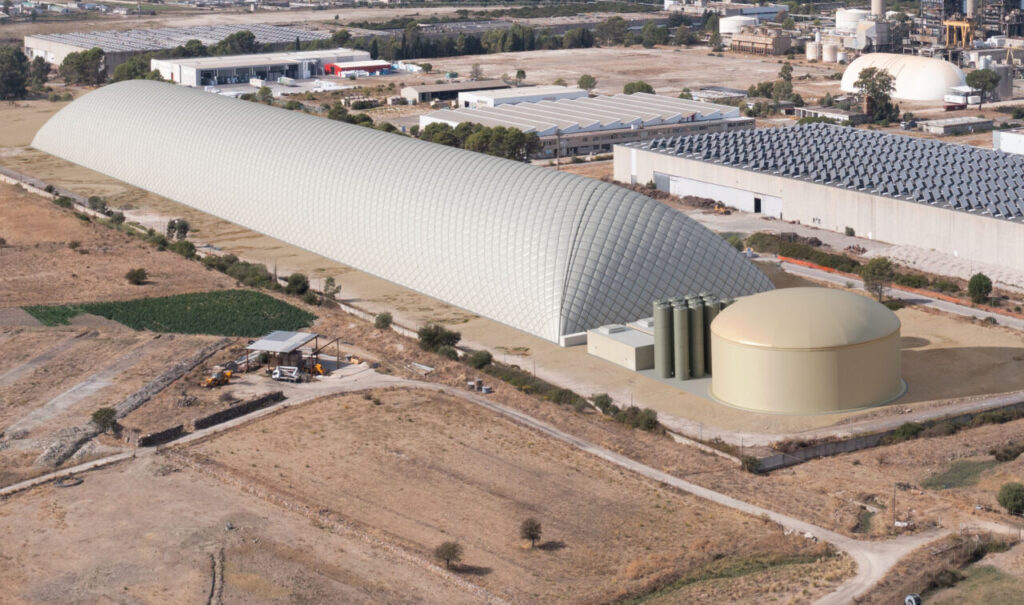
Italy-headquartered Energy Dome holds the IP for its CO2 Battery, which essentially stores energy through the adiabatic compression of carbon dioxide. The gas is liquified during charging and evaporates during discharge in a thermodynamic cycle.
It is intended for energy storage applications involving medium- and long-duration discharge at full power. The company claims it is safe and built using abundant materials and a combination of off-the-shelf manufacturing techniques taken from existing industries.
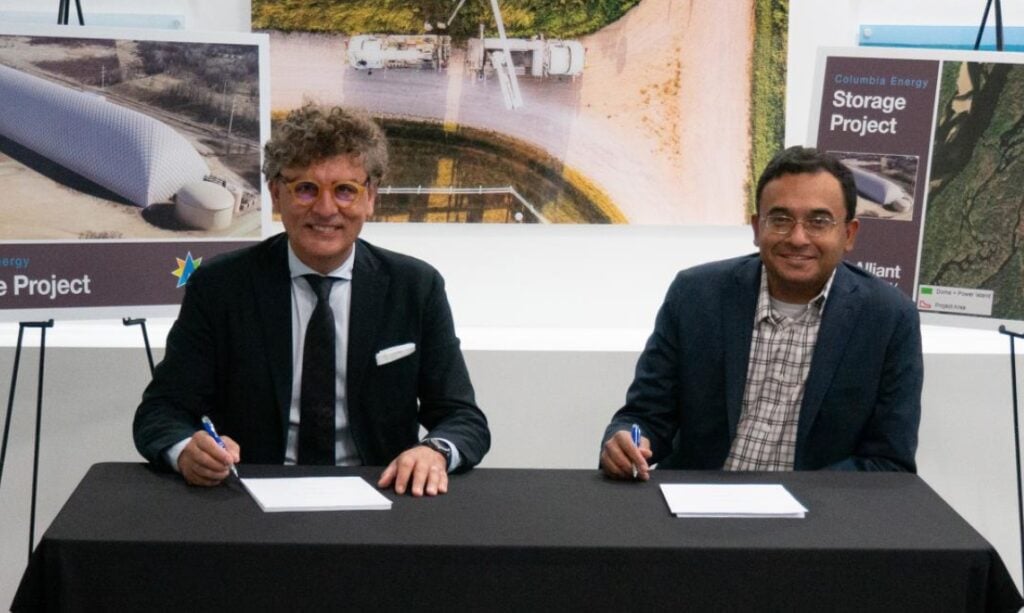
Energy Dome’s CEO and technology inventor Claudio Spadacini and Alliant Energy executive VP Raj Sundararajan signed a supply contract for the 10-hour duration (20MW/200MWh) Columbia Energy Storage Project, the company announced this morning.
Try Premium for just $1
- Full premium access for the first month at only $1
- Converts to an annual rate after 30 days unless cancelled
- Cancel anytime during the trial period
Premium Benefits
- Expert industry analysis and interviews
- Digital access to PV Tech Power journal
- Exclusive event discounts
Or get the full Premium subscription right away
Or continue reading this article for free
The project is planned for a site near an Alliant Energy-operated coal plant in Portage, Wisconsin. The utility filed a project application with the regulatory Public Service Commission (PSC) of Wisconsin in August.
At the time, Alliant Energy said construction was planned to begin in 2026 and go into commercial operation during 2027.
Columbia Energy Storage Project is being developed by a coalition including two other Wisconsin utilities, WEC Energy Group and Madison Gas & Electric, together with Shell Global Solutions and the US Electric Power Research Institute, and two academic institutions.
Output and capacity were originally given as 18MW/180MWh, but this appears to have been revised upwards.
“After a thorough evaluation of technologies available in the market, the Energy Dome’s CO2 Battery stood out as a cost-effective, efficient and scalable solution,” Alliant Energy’s Raj Sundararajan said at the signing of the supply contract.
“We see this as the first of many CO2 Batteries to be built in partnership between Energy Dome and Alliant to continue delivering reliable and affordable energy in the communities we serve.”
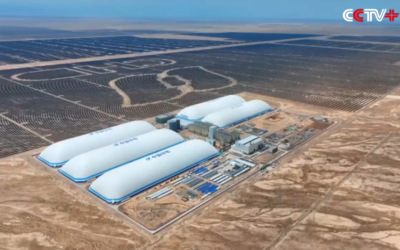
Identical to Energy Dome project currently in construction in Italy
Energy Dome, to date, has delivered one 2.5MW/4MWh commercial-scale demonstrator project in Sardinia, Italy, which went online in 2022.
It is currently building another system in Sardinia which is of the same sizing as the Wisconsin project. Energy Dome said that the 200MWh Sardinia project received full notice-to-proceed in 2023 and is on track for completion by the end of Q1 2025, claiming this to be proof it can deliver multiple megawatt-scale projects quickly.
The startup also claims its modular CO2 Battery is highly standardised, which in addition to speeding up the construction and installation process, means the system in Wisconsin will be identical to the one in Sardinia, and learnings from the Italian project could be applied in the US.
The Alliant Energy project has been selected by the US Department of Energy’s Office of Clean Energy Demonstrations (OCED) to receive US$30 million funding as part of a US$325 million total pledged towards supporting long-duration energy storage technologies.
The DOE defines LDES as technologies that provide 10 hours or more discharge at full rated power, with the department seeking to accelerate cost reduction of LDES 90% by 2030.
Shortly after the DOE’s selection of Columbia Energy Storage in September 2023, the European Investment Bank (EIB) and Breakthrough Energy Ventures invested €60 million (US$65.37 million) in Energy Dome’s Sardinia project, subject to certain conditions.
The company thinks it can pencil out cheaper tolling agreements than lithium-ion battery storage, Ben Potter, Energy Dome COO of its energy-as-a-service division, said in a March 2024 interview with ESN Premium.
Potter also said that because CO2 Battery components do not degrade as lithium-ion battery cells do, they do not need augmentations or repowering after a few years in the field, meaning “the economics stack very, very favourably.”
In addition to the build-own-operate model offered by Potter’s energy-storage-as-a-service division—an area an increasing number of novel non-lithium technology providers are moving into—Energy Dome also sells and supplies the kit for customers to own, as in the case of the Wisconsin project.