Anil Srivastava has vacated his position as CEO of Leclanché with the European battery and energy storage system manufacturer and integrator announcing other leadership changes.
“When I decided to accept this position eight years ago, it was because of the reputation and the exceptional potential of Leclanché,” Srivastava said.
“Today, after all this time with Leclanché, I must say that I am proud of the work I have done together with all employees.”
Leclanché’s chief technology officer (CTO) since 2006, Pierre Blanc, takes over as CEO, and is also the chief technology and industrial officer of subsidiary Leclanché e-mobility. Newly appointed chief sales and development officer Phil Broad is now CEO of the e-mobility division, where he has worked since joining the group in 2018.
Try Premium for just $1
- Full premium access for the first month at only $1
- Converts to an annual rate after 30 days unless cancelled
- Cancel anytime during the trial period
Premium Benefits
- Expert industry analysis and interviews
- Digital access to PV Tech Power journal
- Exclusive event discounts
Or get the full Premium subscription right away
Or continue reading this article for free
Pasquale Foglia, an experienced finance professional who was made interim CFO at the company earlier this year, has been appointed permanently as CFO.
The changes come after a reorganisation of the group’s management structure and the appointment of a new board of directors at the end of September. At that time the group’s owners including main shareholder SEFAM agreed to the conversion of debt owed to it into equity shareholding, and Leclanché noted that this and other measures had enabled the company to finance its development.
The Switzerland-headquartered company makes its own battery cells as well as manufacturing and integrating complete energy storage solutions with its own and third-party cells, for stationary and mobility applications, from grid-scale battery energy storage systems (BESS) to marine propulsion.
The company claimed it has strong customer demand which the capital raised by SEFAM will enable it to meet from its factory in Willstätt, Germany.
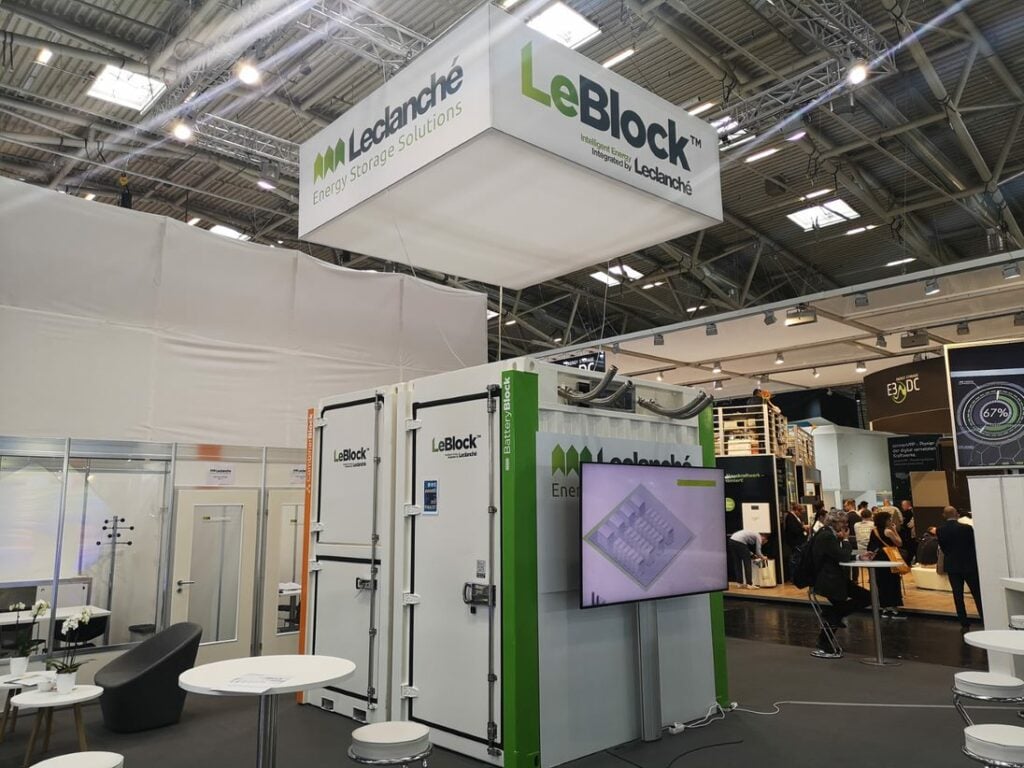
Leclanché launched LeBlock, the newest iteration of its containerised BESS solution for utility-scale applications, in 2021. The product is claimed to be modular and easy to transport and install, featuring combi-blocks that allow for the stacking of multiple 745kWh lithium iron phosphate (LFP) units.
In April it was awarded a contract to provide an 11.9MWh BESS for installation at the site of a solar PV plant in Germany, which will play into frequency regulation markets through an automated bidding software platform.
Other projects Leclanché has underway include a solar-plus-storage power plant on the Caribbean island of St Kitts and Nevis on which construction began in June and features a 44.2MWh lithium-ion BESS paired with a 35.6MW solar PV plant.
In August, the company said it had made a breakthrough for battery storage safety when it unveiled a fire-retardant additive for lithium electrolyte that it claimed could reduce the risk of a thermal event by nearly 80%.