
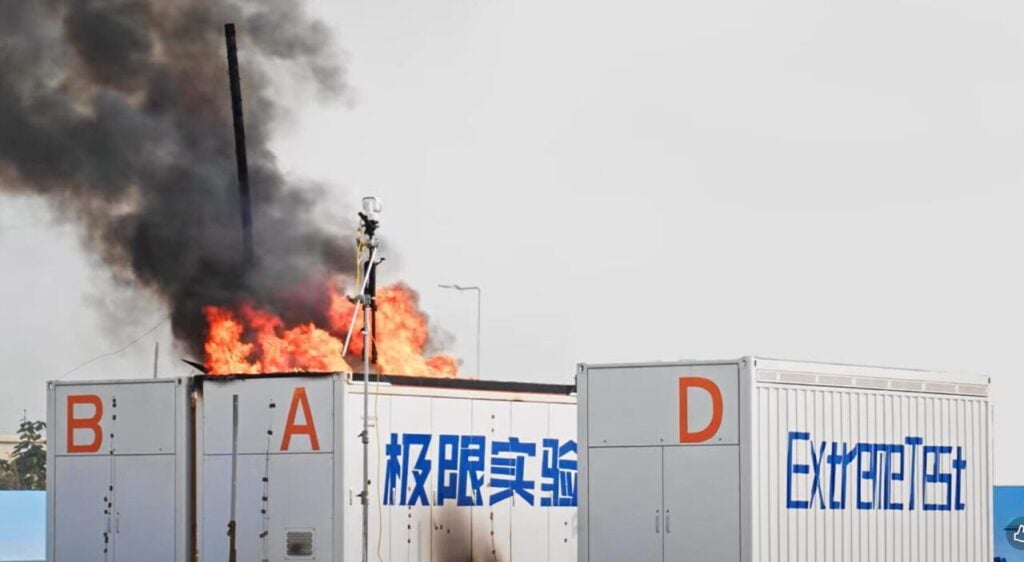
BESS Large-Scale Fire Testing (LSFT) has been adopted as part of best practice thinking on safety validation, with at least a dozen companies announcing tests and results and many more expected going forward. It becomes mandatory in the 2026 edition of NFPA 855.
What is LSFT and why is it being done?
An LSFT involves setting a BESS unit completely alight, with all suppression and detection systems turned off, mimicking a worst-case scenario fire. The aim is to see if the fire spreads to neighbouring units.
LSFT, conducted under a technical specification protocol (CSA TS-800:24) developed by CSA Group, is a companion to the cell-level thermal runaway test UL9540A. UL9540A itself continues to evolve, but its limitations became evident over time.
NFPA 855, including LSFT from this year, is required by many Authorities Having Jurisdiction (AHJs) in the US. It is also a widely used reference for projects elsewhere and is increasingly asked for by insurers and financiers.
Try Premium for just $1
- Full premium access for the first month at only $1
- Converts to an annual rate after 30 days unless cancelled
- Cancel anytime during the trial period
Premium Benefits
- Expert industry analysis and interviews
- Digital access to PV Tech Power journal
- Exclusive event discounts
Or get the full Premium subscription right away
Or continue reading this article for free
No fire, or no propagation?
LSFT’s emergence reflects an acceptance that in the unlikely event a BESS fire does happen, the spread is contained to a single unit at the system level, in much the same way that UL9540A assesses the propagation risk of thermal runaway from a single cell.
In an ideal world, BESS temperature management and fire detection and suppression systems should prevent fires from happening or going beyond a single module. Fire suppression technologies like Etica’s immersion cooling, StatX’s aerosol-based tech or Honeywell’s Li-Ion Tamer off-gas detection systems aim to contribute to reducing fire incidents to near zero.
With LSFTs, technology providers aim to demonstrate that if systems do fail, there will be no repeat of fires at the Moss Landing or Gateway projects in California, where entire BESS arrays caught fire and burned for days.
LSFTs aim to ensure that any future fire events are more like the incident at the Thurrock BESS project in the UK, where a single unit caught fire during construction. With close monitoring and a carefully controlled response, the fire was contained, with no risk to the wider community. The site was declared safe by fire teams and handed back to owner Statera within 24 hours. Thurrock BESS went into commercial operation in the second half of 2025.
“That is the story of BESS fires and the types of loss events that we expect to see for the BESS market going forward,” an insurer said at the time, referencing Thurrock.
So, who has done them?
The table below shows notable LSFTs conducted by leading BESS manufacturers and system integrators, using what has been publicly announced and reported on by Energy-Storage.news.
The list is not comprehensive and as LSFTs become minimum requirements expect more in 2026, possibly between the time of writing and printing.
| Company | Product | Date |
| BYD | MC Cube | June 2025 |
| Canadian Solar | SolBank 3.0 BESS | June 2025 |
| Clou ESS | Aqua C2.5 | May 2025 |
| Envision | Envision Smart Energy Storage | July 2025 |
| Fluence | Gridstack Pro 5000 | June 2025 |
| Hithium | Block 5MWh BESS | June 2025 |
| Huawei | LUNA2000-4472 Series | February 2025 |
| Prevalon | HD5 | April 2025 |
| Rept Battero | Grid-scale BESS product | July 2025 |
| Sungrow | PowerTitan 1.0, PowerTitan 2.0 | June 2024, April 2025 |
| Trina Storage | Elementa 2, Elementa 2 Pro | September 2024, December 2025 |
| Wärtsilä | GridSolv High Energy, Quantum 2 and Quantum 3 | 2023/2024 |
The timeline of LSFTs
Sungrow claimed to have taken a pioneering approach to fire testing with its PowerTitan 1.0 BESS solution in June 2024, conducting a test broadcast live with DNV oversight. It followed this with PowerTitan 2.0 testing in April 2025, featuring a 25-hour burn duration that demonstrated no propagation to neighbouring units. Wärtsilä followed with LSFTs on its products later that year.
Hithium claimed a significant milestone with its LSFT in June 2025, conducting what it termed the “world’s first all open-door LSFT.” This 15-hour full combustion test at 100% state of charge (SOC) was conducted by UL Solutions.
Fluence conducted comprehensive testing of its Gridstack Pro 5000 system in June 2025 at SAFE Labs in North Carolina, combining five days of explosion testing with fire testing under CSA Group observation. BYD, Canadian Solar and other providers conducted significant tests throughout 2025.
A notable omission from the list is Tesla, which has not publicly made any announcements about an LSFT on its Megapack technology. A fire at the Tesla-supplied Victorian Big Battery project in Australia in 2022 during commissioning tests saw one 3MWh Megapack ignite and spread to a neighbouring unit, although it did not propagate further and burned out within six hours, in line with the manufacturer’s guidance.