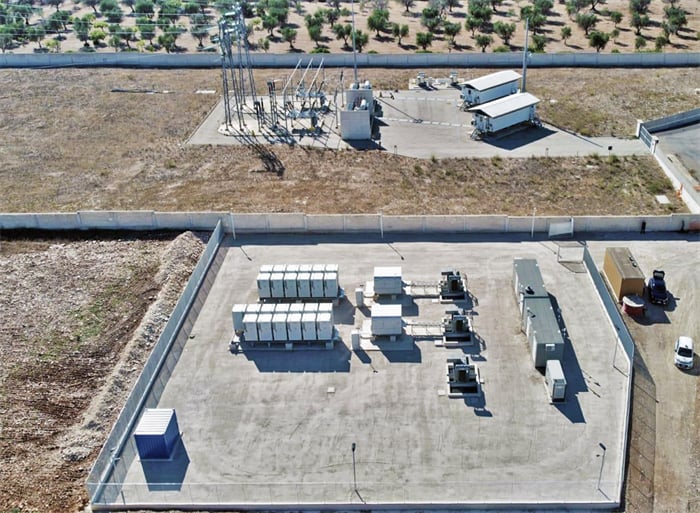
PV module manufacturer Trina Solar has deployed its first energy storage project in Italy, for its project development arm.
Subsidiary Trina Storage has commissioned the 9.3MWh battery energy storage system (BESS) project in Torre di Pierri, Italy, in the province of Taranto, southeast Italy.
The owner of the project is Trinasolar’s International System Business Unit (ISBU), its global project development. The standalone BESS will support grid stability and also do wholesale energy trading.
The project has a contract with Italian transmission system operator (TSO) Terna to provide the Fast Reserve ancillary service for 1,000 annual operation hours, following a tender run by the TSO. The remaining capacity will be used for energy arbitrage.
Try Premium for just $1
- Full premium access for the first month at only $1
- Converts to an annual rate after 30 days unless cancelled
- Cancel anytime during the trial period
Premium Benefits
- Expert industry analysis and interviews
- Digital access to PV Tech Power journal
- Exclusive event discounts
Or get the full Premium subscription right away
Or continue reading this article for free
Gabriele Buccini, head of utility storage at Trina Storage said: “Commissioning our first utility storage system in Italy is a significant milestone for Trina Storage and the wider Trinasolar group. Trinasolar is an integrated provider of renewable energy solutions, and Trina Storage and Trinasolar ISBU are proud to have worked together to connect the company’s first system to the Italian grid.”
Trina’s Elementa 2 grid-scale BESS product uses in-house manufactured battery cells. The company talked through this approach in a recent webinar with Energy-Storage.news, which you can watch here.
Italy has relatively little grid-scale energy storage online but that number is expected to soar in the next few years, with Terna estimating it ultimately needs 71GWh online by 2030 to integrates its renewables pipeline (Premium access article).
Projects will be monetised through a combination of ancillary services, which have kickstarted the market’s growth, energy arbitrage and a dedicated time-shifting capacity market mechanism where renewable IPPS can buy time-shifting capacity from BESS operators, detailed in the above piece.