
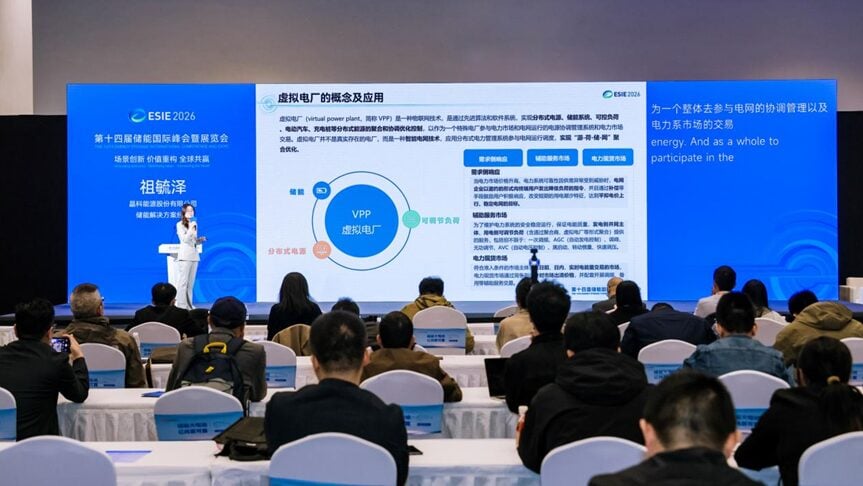
Jinko ESS has unveiled an integrated Virtual Power Plant (VPP) solution at the 14th Energy Storage International Conference and Expo (ESIE 2026) in Beijing. The solution introduces an innovative approach to addressing systemic challenges associated with high renewable energy penetration, marking the company’s transition from an energy storage equipment provider to a comprehensive “storage + aggregation” energy service provider, enabling distributed energy resources to evolve from passive grid connection to active aggregation and dispatch.
As the share of wind and solar capacity continues to rise, power systems are approaching critical thresholds in flexibility, leading to increasing challenges such as supply-demand imbalances, renewable energy curtailment, and limited system regulation capacity. In this context, the coordinated development of energy storage and VPPs has emerged as a key pathway to enhance system flexibility, ensure grid stability and unlock diversified value streams. Meanwhile, policy support is accelerating market growth.
The latest ‘Guiding Opinions on Accelerating the Development of Virtual Power Plants’ issued by China’s NDRC formally defines VPPs and recognizes them as independent market entities, while setting clear development targets of over 20 GW by 2027 and 50 GW by 2030. Regional deployment is also gaining momentum, with evolving market mechanisms shifting from subsidy-driven models toward market-based revenue and cross-regional trading.
Jinko’s ‘Virtual Battery’ platform adopts an advanced ‘Cloud–Station–Edge’ architecture, with the cloud layer integrating IoT-enabled data acquisition and a centralized data platform, directly interfacing with power trading markets and dispatch centers, the station layer leveraging an Energy Management System (EMS) for precise device-level control and the edge layer aggregating diverse distributed resources, including photovoltaics, energy storage systems, flexible loads and electric vehicles.
At its core, the platform is powered by four intelligent algorithm clusters, including operations research optimization for dynamic dispatch, machine learning for equipment state prediction, deep learning for renewable generation and load forecasting and model predictive control (MPC) for cost optimization and enhanced resilience to system fluctuations.
Looking ahead, Jinko ESS is developing a next-generation system based on advanced energy foundation models, driving a paradigm shift from data-driven to AI-native intelligent operations. With an AI-powered trading strategy engine—supporting applications such as peak-valley arbitrage, spot market decision-making and multi-scenario optimization—combined with an intelligent risk control system featuring price spread alerts and rapid response to dispatch deviations, the platform is designed to maximize asset-level returns.
