
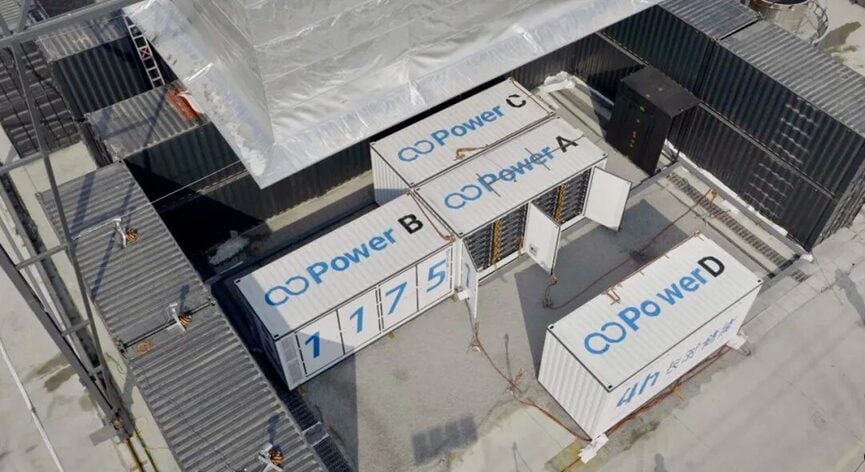
HiTHIUM has completed the world’s first open-door large-scale fire test of its ∞Power 6.25MWh 4h long-duration energy storage (LDES) system, equipped with kAh battery cells. The test was conducted under the supervision of representatives from UL Solutions, U.S. Authorities Having Jurisdiction and Fire Protection Engineers, strictly complying with the latest requirements of UL 9540A 2025 and NFPA 855-2026.
The test results demonstrated that the high-energy-density 6.25MWh energy storage system, incorporating ultra-large-capacity battery cells, exhibited stable and controllable safety performance under extreme conditions, marking a critical breakthrough in safety validation at higher energy levels for LDES systems and further strengthening the safety foundation for large-scale industry deployment.
Building on its previous open-door fire test of a 5MWh system, HiTHIUM conducted an upgraded validation focusing on the ∞Power 6.25MWh LDES system and its core 1175Ah ∞Cell, verifying system-level safety at significantly higher energy levels.
The test was conducted under the most stringent conditions: the container doors remained fully open throughout the test, creating an “open-door combustion” condition to maximize oxygen supply and flame impact; adjacent containers were arranged back-to-back and side-by-side with spacing of only 15 cm; the system operated at 100% state of charge; and all active fire suppression systems were disabled, relying solely on intrinsic safety design.
To address the compounded risks introduced by ultra-large-capacity cells and high-energy-density systems, HiTHIUM implemented a multi-layer safety architecture spanning cell, module and system levels. Guided by the core technical approach of “release, protection and resistance,” the test validated the three core safety challenges.
To manage the massive energy release of the 1175Ah cells during thermal runaway, the company designed a three-dimensional airflow channel with directional venting and the module adopted a dual pressure relief valve safety design. This structure enabled rapid and controlled gas release at the cell and module levels, preventing explosive pressure buildup. No explosions or debris ejection were observed during the test.
Under the most severe conditions of open-door combustion and minimal spacing, the system endured direct flame exposure and intense heat transfer. Fire-resistant module covers, reinforced steel enclosures and insulated multi-layer container structures confined the fire to a single battery system with no thermal propagation across the containers, with the temperature of cells in adjacent containers remaining below safety thresholds.
To withstand prolonged high-temperature exposure, the 6.25MWh ∞Power system was structurally reinforced with a high-strength steel frame, stiffeners and dual-layer partitions. After continuous combustion, the affected container remained structurally intact, with no significant deformation or collapse observed.