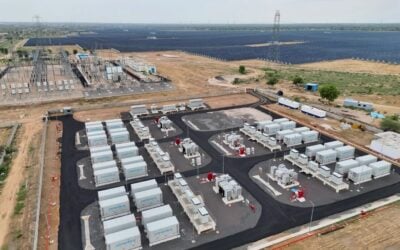
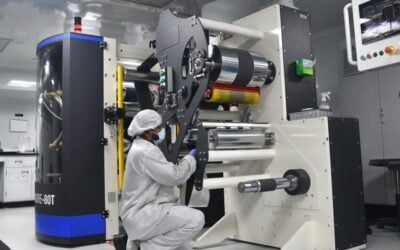
Detail of an AES Advancion array. Image: AES.
What is thought to be India’s first grid-scale energy storage array will be developed and delivered by a joint partnership between system provider AES and Mitsubishi Corporation, it was announced.
A 10MW system built on AES’ lithium-ion battery-powered Advancion platform will be delivered to grid operator Tata Power Delhi Distribution (Tata Power DDL). One of the primary motivations for its deployment is to aid the penetration of rooftop solar.
The Advancion array, which AES has deployed in numerous locations around the world, will in this instance help manage peak loads, increase flexibility of the network and improve reliability of power supplies. It will be installed in Rohini, Delhi and is expected to be completed by the end of this year.
“For a rooftop solar program to be successful, it is important for the distribution network to integrate it with energy storage solutions to take care of power generation spikes and fluctuations, system stability, reactive power compensation and grid emergencies,” Tata Power DDL’s CEO and managing director Praveer Sinha said.
Try Premium for just $1
- Full premium access for the first month at only $1
- Converts to an annual rate after 30 days unless cancelled
- Cancel anytime during the trial period
Premium Benefits
- Expert industry analysis and interviews
- Digital access to PV Tech Power journal
- Exclusive event discounts
Or get the full Premium subscription right away
Or continue reading this article for free
“This will prove to be an important learning for developing integrated rooftop solar and storage solutions for India.”
AES and Japan’s Mitsubishi Corporation signed an agreement to work together in February last year, to sell Advancion – which is now into its fourth generation – into markets including Asia, Australia and New Zealand.
India’s renewable energy ambitions could drive storage demand
As frequently reported on sister site PV Tech, India’s current Prime Minister Narendra Modi is keen to foster renewable energy development, leading to seemingly weekly announcements of vast solar PV projects. The country has a target of 100GW of solar by 2022. This has already led to a number of Indian states tendering for solar projects paired with energy storage.
An aspirant middle class which seeks more reliable energy supplies and several hundred million people in rural populations that want greater access to electricity mean that demand is expected to continue to grow. In a blog for this site in October last year, analyst Harsh Thacker of the India Energy Storage Alliance (IESA) talked of a potential 15GW of large-scale opportunities in India over the next seven years in energy storage.