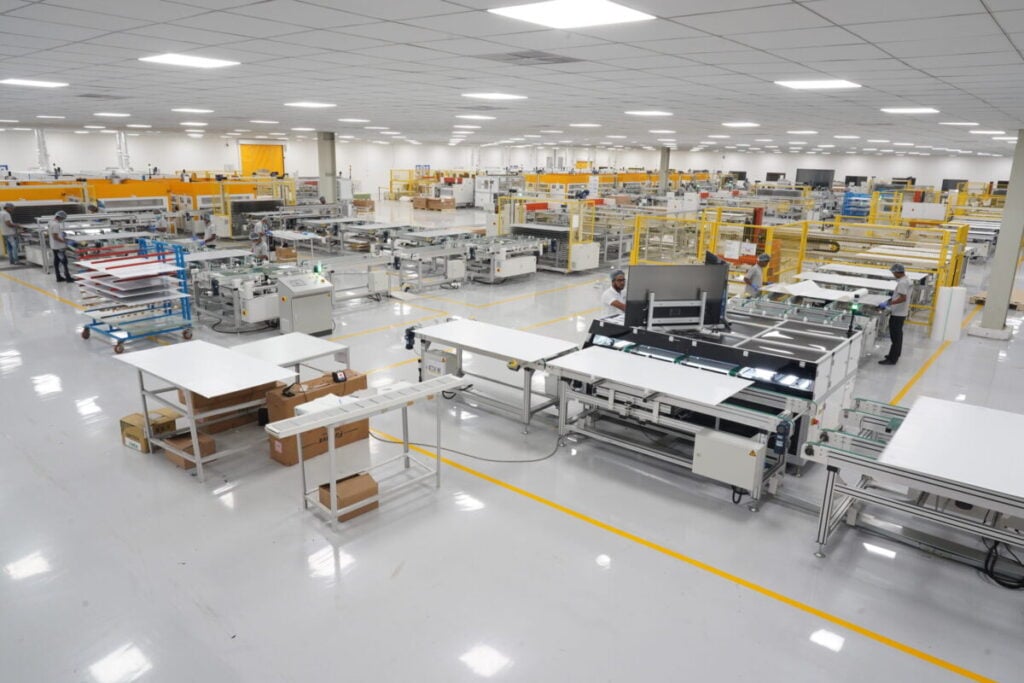
An energy storage subsidiary of Waaree Energies has raised INR10 billion (US$110.9 million) in funding for a planned manufacturing plant in India.
Waaree said yesterday that its subsidiary, Waaree Energy Storage Solutions Pvt Ltd (WESSPL), has completed the funding round. It will be put toward the total INR100 billion investments required for WESSPL to build a lithium-ion (Li-ion) cell and pack factory.
Waaree said the plant is planned to have a combined 20GWh of annual production capacity when fully ramped, although the split between cell and module production capacities was not disclosed. It will make products for the battery energy storage system (BESS), electric mobility and distributed energy markets.
The group is considered India’s biggest solar PV manufacturer with 22.3GW of annual solar module manufacturing capacity and 5.4GW of PV cell manufacturing capacity.
Try Premium for just $1
- Full premium access for the first month at only $1
- Converts to an annual rate after 30 days unless cancelled
- Cancel anytime during the trial period
Premium Benefits
- Expert industry analysis and interviews
- Digital access to PV Tech Power journal
- Exclusive event discounts
Or get the full Premium subscription right away
Or continue reading this article for free
At the end of December, Waaree said it is the manufacturer with the most capacity listed on the Indian government’s Approved List of Models and Manufacturers (ALMM) for PV modules, published by the Ministry of New and Renewable Energy (MNRE) to denote that suppliers’ products have passed quality and efficiency evaluations.
As well as a majority of its capacity located within India, the numbers include a module assembly plant in Texas, US, which the company is expanding to 3.2GW of annual nameplate capacity from an initially planned 1.6GW.
According to the company, the funding round was completed with investment from strategic investors that included family offices and high-net-worth individuals and institutional financiers, although names were not disclosed in a press release or stock exchange announcement.
“With these strategic resources, we will fast-track the commissioning of our 20GWh cells and battery pack facility, strengthen domestic supply chains, and contribute to the growth of India’s energy storage capacity,” WESSPL director Ankit Doshi said.
National efforts to create domestic value chains
The announcement comes a few days after the national Ministry of Power issued a directive requiring all projects bidding for capex support under the government’s Viability Gap Funding (VGF) scheme to utilise a minimum of 20% domestic content by capex value.
Waaree Energies said the new factory will be a key milestone in its integrated renewable energy manufacturing roadmap. The group aims to vertically integrate manufacturing of everything from solar PV modules and inverters to batteries, complete energy storage systems (ESS) and other technologies.
While both public and private sector promotion and support for Indian solar manufacturing has largely been successful, including the more tricky cells as well as modules—our colleagues at PV Tech recently noted India had 120GW of PV module production capacity and 29.3GW of annual cell capacity as of June last year, according to the Institute for Energy Economics and Financial Analysis (IEEFA)—the promotion of batteries and ESS equipment manufacturing is still at a much earlier stage.
IEEFA said in a December report that much of the solar manufacturing impetus had been provided by the government’s Production Linked Incentive (PLI) scheme since it was introduced in 2022.
A PLI scheme for advanced cell chemistry (ACC) battery manufacturing was run in 2021-2022, awarding Capex support to four companies building 40GWh of annual capacity. However, the scheme had targeted incentivising 50GWh in total. At the same time, the manufacturing ambitions of the other three, which do not include Waaree, have faced delays, Debmalya Sen, president of the India Energy Storage Alliance (IESA) wrote in a Guest Blog for this site in May last year.
At the Energy Storage Summit India 2025 in October, the audience heard that while investments in downstream technologies such as battery management systems (BMS) and liquid cooling systems have largely been successful, the Indian energy storage market is still dependent on imported cells, which represent about 80% of total system costs.