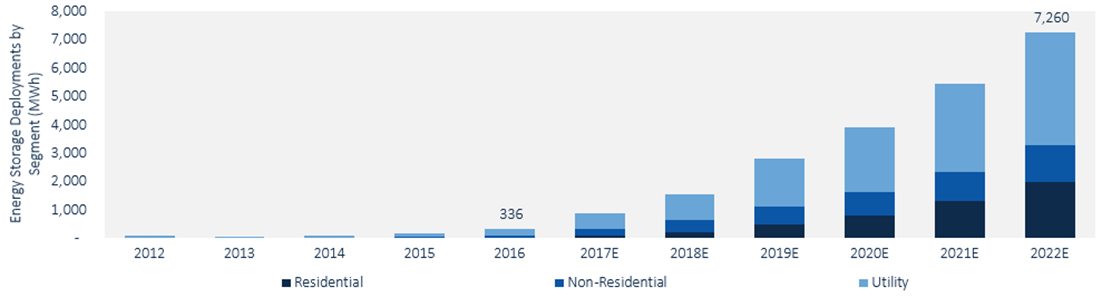
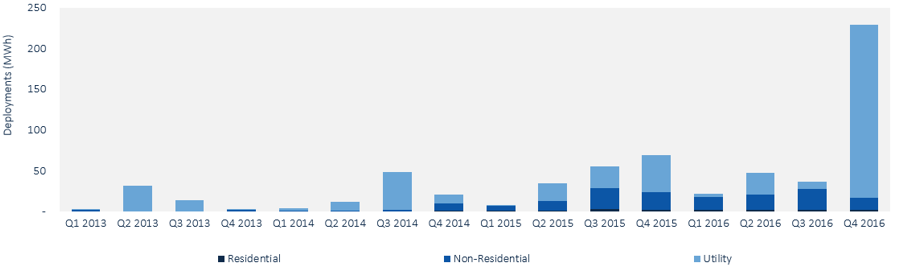
Led by a record-breaking final quarter, energy storage reached 336MWh in 2016, growing 100% in megawatt-hours from 2015’s installed capacity, despite staying roughly flat in megawatts with 221MW deployed last year.
In fact, the energy storage market is set to grow from 336MWh in 2016 to 7.3GWh in 2022 when it will be a US$3.3 billion market.
According to Ravi Manghani, GTM Research’s director of energy storage, Q4 2016 was an inflection point in storage deployments in the US, with 230MWh coming online; more than the sum of the previous 12 quarters combined.
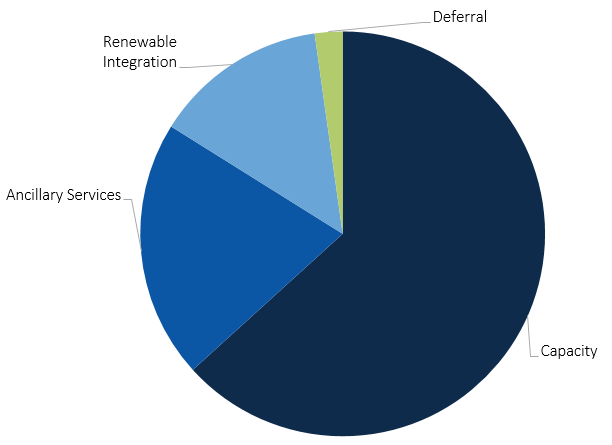
“The fourth quarter marked a turning point in the U.S. utility-scale energy storage market, reflected by the burst of deployments over an extremely short period from inception to interconnection,” said Manghani. “California will play a significant role in the future as utilities there continue to contract energy storage under the state’s 1.3-gigawatt mandate. While California took over the pole position in 2016 from PJM, the market shift was also transformational in terms of applications — from short-duration ancillary services to longer-duration capacity needs.”
Try Premium for just $1
- Full premium access for the first month at only $1
- Converts to an annual rate after 30 days unless cancelled
- Cancel anytime during the trial period
Premium Benefits
- Expert industry analysis and interviews
- Digital access to PV Tech Power journal
- Exclusive event discounts
Or get the full Premium subscription right away
Or continue reading this article for free
“The energy storage industry is rapidly maturing, and in 2016 we saw that growth take hold in a significant way,” said Matt Roberts, executive director of the Energy Storage Association. “The energy storage industry’s rapid response to address the Aliso Canyon disaster, as well as the continued growth in applications and business models for storage systems, signals to all stakeholders the immense value that energy storage systems are delivering today.”
The growth experienced in the fourth quarter can be mainly attributed to California, which made up 88% of all installed energy storage capacity; driven by the projects that were procured in response to the four-month long Aliso Canyon gas leak. GTM Research’s latest report details that this trend of long-duration energy storage is likely to continue this year also.
Utility-scale storage accounted for most of the deployed megawatt-hours in Q4 2016, with behind-the-meter commercial and residential storage systems representing 25% of capacity on the year. Again, the majority of that commercial storage was from California, but two-thirds of the residential segment came from outside California and Hawaii. GTM Research anticipates that the residential segment, although growing from a small base, will be the fastest growing segment over the next five years.