Lenders’ requirements for contracted revenues for battery energy storage system (BESS) projects in the UK appears to have softened, an executive at investment firm Triple Point said.
Ariane Brunel, investment manager for the company was talking to Energy-Storage.news ahead of the Energy Storage Summit 2026 in London, which takes place on 24-25 February, in less than a month’s time.
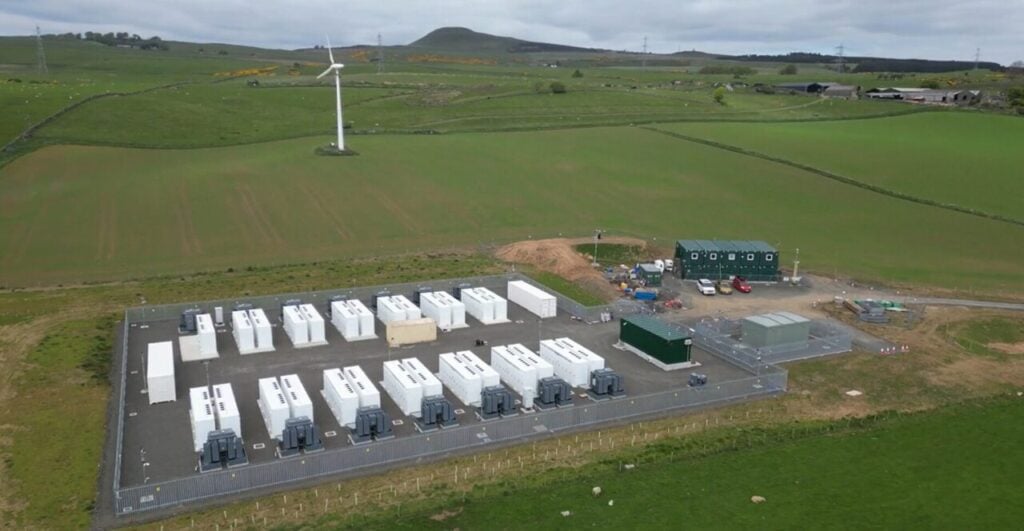
Triple Point has been very active in the UK’s merchant BESS financing space, supporting projects from developers and owner-operators including Noriker Power, Balance Power, Ethical Power, Innova and TagEnergy. It helped finance TagEnergy’s 100MWh Pitkevy BESS, pictured above. ‘Merchant’ means a project has little or no contracted revenues.
Brunel will be speaking on the ‘M&A Market: How Attractive is BESS Right Now?’ panel discussion on Day One. In this Q&A, she discusses broad trends in the European market and financing, commercialisation and project delivery in the UK specifically.
Try Premium for just $1
- Full premium access for the first month at only $1
- Converts to an annual rate after 30 days unless cancelled
- Cancel anytime during the trial period
Premium Benefits
- Expert industry analysis and interviews
- Digital access to PV Tech Power journal
- Exclusive event discounts
Or get the full Premium subscription right away
Or continue reading this article for free
Energy-Storage.news: How would you characterise the current state of the European energy storage market, in terms of the key trends, major successes and achievements, and challenges still to be overcome?
Ariane Brunel: The European energy storage market is at a pivotal stage of maturity, having transitioned from a niche technology to an increasingly mainstream infrastructure asset. Deployment has accelerated across multiple jurisdictions, supported by growing lender and investor confidence, improved technology performance and more sophisticated revenue-stacking strategies.
Financing structures and monetisation models have evolved accordingly, with greater acceptance of merchant exposure alongside emerging alternatives such as tolling arrangements, reflecting a deeper understanding of the role storage plays in balancing power systems with high renewable penetration.
At the same time, important challenges remain. Merchant revenues continue to be volatile and complex to forecast, grid connection constraints are slowing project delivery in several markets, and contractual and regulatory frameworks remain uneven across Europe.
While the sector has achieved clear milestones in terms of bankability and market participation, further progress on standardisation, grid access and long-term policy clarity will be critical to sustaining growth and reducing risk premiums as the market continues to scale.
UK market
How is the financing of BESS projects evolving in the UK?
A few years ago, the financing market for BESS projects was dominated by a relatively small group of specialist lenders. Over the past two or three years, there has been a marked increase in the number of active market participants. This expansion reflects the fact that BESS technology is now better understood by lenders and is increasingly viewed as a proven and bankable technology, supported by a more established revenue framework.
That said, the revenue profile for BESS remains comparatively less straightforward than for more mature and “vanilla” technologies such as solar and wind, particularly where merchant revenues form a material part of the business case. In that context, it is notable that pricing and risk premiums do not always appear fully aligned with the underlying complexity and volatility of BESS revenues, and in some cases seem to reflect heightened competition among lenders rather than the actual risk profile of the assets.
Closely related to that is how projects are monetised: how is the balance between merchant and tolling/fixed revenue schemes changing?
Closely linked to the evolution of financing is the way BESS projects are monetised, and in particular the balance between merchant exposure and contracted revenues. The market has clearly seen a shift in lender risk appetite over time.
For debt-financed projects, lenders initially required a minimum level of contracted revenues—often around 50% of projected cash flows, typically supported by floor mechanisms. As confidence in the asset class grew, this requirement softened, with many financings accepting significantly higher merchant exposure and, in some cases, little or no long-term contracted revenue beyond what might be provided under a capacity market or optimisation agreement, if at all.
This evolution in lender risk appetite has, in practice, driven how projects are monetised. However, following several years of heightened volatility in merchant revenues, there has been renewed interest in tolling arrangements and other structures offering greater revenue certainty (going beyond the traditional floor mechanisms).
While such structures remain relatively limited in volume, their increasing use highlights a continued willingness among certain sponsors and lenders to participate in the BESS market while seeking to secure more predictable and contracted cash flows.
What is the current mix of ‘full wrap’ and ‘multi-contracting’ for BESS project delivery, and is this/how is this expected to change going forward?
The evolution of delivery structures for BESS projects closely mirrors what happened in the solar and wind sectors. Initially, lenders typically required a fully wrapped engineering, procurement and construction (EPC) structure in order to mitigate construction and interface risk. As the market has matured and participants have gained greater familiarity with BESS technology and delivery risk, a multi-contracting approach has become increasingly accepted and is now widely viewed as bankable.
As a result, the choice between a fully wrapped EPC contract and a multi-contracting structure is today largely a commercial decision for sponsors rather than a lender-driven constraint. Sponsors must weigh the higher cost and risk transfer associated with a fully wrapped solution against the potential cost savings of a multi-contracting approach, which comes with increased interface and coordination risk. Looking ahead, this dynamic is not expected to change materially, with both structures likely to continue co-existing, selected on a project-by-project basis depending on sponsor capability, risk appetite and project complexity.