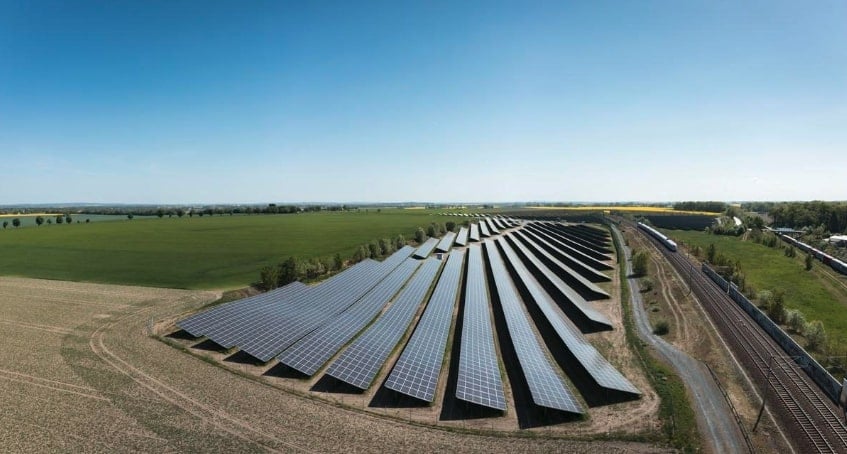
Germany awards Innovation Tender contracts to 512MW of solar-plus-storage bids

LinkedIn
Twitter
Reddit
Facebook
Email

Germany has awarded 512MW of capacity to solar-plus-storage projects in its most recent Innovation Tender auction.

The auction, run by the Bundesnetzagentur – the German Federal Network Agency – had a total available capacity of 583MW. 48 project bids were submitted, adding up to a total of 564MW, and ultimately 512MW was accepted, while five bids were rejected.

The prices for successful bids ranged between €0.0678/kWh (US$0.073/kWh) and €0.0917/kWh and the average volume-weighted price was €0.0833/kWh, which the Bundesnetzagentur said was “well below” the maximum tendered price.

The auction sought solar-plus-storage projects on arable grasslands, with different criteria offered for different states. Bavaria was awarded the most capacity by far, with 245MW across 24 projects. Next closest was Mecklenburg-Western Pomerania with four projects for 79MW and Schleswig-Holstein with five projects for 73MW.

This article requires Premium SubscriptionBasic (FREE) Subscription

Try Premium for just $1

  • Full premium access for the first month at only $1
  • Converts to an annual rate after 30 days unless cancelled
  • Cancel anytime during the trial period

Premium Benefits

  • Expert industry analysis and interviews
  • Digital access to PV Tech Power journal
  • Exclusive event discounts

Or get the full Premium subscription right away

Or continue reading this article for free

The October 2023 iteration of the innovation auction was oversubscribed and awarded 408MW of solar-plus-storage capacity.

At the same time, the government announced the results of its latest onshore wind auction, where over 2.3GW of capacity was awarded, which it said “set a new record”.

To read the full version of this story, visit PV Tech.
15 September 2026
Berlin, Germany
Launching September 2026 in Berlin, Energy Storage Summit Germany is a new standalone event dedicated to Germany’s energy storage market. Bringing together investors, developers, policymakers, TSOs, manufacturers and optimisation specialists, the Summit explores the regulatory shifts, revenue models, financing strategies and technology innovations shaping large-scale deployment. With Germany targeting 80% renewables by 2030, it offers a focused platform to connect with the decision-makers driving the Energiewende and the future of utility-scale storage.

Read Next

July 3, 2026
AGL has delivered a solar and battery microgrid described as “one of the largest privately owned non-mining microgrids in Australia”.
July 2, 2026
Singapore-headquartered clean energy developer Vena Energy has raised AU$1.4 billion (US$970 million) in green finance to support 614MW of solar PV capacity and 1,141MWh of battery energy storage systems (BESS) in Australia.
July 1, 2026
Three massive BESS projects have been launched in Europe: BW ESS has broken ground on a 1GW/5.7GWh system in Germany, while Greenvolt and Giga Storage have enlisted suppliers (BYD and Tesla) for 2.4GWh and 2.8GWh projects in Poland and Belgium.
June 30, 2026
EnBW and VPI have launched construction on large-scale BESS projects in Germany, while Elements Green and Eku Energy have agreed supply and acquisition deals respectively for separate 400MW/1,600MWh projects.
June 29, 2026
Two recent microgrid projects highlight the expanding role of flow batteries, with Quino Energy deploying organic flow batteries in the Maldives and the Paskenta Band of Nomlaki Indians integrating zinc hybrid cathode storage in Northern California.