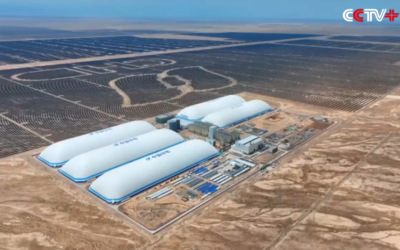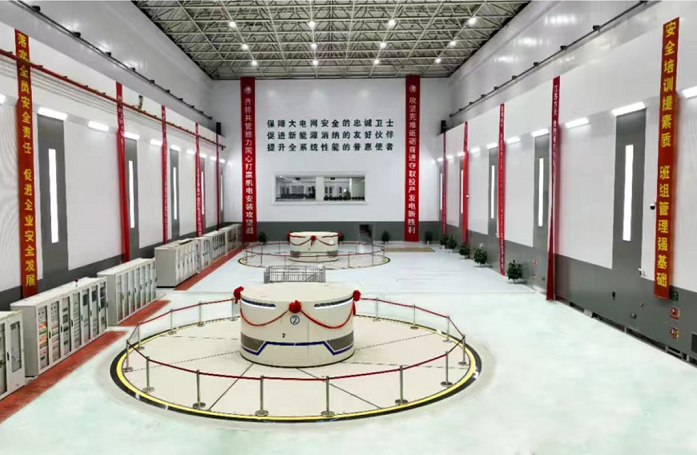
The hydropower subsidiary of General Electric’s renewables business has installed the first pair of 300MW turbines at a pumped hydro energy storage (PHES) site in China.
GE Renewable Energy’s GE Hydro Solutions said last week that the turbines are in place at the project in Jinzhai County, Anhui Province.
The company is supplying four turbines, generator-motors, and balance of plant (BOP) equipment to the 1,200MW long-duration energy storage (LDES) resource. Duration of the storage was not disclosed by GE in a press release, but PHES plants typically have between about 6 to 20 hours duration.
GE Hydro Solutions was awarded the project by state-owned entity State Grid Xinyuan’s pumped hydro division, Anhui Jinzhai Pumped Storage Power Co. State Grid Xinyuan is a member of the International Hydropower Association, and its owners are State Grid Corporation of China and China Three Gorges Corporation, which hold 70% and 30% stakes respectively.
Try Premium for just $1
- Full premium access for the first month at only $1
- Converts to an annual rate after 30 days unless cancelled
- Cancel anytime during the trial period
Premium Benefits
- Expert industry analysis and interviews
- Digital access to PV Tech Power journal
- Exclusive event discounts
Or get the full Premium subscription right away
Or continue reading this article for free
China’s national energy strategy includes a commitment to building more than 200 PHES plants around the country, adding up to 270GW, by 2025.
With GE having delivered 8.2GW of pumped hydro in China already, the US company claimed it is responsible for about a quarter of China’s existing PHES, as well as its equipment being used in just under a third of all PHES plants worldwide.
GE’s first two 300MW turbines at the Jinzhai site have passed a period of trial operation successfully and are now connected to the grid.
“Once the project is fully commissioned, the giant 1.2GW hydro battery will offer a high level of flexibility and reliability to the local power grid,” GE Hydro Solutions president and CEO Pascal Radue said.
Like other PHES plants the world over, the storage system will help bring flexibility to the grid network. It will ‘charge’ with energy during off-peak periods and times when renewable energy production is abundant, outputting to the grid its stored energy when demand peaks. GE Renewable Energy talked up its ability to reduce reliance on coal in the area.
Global energy transition prompting pumped hydro revival
Energy-Storage.news has reported on numerous pumped hydro developments in the past few months.
Australia’s first new PHES plants since the mid-1980s are currently under construction amid plans for more, while in Switzerland a 20GWh plant was inaugurated in June and a 40GWh PHES commissioned a few weeks later in Portugal.
Elsewhere in Europe, plans have been announced for new PHES plants in Estonia, the UK and Finland within the last couple of months, while earlier this week the site reported that in India, an energy storage tender hosted by state-owned power group NTPC’s renewables subsidiary was won by a bid for a 500MW/3,000MWh PHES plant proposed by renewable power producer Greenko.
Other projects in development include a 7GWh project in Malawi, Africa, and a 500MWh project in the Philippines.
Those are among the projects covered, but you can see more of our pumped hydro energy storage coverage here.