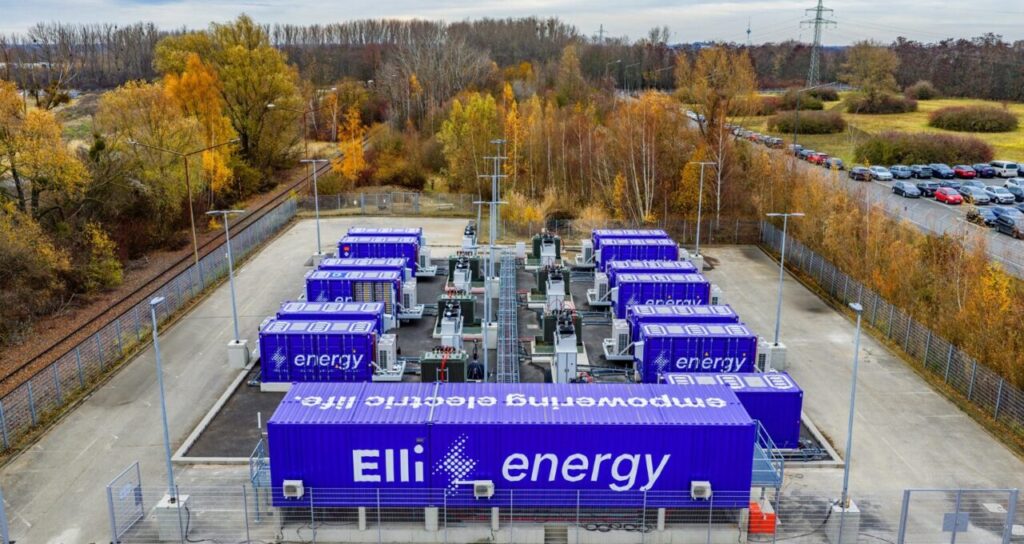
Software and optimisation firms Flower, Volkswagen’s Elli and Nuvve have progressed large-scale BESS projects under own-and-operate models.
Flower has bought a project in Germany while Elli has commissioned one there, while Nuvve is launching its first Europe BESS in Sweden, with all three totalling nearly 400MWh.
Sweden’s Flower buys largest BESS yet in Germany
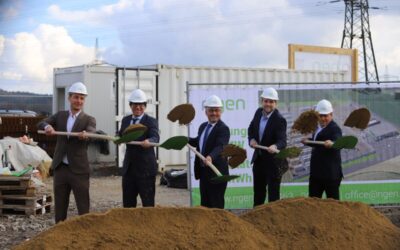
Sweden-headquartered optimiser Flower has further moved into owning large-scale battery energy storage system (BESS) projects with the acquisition of a 63MW/257MWh project in Dollnitz, Saxony-Anhalt, Germany. The project has a 4-hour duration, relatively long for the German market.
The deal is being done via a share purchase agreement with developer CCE. Flower will be responsible for project financing, EPC, operations and commercialisation of the project. Construction is scheduled for 2027 with commercial operation targeted for 2028.
Try Premium for just $1
- Full premium access for the first month at only $1
- Converts to an annual rate after 30 days unless cancelled
- Cancel anytime during the trial period
Premium Benefits
- Expert industry analysis and interviews
- Digital access to PV Tech Power journal
- Exclusive event discounts
Or get the full Premium subscription right away
Or continue reading this article for free
The firm started primarily as an optimiser but has moved into long-term BESS ownership. In an interview with Energy-Storage.news in 2024, CEO John Diklev explained that this was to prove the firm’s strategy and market thesis around BESS’ untapped value in long-term offtake and risk management for renewables.
It then bought its first BESS project in Sweden in 2024.
Volkswagen and Elli commission first large-scale BESS
Elli, the energy trading and services arm of automotive group Volkswagen, has become a BESS owner-operator with its first large-scale commissioning.
The company has put live a 20MW/40MWh BESS project in Salzgitter, Germany, with performance tests for trading on the European power market EPEX SPOT now underway.
The BESS was provided by another Volkswagen subsidiary PowerCo, which develops and manufactures industrial-scale storage systems based on its Unified Cell format. PowerCo started manufacturing battery cells at a gigafactory, also in Salzgitter, last year.
“For us, energy storage and energy trading represent a new strategic business area with strong growth potential”, said Oliver Blume, CEO of Volkswagen AG.
Elli was initially set up primarily to manage the company’s EV charging network’s capacity on the grid, including by providing vehicle-to-grid (V2G) services, but has evolved into BESS. We spoke to an Elli executive in 2023 about this when it was primarily to be done through smaller projects repurposing EV batteries, but the firm then announced plans to deploy large-scale systems a year later.
Giovanni Palazzo, CEO of Elli, commented on the first operational project: “This marks the launch of our Managed Battery Network – a platform that intelligently connects large-scale storage systems, and will include vehicle batteries and other assets in the future. Physical storage capacity becomes digital system intelligence. We are consistently evolving Elli from a charging provider into an energy company that trades and delivers flexibility on behalf of its customers.”
Nuvve partners with OMNIA for BESS, first project in Sweden
US-headquartered V2G specialist has continued its pivot into BESS with a 1GW partnership with investor Omnia Global for deployments in the next 24 months.
The first project is a 50MW/75MWh system in Sweden, which Nuvve described as ‘one of Europe’s most attractive markets’. That project will start commercial operations in Q2 2026, and is part of a pipeline spread across numerous European markets. Revenues can reach up to €240,000–€300,000 per MW per year (US$260,000-325,000) in Europe, Nuvve said.
Nuvve will be owner and asset manager for the facility and provide full market access services to optimise revenue generation and grid participation. The firm announced its expansion into the BESS market in late 2025, having historically solely focused on EVs and V2G.